

Your well pump didn't freeze. Something next to it did.
A submersible pump sits below the frost line. The pipe, switch and tank plumbing above it are what quit at 5 a.m. in January.
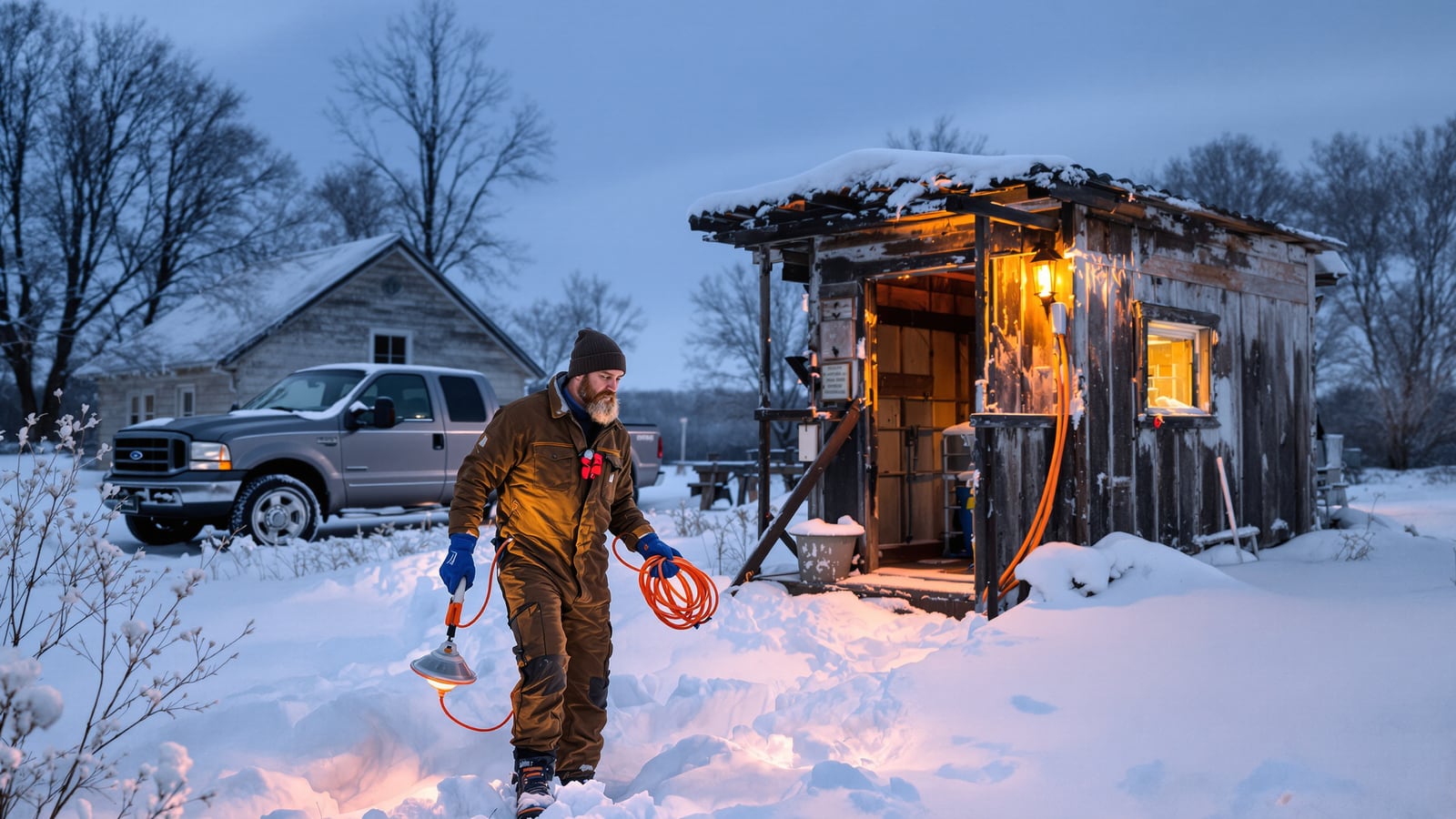
Quick answer: A submersible pump hangs deep in the well, below the frost line, and almost never freezes. What freezes is the pipe, the pressure switch, the tank fittings or the wellhead. Figure out which one before you put heat on anything.
At 5:40 on a four-below morning, the kitchen faucet coughs, spits air and goes quiet. Most people blame the pump. Most people are wrong, and that costs them a service call they didn't need or a replacement pump they didn't need either.
Work out what froze
Walk to the pressure tank and read the gauge. Then listen. The two together tell you most of it.
- Gauge reads normal (40 to 60 psi, or whatever your system holds), faucets dry. The pump and tank are fine. The line between the tank and the house is frozen.
- Gauge at zero, pump silent. Check the breaker first. If it's on, the pressure switch may be frozen or the pump house is cold enough to have stiffened the switch's tiny sensing port.
- Gauge at zero, pump running and running. Shut it off at the breaker now. Either you've got a burst pipe, a lost prime, or a frozen section on the suction side of a shallow-well jet pump. A pump that runs dry cooks itself.
- Water on the floor of the pump house. Something split. Kill the power, close the valve you can reach, and look for the crack before you do anything else.
One distinction matters. If you've got a shallow-well jet pump, the pump itself sits above ground in a pit or a small shed, and it can freeze. If you've got a submersible, you're hunting for a frozen pipe, not a frozen pump.
Thaw it without making it worse
Open a faucet in the house first. Melting ice needs somewhere to push the water.
Start heating at the end nearest the faucet and work back toward the blockage. That way the thawed water has a path out. Starting in the middle can trap steam between two plugs of ice, and trapped steam splits pipe.
Use a hair dryer, a heat gun on its lowest setting held a few inches off, or towels soaked in hot water and wrapped around the pipe. Keep the heat moving. Plastic pipe softens well before metal pipe cares.
Don't use a propane torch. Not on copper, not on PVC, not on PEX, not anywhere near the wood framing of a pump house. Torches burn down more sheds in January than the cold ever froze pumps.
And treat water and electricity with respect. If the pump house is damp and you're working around the pressure switch or the wiring, turn off the breaker first. A frozen switch isn't worth a shock.
Don't send anything down the well yourself. If the wellhead cap or the connection at the top of the casing is frozen or cracked, that's a licensed well contractor's job.
Why it froze this time
Ask why this winter, because the pipe didn't change. Something else did.
Plowing is the classic. Snow is insulation. A buried line that crosses the driveway has sat under a foot of snow for years, then you scraped the drive clean for the first time in a cold snap, and the frost went down twice as deep as usual. The line was never quite deep enough. It just got away with it.
The other common cause is a pump house that lost its heat. A dead bulb, a tripped breaker on the heat circuit, a door left cracked, a gap where a mouse chewed out the foam board. The pump house doesn't have to be warm. It only has to stay above freezing, and it gets there on very little.
If frozen pipes keep turning up around your property, What Freezes First on a Property and How to Stop It is worth ten minutes. Well pipes are rarely the only thing waiting to quit.
Fix it before the next cold snap
Do this in October. You'll hate doing it in January.
Insulate the pipe, then heat it. Foam sleeves alone only slow the cold. They don't stop it. Add electric heat cable made for water pipes, run along the exposed section, with foam over the top. Match the cable to the pipe material, since plastic and metal need different ratings. Follow the label on how to wrap it. Never overlap constant-wattage cable on itself, and plug it into a GFCI outlet.
Seal the pump house. Foam board on the walls and ceiling, weatherstripping on the door, and every gap you can see daylight through. A mouse hole is a freezer vent.
Put a thermostat on the heat source. A small thermostat-controlled heater or a thermostat-plugged lamp keeps the space just above freezing without burning power all night. A bare bulb on a cord with no thermostat is how people end up with a pump house fire.
Check the pressure switch cover and tank fittings. These are the small parts that freeze first and get insulated last. Wrap them, or put them in a small insulated box.
Know where your line runs and how deep. Your county's frost depth is a local number, and your well contractor or building department knows it. If the line crosses the driveway and sits shallower than that, you've found your weak point. Mark it before the snow falls so you know where not to scrape bare.
Let one faucet drip on the coldest nights. Pick the one farthest from the tank, on the exterior wall. Moving water is harder to freeze. The trade-off is that your pump cycles more and a septic system takes extra water, so use it only for the nights that dip well below zero. What a Well and a Septic Really Cost to Keep Running lays out what that actually adds.
Keep a backup that doesn't depend on the pump
Fill two or three five-gallon jugs in November and keep them by the door. Add a cooler for the fridge if you're gone a long time. That's enough to flush, cook and wash up while you thaw.
A thawing job can take an hour or an afternoon. Cattle, chickens or a barn full of horses don't wait. If you've got livestock, water for them comes first, and a stock tank heater is the cheap fix for that half of the problem.
And look in on your neighbor. The person up the road with a well and a bad week at work may not know a pump house needs heat until the water stops. If you've got a hair dryer and an hour, you could be the one who saves him the call.
Check the breaker for the pump house heat tonight. Do the rest in October, not at 5:40 on a Tuesday in January.
Wes Dunbar
Country & Skills
Grew up on an acreage and never quite left. Covers trucks, trades, land, and how to do the thing yourself.

Watch
Worth an hour of your evening
More from Country Bro.
From channels we rate. Plays on YouTube.
Read next