

Don't dig where the water sits. Dig where it comes from.
A puddle that lingers after rain is a symptom. Find the source, fix the grade, and only then pick up a shovel.
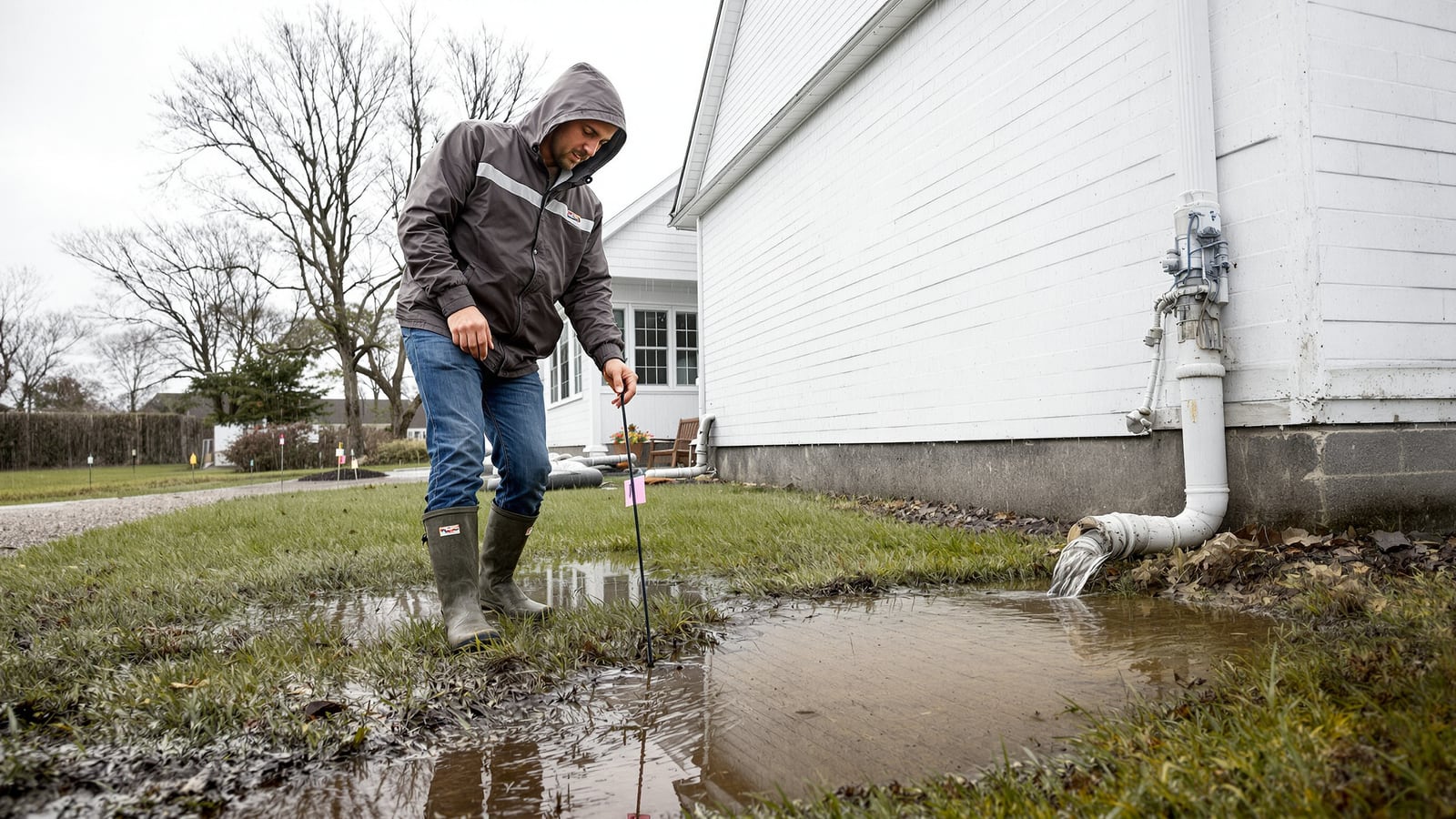
Quick answer: Water pools for one of three reasons: it's being delivered there (downspouts, a roofline, a neighbor's slope), the ground is shaped like a bowl, or the soil won't let it soak in. Fix them in that order. The cheapest fix is usually a few feet of downspout extension, not a trench.
Walk it in the rain
The worst time to diagnose a wet yard is on a dry Saturday. Wait for a real storm, pull on boots, and go look.
Take a bag of marking flags or a can of marking paint. Put a flag where the water stands. Put another where it first starts moving across the yard. Then follow it uphill until you find where it enters your property or leaves the roof. That uphill spot is your real problem. The puddle is just where it ends up.
Check three things while you're out there:
- Where each downspout dumps. If one empties within a few feet of the foundation, you may be done right there.
- Whether the water runs toward the house or away from it.
- How fast it clears. A puddle gone in an hour is a nuisance. One that's still there two days later is a project.
Take a photo of each flag from the same spot. In July you'll have forgotten exactly where the low point was.
Start with the roof
A 1,000-square-foot roof sheds hundreds of gallons in a decent storm, and most of it leaves through four or five spouts. If those spouts dump at the foundation, the soil there takes the whole load.
Run solid pipe, not the flimsy accordion kind, at least ten feet from the house and let it end on ground that slopes away. Buried solid pipe to a pop-up emitter at the low edge of the yard works even better. Gutters packed with leaves overflow at the corners, so clear them before you decide the yard is the problem.
This fix costs the price of some pipe and an afternoon. Do it first, then watch the next storm before you spend another dime.
Check your grade
Dirt next to a foundation settles over the years. It sinks, the slope flattens, and then it reverses. The standard target is a drop of about six inches over the first ten feet away from the house.
You can check it with a four-foot level, a stake, and a tape measure. Set a stake at the foundation and another ten feet out. Run a string between them, hang a line level on it, and measure down from the string at the far stake. If the ground at ten feet is less than about six inches lower than the ground at the wall, you're short.
Fix it with fill dirt, not topsoil. Topsoil is loose and organic, and it'll settle again. Use a clayey fill that packs, build it up in lifts of a few inches, and tamp each one. Keep it well below the siding and the wood sill. Burying those invites rot and bugs.
When the yard is a bowl
Sometimes there's no source to fix. The ground just dips, and water has nowhere to go but the dip.
The cure is a swale, which is a shallow, wide channel that carries water to somewhere that can take it. Think a shallow ditch you can mow across, maybe a foot deep and six to ten feet wide, with the sides gently sloped. It needs a fall the whole way. A channel that dips and rises again is just a longer puddle.
Where does it go? Not onto the neighbor's land. Water you redirect becomes your responsibility, and drainage disputes are among the fastest ways to sour a fence line. Read the unwritten rules of having neighbors in the country before you move any water toward a boundary. Aim it at a ditch, a low corner of your own land, or a spot with real room to spread out.
And stay away from your septic field. Pushing extra water across a drain field can wreck it, and that repair costs far more than any drainage job. What a well and a septic really cost to keep running lays out what's at stake.
Now, the French drain
A French drain is a trench with perforated pipe in clean gravel, wrapped in fabric so silt doesn't clog it. It's the right tool for a wet strip you can't regrade, like a flat yard against a hillside or a soggy spot at the base of a slope. It's the wrong tool for a yard that's wet because of bad grade or a roof.
Here's how it goes together:
- Call before you dig. Use the free utility locate service and wait for the flags. Hitting a gas or power line ends your day and possibly more.
- Pick the outlet first. The drain has to end somewhere lower than where it starts, such as daylight at a slope, a ditch, or a dry well. If there's no lower point, there's no French drain.
- Dig the trench. About a foot wide and 18 to 24 inches deep. The bottom needs a fall of at least a quarter inch per four feet, so the water runs downhill in the pipe. Check it with the string and line level, not by eye.
- Line it with filter fabric, leaving enough hanging over each side to fold back over the top.
- Lay two or three inches of washed gravel, set the pipe on it, and cover it with more gravel to within a few inches of the surface. Use washed three-quarter-inch stone. Crushed stone with dust in it clogs the fabric.
- Fold the fabric over and top with soil or sod.
A rented trencher or mini excavator turns a weekend of digging into half a day. A shovel works on short runs, but you'll feel it for a week. Whoever does the digging, keep spoil on a tarp so you're not tracking the trench across your lawn.
The dry well and the clay problem
A dry well is a buried pit of gravel or a large perforated chamber that holds water while it soaks into the ground. It only works when the ground can soak.
Test before you build one. Dig a hole a foot deep, fill it with water, let it drain once to saturate the soil, then fill it again. If it's empty in a few hours, you've got drainable soil. If there's still water in it the next day, you have clay or a high water table, and a dry well will just become a buried bathtub. In that case you need to daylight the pipe to a lower spot instead.
When to hire it out
If water is coming through the basement wall or the slab, or the puddle sits against the foundation despite good grade and clean gutters, get a licensed drainage contractor or a structural engineer to look at it. That's beyond a weekend job, and a wrong guess can cost you the house.
If you're still shopping for ground, the questions to ask before you buy your first few acres should include one for the seller: where does the water go in April? Ask it, then go stand there in the rain.
Wes Dunbar
Country & Skills
Grew up on an acreage and never quite left. Covers trucks, trades, land, and how to do the thing yourself.

Watch
Worth an hour of your evening
More from Country Bro.
From channels we rate. Plays on YouTube.
Read next