
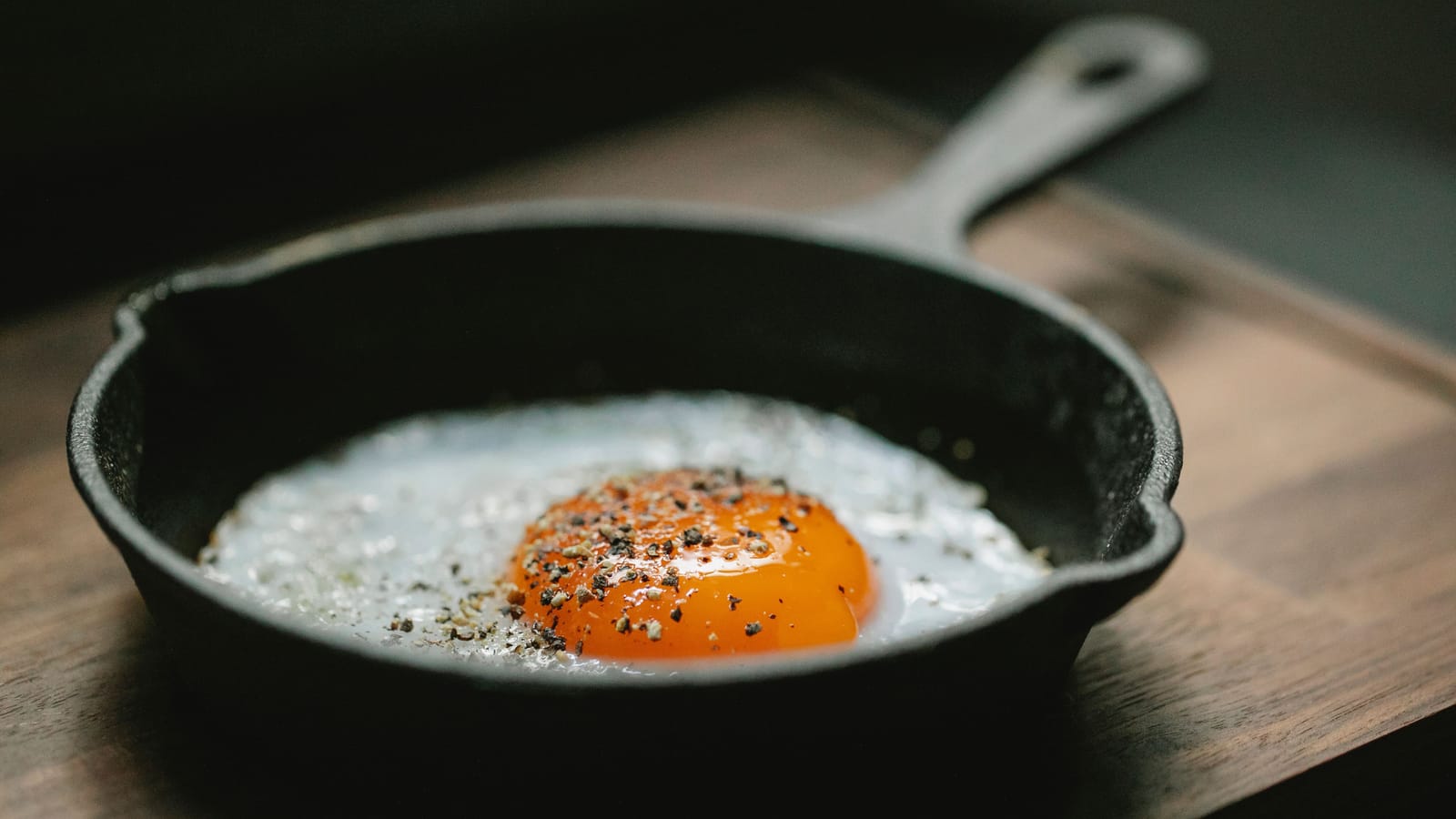
Quick answer: Seasoning is oil baked into a hard film, and it only works in coats so thin they look like nothing. Wash with a little soap, dry it on the burner, wipe on a drop of oil, done. Rust comes off with steel wool and a 450°F oven.
Somebody hands you their skillet and it feels like the underside of a movie theater seat. Tacky. Brown splotches. A spot near the handle that's gone orange. The owner will tell you they "season it all the time."
That's the problem. They season it all the time, with a quarter cup of oil, and the oil never finishes turning into anything.
What seasoning actually is
When fat gets hot enough, past its smoke point, it stops being a liquid and bonds into a hard, slick polymer layer on the iron. That layer is seasoning. It's the same chemistry that makes old varnish hard. It isn't grease sitting on the surface. It's grease that has been cooked until it changed into something else.
A thick coat can't do that all the way through. The outside skins over and the inside stays soft. You get the sticky feel, then the coat bubbles, then it flakes off in black chips that land in your eggs. Most people read the flakes as "the seasoning is coming off, I need more seasoning." So they pour on more oil, and the cycle runs another lap.
The rule that fixes almost every bad pan: oil it, then wipe it off like you made a mistake. Rub the oil in with a paper towel, grab a clean towel, and buff until the pan looks dry. It isn't dry. There's a layer there a few molecules thick, and that's exactly the amount that cures properly.
Seasoning in the oven, the right way
You don't need to do this often. A pan you cook in builds its own seasoning every time you sear a steak or fry bacon. The oven method is for a new start: after rust removal, after stripping, or when a pan's gone patchy.
- Wash the pan and dry it completely. Then set it on a burner for a few minutes to drive off the water you can't see.
- While it's warm, rub a teaspoon of oil over every surface. Inside, outside, handle, bottom. Rust doesn't care which side you cook on.
- Wipe it all off with a clean towel. Keep wiping until there's no shine left.
- Put it upside down in the oven at 450°F to 500°F. Upside down so any extra oil drips off instead of pooling. Foil on the rack below catches the drips.
- Leave it an hour. Turn the oven off and let the pan cool inside.
- Repeat three or four times if you're starting from bare metal.
It'll smoke. Open a window and turn on the vent fan before you start, not after the alarm goes off.
Which oil: Use whatever high-smoke-point fat you have. Vegetable oil, canola, Crisco shortening. Flaxseed oil had a big moment online because it cures very hard, and plenty of people found out it also cures brittle and flakes in sheets. Skip it. Expensive oil doesn't buy you a better pan.
Cleaning after dinner
You can use soap. The old warning dates back to when soap was made with lye, which really would eat seasoning. A squirt of modern dish soap won't touch a properly cured layer. If your seasoning washes off with dish soap, it was never seasoning. It was that soft, half-cured gunk, and good riddance.
The routine takes two minutes:
- Clean it while it's still warm, not tomorrow morning.
- Hot water, a little soap, a stiff brush or a chainmail scrubber for stuck bits.
- For something really welded on, put in an inch of water, bring it to a simmer for a minute, and scrape with a flat wooden spatula.
- Dry it with a towel, then put it back on the burner for two minutes until every bit of moisture is gone.
- Off the heat, a few drops of oil, wipe, buff off. Put it away.
That last step is where people get lazy and it's where rust starts. Water left in the pores of the iron overnight shows up as orange freckles by the weekend.
What actually strips a pan
Three things do real damage, and none of them is soap.
Soaking. A night in the sink full of water will rust it. Every time.
The dishwasher. Long hot cycle plus harsh detergent. It comes out gray and rusty. Don't.
Long acidic cooking. A quick pan sauce with a splash of wine or a squeeze of lemon is fine on a well-seasoned skillet. A tomato sauce simmered for three hours isn't. The acid works on the seasoning and the food picks up a metallic taste. Use enameled or stainless for the long simmers and save the cast iron for searing. If you want a cast iron dish that earns its keep without the risk, the Sunday roast that leaves your afternoon alone is a better use of it than marinara.
You'll hear that cast iron is "indestructible." Mostly true. Then somebody sets a ripping-hot pan into a sink of cold water and it cracks. Iron is tough, but it's brittle. Let it cool before it meets water.
Bringing back a rusty skillet
Surface rust looks terrible and is usually nothing. The pan underneath is almost always sound. (For the full triage on whether a pan is worth saving, warped, cracked or pitted, see your cast iron pan is probably not ruined.)
For ordinary rust:
- Scrub it to bare metal. Steel wool or a stiff wire brush, a little soap and water. Work until you see dull gray iron with no orange left. Your arm will get tired. That's the job.
- For heavy rust, use vinegar, carefully. Mix white vinegar and water half and half and submerge the pan. Check it every 15 minutes and pull it out within an hour. Vinegar doesn't stop at the rust. Leave it overnight and it starts eating the good iron, leaving the surface pitted.
- Rinse it well, scrub again, dry it immediately on a burner. Bare iron can flash-rust within minutes of getting wet. Move fast.
- Season it in the oven, three or four thin coats, as above.
The first few times you cook in it, choose something fatty. Bacon, burgers, shallow-fried chicken. The fat finishes the job faster than another oven session would.
What I'd skip: the self-cleaning cycle on your oven. People use it to burn a pan down to bare metal, and it works. But those cycles run close to 900°F and can warp or crack a skillet, and some people end up ruining a pan their grandmother cooked in for fifty years. A bag with oven cleaner is the old-timer's stripping method and it works too, but it's caustic. Use gloves and eye protection, and it's only worth it if the pan has years of built-up crud, not a little rust.
What I'd buy, what I'd skip
Buy:
- A Lodge skillet, 10 or 12 inches. It comes pre-seasoned, it's made in Tennessee, and it'll outlive you.
- A chainmail scrubber. Gets stuck food off without taking the seasoning with it.
- A flat wooden spatula with a straight edge, for scraping.
- A tub of Crisco or a bottle of canola oil for upkeep.
Skip:
- Flaxseed oil.
- "Cast iron conditioner" in a fancy tin. It's oil and wax. You already own oil.
- Lids that don't fit tightly. They trap steam during storage and cause rust. Store the pan uncovered, or put a paper towel between it and anything stacked on it.
The pan that comes back better
A good skillet is the rare thing in your kitchen that improves with use. Cook in it twice a week for a year and it'll be slicker than the day you bought it. And it's one of the few things in a house that gets passed down on purpose.
If you borrow somebody's cast iron for a camping trip or a cookout, give it back the way the old code says. Clean, dry, a fresh thin coat of oil buffed in, and wrapped in a paper towel. Even if it came to you crusty and dull. Especially then.
A friend who hands you a sticky skillet and gets back a black, glassy one will remember it longer than whatever you cooked in it.
Dean Shaw
Gear & Garage
Reads the warranty, the parts list and the long-term owner reviews before anything else. Trucks, tools, watches, and the cheap version that costs more.

Watch
Watch how it's done
Picked for this article.
From channels we rate. Plays on YouTube.
America's Test Kitchen
Everything You Need to Know About Cast Iron Maintenence | Gear Heads
Lodge Cast Iron
Cast Iron Seasoning 101: How to Season, Maintain & Restore Your Skillet
Read next