

A bit holder should hold bits, not collect sawdust
Most bit holders fail the same way: a magnet that works on the bench and spills in the truck. Pick the holder for where it actually lives.
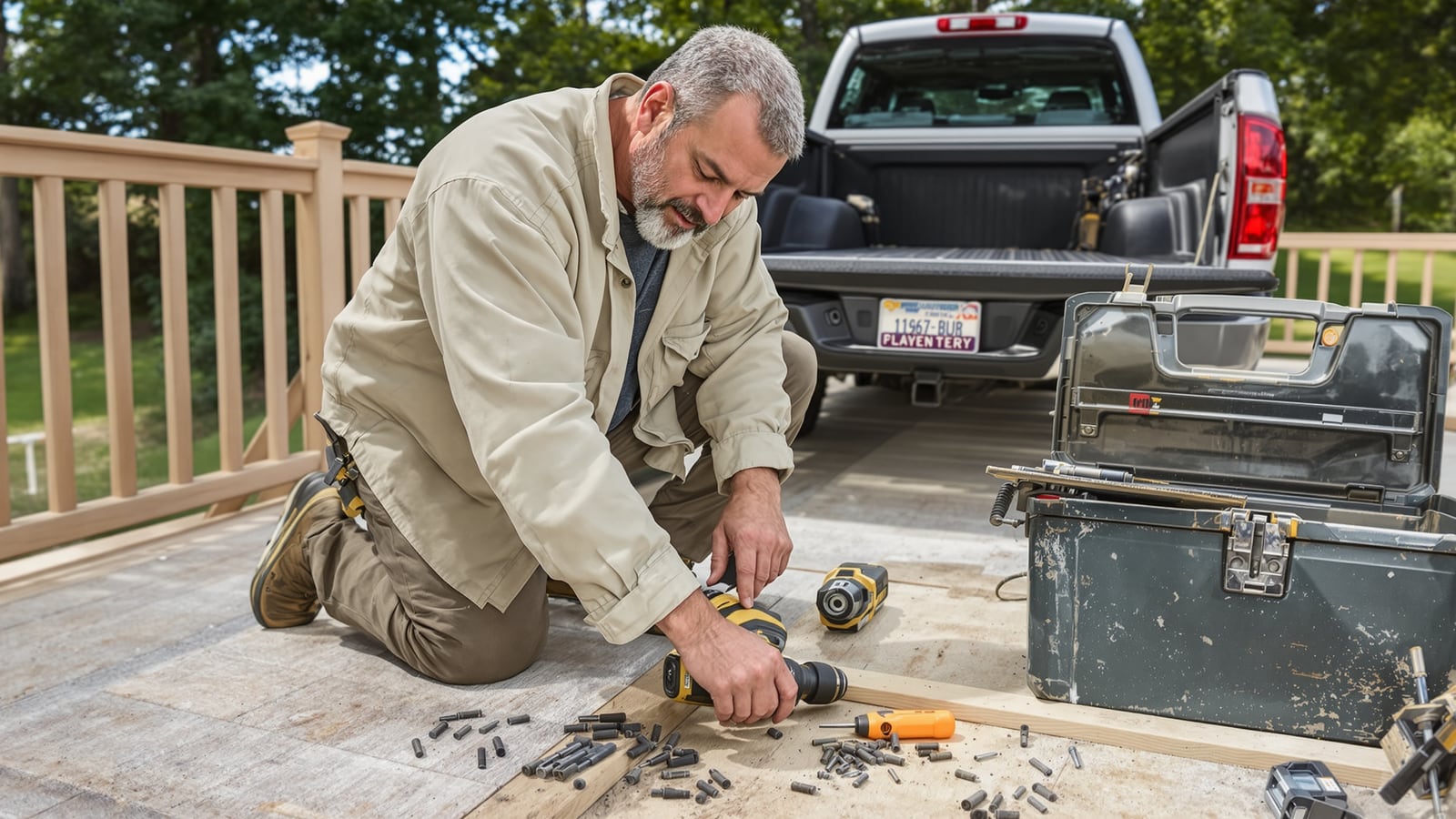
Quick answer: Magnets are for the bench. Anything that rides in a truck, bag or toolbox needs a closed case that grips each bit by friction or a spring detent. Buy the holder for where it lives, not for how neat it looks on the package.
The magnet is doing the wrong job
A magnet holds a bit against gravity. That's all. It doesn't hold a bit against a toolbox sliding across a truck bed, or a bag tossed onto the porch, or a drawer yanked open by a kid.
Open magnetic strips and trays look organized in the store photo. Then you drop one on a jobsite and you're crawling around on a deck on your hands and knees, hunting for a T25 that rolled between two boards. It's a very specific kind of bad afternoon.
The magnet also grabs everything else. Drywall screws shed fine steel dust, and drilling into metal makes filings. All of it clings to a magnetic tray in a fuzzy gray beard. Add sawdust, which sticks to that beard, and in a month your holder is a small compost pile of grit. That grit packs into the slots and gums up the fit. Now the bit doesn't seat all the way, and a bit that doesn't seat is a bit that cams out and chews up a screw head.
So the holder that spills into sawdust usually has two flaws. It's open, and it relies on magnetism to keep things where they belong.
Pick by where it lives
Ask one question before you buy: where does this sit when you're not using it?
On a wall or bench. This is where a magnetic strip earns its keep. Mount it at eye level over the bench and you can see every bit at a glance, grab one with one hand, and put it back without looking. Nothing moves, nothing gets bumped, and the grit is easy to wipe off. If it never leaves the shop, a strip is hard to beat.
In a tool bag or toolbox. Skip the magnet. You want a case with a lid that latches and slots that hold each bit with a rubber grip or a small spring clip. Shake it. If anything rattles or slides, put it back on the shelf. Test the latch too, because a latch that pops open in a bag defeats the whole case.
On your belt or in a pocket. Here you want a short holder with five or six bits and a flip-top or a cap. Anything bigger will annoy you by lunch. One that clips to the belt beats one that rides loose in a pocket with your keys. Keys scratch plastic, and scratched plastic cracks.
In the truck. A sealed case again, and keep it off the dash. Heat warps cheap plastic hinges, and the case ends up not closing. Humidity does a slow job on bare steel too. A drop of light machine oil on a rag, wiped across the bits twice a year, keeps rust off.
What goes in the holder
Most people carry thirty bits and use six. The rest are dead weight that makes the six harder to find.
For general house and yard work, the working set is short:
- Phillips #2, two or three of them, because it's the bit you'll wear out first
- Square drive #2, common in deck and construction screws
- Torx T25, plus T20 and T30 if you do much deck work
- A slotted bit around a quarter inch wide
- Phillips #1 and #3 for the odd small and large screw
That's the core. Add hex bits if you assemble furniture, and security bits if you work on something that needs them. Everything else can live in a drawer until a job calls for it.
If you use an impact driver, buy impact-rated bits and keep them in a separate slot from your hand-driver bits. They're built to flex under hammering force. Regular bits can snap in an impact driver, and a snapped bit tip lodged in a screw head is a miserable thing to dig out.
The habits that keep it organized
A good holder only works if you use it the same way every time.
Put the bit back in its own slot, every time, even when you're tired. Tape a small colored dot on the holder or the case next to each slot, so your hand learns the layout. It takes thirty seconds and saves you the shuffle at the next job.
Blow the grit out once a month. A can of compressed air does it, or a stiff old paintbrush. Pay extra attention to the slot bottoms, where grit packs in. A toothpick clears the stubborn bits. Do it outdoors or over a trash can, unless you like dust in your lungs.
Replace the worn bit the moment you notice it. A rounded Phillips tip slips and strips screws. Bits cost very little, and a ruined cabinet face costs a lot. Keep a spare of the bit you burn through, so the job never stops over a ten-minute store run.
Borrowing a set
If a neighbor lends you his bit set, return it fuller than it left. Wore down his Phillips #2 on your fence project? Buy him a new one and drop it in the slot. Clean the grit out of the case before you hand it back. He'll never mention it, and he'll always lend you the next one.
The same goes for the kid you're teaching to drive a screw. Give him a case with slots, and teach him that every bit has a home. It's a small lesson, and it carries over to everything else he'll own.
When the cheap one is fine
Not every holder needs to be a fortress. If you drive a handful of screws a year, a basic latched case with a few bits will serve you for decades. Spending big on a fancy system makes sense only if you use it hard. A contractor who drives screws all day should buy a better case than a homeowner who assembles a bookshelf twice a decade.
The same logic runs through any gear buying. Buy headphones for your week, not for the review scores makes that argument for electronics, and smart home kit that earns its place, and kit that just sits there makes it for the gadgets that fill a house. Fit the tool to the actual week.
Before you buy one
Hold the case closed, turn it upside down, and shake it hard. Open it. If every bit is still in its slot, buy it. If one fell out in the store, it'll fall out on your deck.
And if you already own an open magnetic tray that lives in a bag, don't throw it out. Screw it to the wall over your bench. It'll finally be doing the job it was built for.
Dean Shaw
Gear & Garage
Reads the warranty, the parts list and the long-term owner reviews before anything else. Trucks, tools, watches, and the cheap version that costs more.

Watch
Worth an hour of your evening
More from Gadgets.
From channels we rate. Plays on YouTube.
Read next