

Read the watt-hours, not the lumens, on a work light
Two work lights can both say "up to 12 hours." One will light your garage all Saturday. The other will quit before lunch. Here's how to tell them apart.
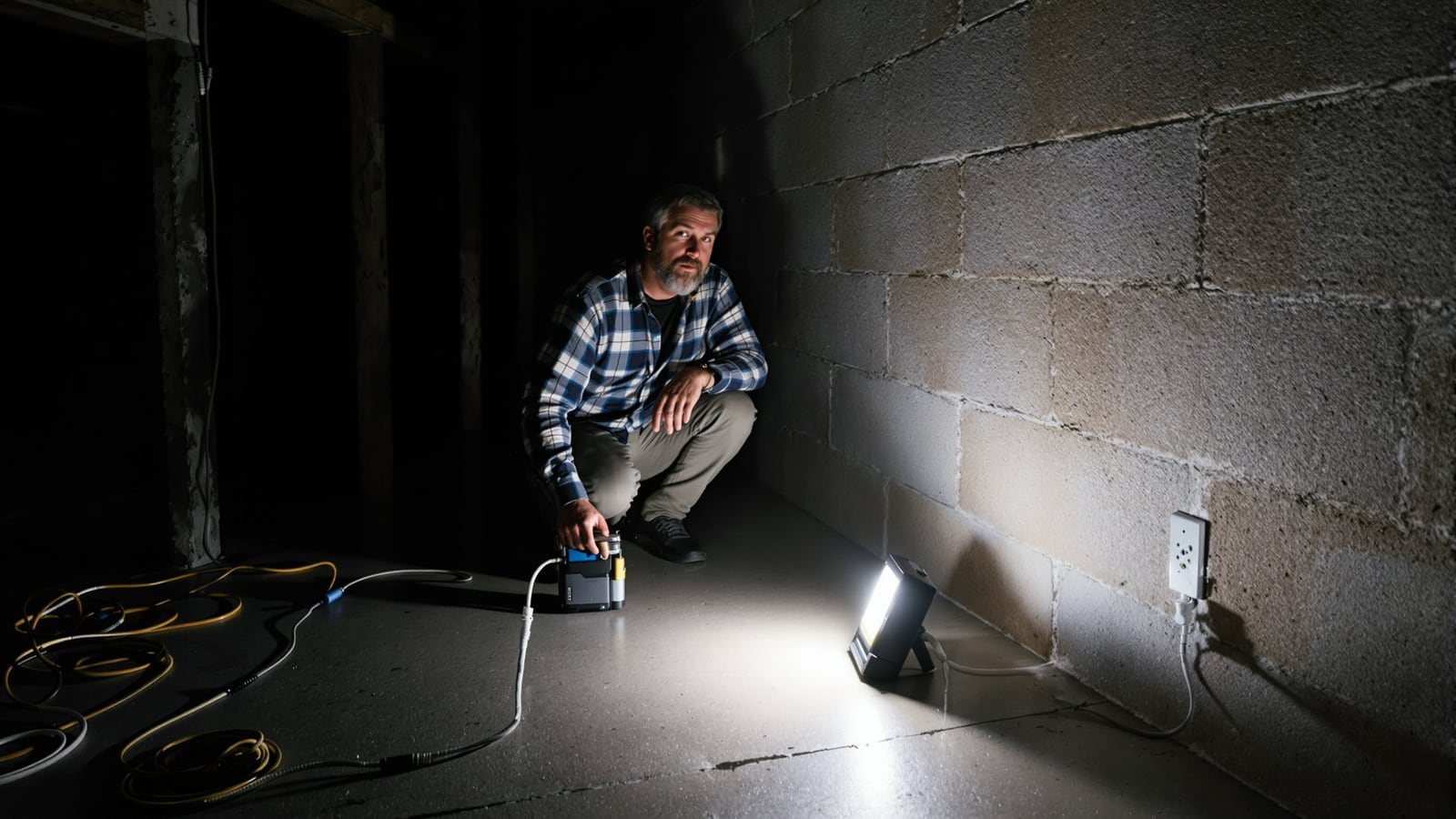
Quick answer: Find the battery's watt-hours and the light's output at the setting you'll actually use. Ignore the "up to" runtime on the box. It's almost always measured on low.
Picture a Saturday. You're under a truck, or in a crawl space, or finishing a deck while the sun drops. The light you bought for forty bucks was great for the first two hours. Then it dimmed, you told yourself it was fine, and now you're holding a phone flashlight in your teeth.
That light didn't fail. It did what the box said. You just read the box wrong.
The number on the box is the low setting
A work light might claim "up to 20 hours." That's true on low, where it puts out a glow you could read a menu by. On high, the setting you bought it for, you might get two.
There's a second trick in the fine print. The flashlight industry's standard, ANSI FL1, counts runtime until output falls to 10 percent of where it started. So a light can be "running" long after it stopped being useful. If a spec sheet says 8 hours, ask yourself how bright it was in hour 7.
Two lights can quote the same runtime and be completely different tools. The honest question is this: how long does it hold a brightness I can work under?
The math takes ten seconds
Battery capacity is measured in watt-hours (Wh). Many packs only list amp-hours, so convert it: volts times amp-hours equals watt-hours.
- An 18V, 5Ah tool battery holds 90Wh.
- A small light with a 3.7V, 5,000mAh (5Ah) cell holds about 18.5Wh.
That's nearly a fivefold difference before you've looked at a single lumen.
Now the other half. Brightness costs power, and a light that throws thousands of lumens is pulling tens of watts. Here's an example. A light drawing 30 watts on high, running off a 90Wh pack, gives you roughly three hours. Drop to a setting that draws 10 watts and you're near nine. Real runtimes come up a little short of that because of losses in the electronics, but the ratio holds.
So the rule is simple. Divide the watt-hours by the watts the light draws on the setting you'll use. If the maker won't tell you the draw, look for a runtime chart with a number for each brightness level. Makers who are proud of their lights publish one. Makers who aren't print "up to."
What most jobs actually need
More lumens isn't the answer. A garage bay, an engine bay or a stretch of fence line rarely needs the maximum. Most work gets done in the middle of the range.
A good work light has real steps, say four or five, and a mid setting that's actually usable. It should also hold that brightness steadily until the battery is nearly gone, then drop. A light that fades gradually from the first minute is wasting your time.
Ask these before you buy:
- Is there a runtime chart per brightness level?
- Does the light hold output, or sag as the battery drains?
- Can you run it while it charges? Pass-through power saves a long job.
- Can you swap batteries, or are you stuck waiting on a cord?
The cheapest long runtime is a battery you already own
If you already have cordless tools, check what platform they run on. Most major brands make work lights that take the same 18V or 20V packs as the drill. You buy the bare light, often for less than a standalone rechargeable. Then you borrow the 4Ah or 5Ah pack that's already sitting in the charger.
The advantages are real:
- A big battery, which means long runtime.
- Swap packs and you're back to full in ten seconds.
- One charging system instead of another drawer of cables.
The trade-off is that the light is only as good as the pack you give it. Clip a small 2Ah battery onto a bright light and you've bought a two-hour light again. And if the tool gets a pack stolen, borrowed or drained, your light goes with it.
If you don't own a platform yet, a work light is a poor reason to pick one. Pick the platform for the tools you use most.
The standalone light, if that's what you want
Sometimes you want a light with its own battery. A tripod unit for the driveway. A compact one that lives in the trunk. Check these things:
- Watt-hours. Look for a number or at least a mAh and voltage. If the maker hides the battery size, that's your answer.
- A USB-C port, in and out. Some lights double as a power bank, which is handy at a campsite or in an outage. Others can only be charged. Know which you're buying.
- A stand or a magnet. You'll spend more time aiming the light than carrying it. A hook, a magnet and a tripod thread earn their keep.
- Weather rating. An IP54 or higher means it survives dust and splashes. A work light spends its life near mud, grease and the occasional dropped wrench.
- Flicker. Cheap LED drivers can flicker in a way you notice around spinning tools. Test it in the store if you can, or buy somewhere with an easy return.
A heavier light is often a better light, because the weight is usually battery. If a unit feels suspiciously light for the size it advertises, there's your explanation for the short runtime.
Cold, age and the stuff that kills runtime later
Lithium-ion packs hold less charge in the cold. A light that runs six hours in a heated shop can give you noticeably less in an unheated garage in January. Keep the battery inside your jacket until you need it, and it'll hold up better.
Batteries also age. A pack that was great in year one will give you less in year four. That's normal, and it's another reason to prefer a light with a replaceable battery over one sealed shut. I wrote about the same idea for phones in make your next phone last five years, and the logic is identical. The battery wears out first, so buy the one you can swap.
For storage, don't leave a pack sitting dead empty or fully charged for months. A half charge is easier on it. Top it off before the job.
Buy it for the job you'll do
This is the same lesson as with headphones: buy for your week, not for the review scores. Decide what you'll do with the light most: a weekend of deck work, roadside repairs, a power outage, a job site. Then buy the runtime that matches that, at the brightness you'll use.
If you're not sure, I'd do this:
- Own cordless tools? Buy the matching bare light and a large battery.
- Don't? Buy a standalone with a published runtime chart, a battery in the 50Wh-plus range, and a stand that actually holds.
- Skip anything that only lists the "up to" runtime and the maximum lumens.
The old rule applies
A light you borrowed should come back charged. A light you lent should get checked before you hand it over. Nothing wrecks a Saturday like grabbing the work light off the shelf and finding it flat because the last guy left it that way.
Charge it when you put it away. The next job is going to start earlier than you planned.
Dean Shaw
Gear & Garage
Reads the warranty, the parts list and the long-term owner reviews before anything else. Trucks, tools, watches, and the cheap version that costs more.

Watch
Watch how it's done
Picked for this article.
From channels we rate. Plays on YouTube.
DIY Solar Power with Will Prowse
Amp Hours vs Watt Hours: Why 12V 100Ah Holds Less Than 48V 100Ah
Read next