

Why the speaker cuts out in the back corner of your shop
The range number on the box was measured in an open field. Your shop has steel, motors and a compressor. Here's how to get music to the back wall.
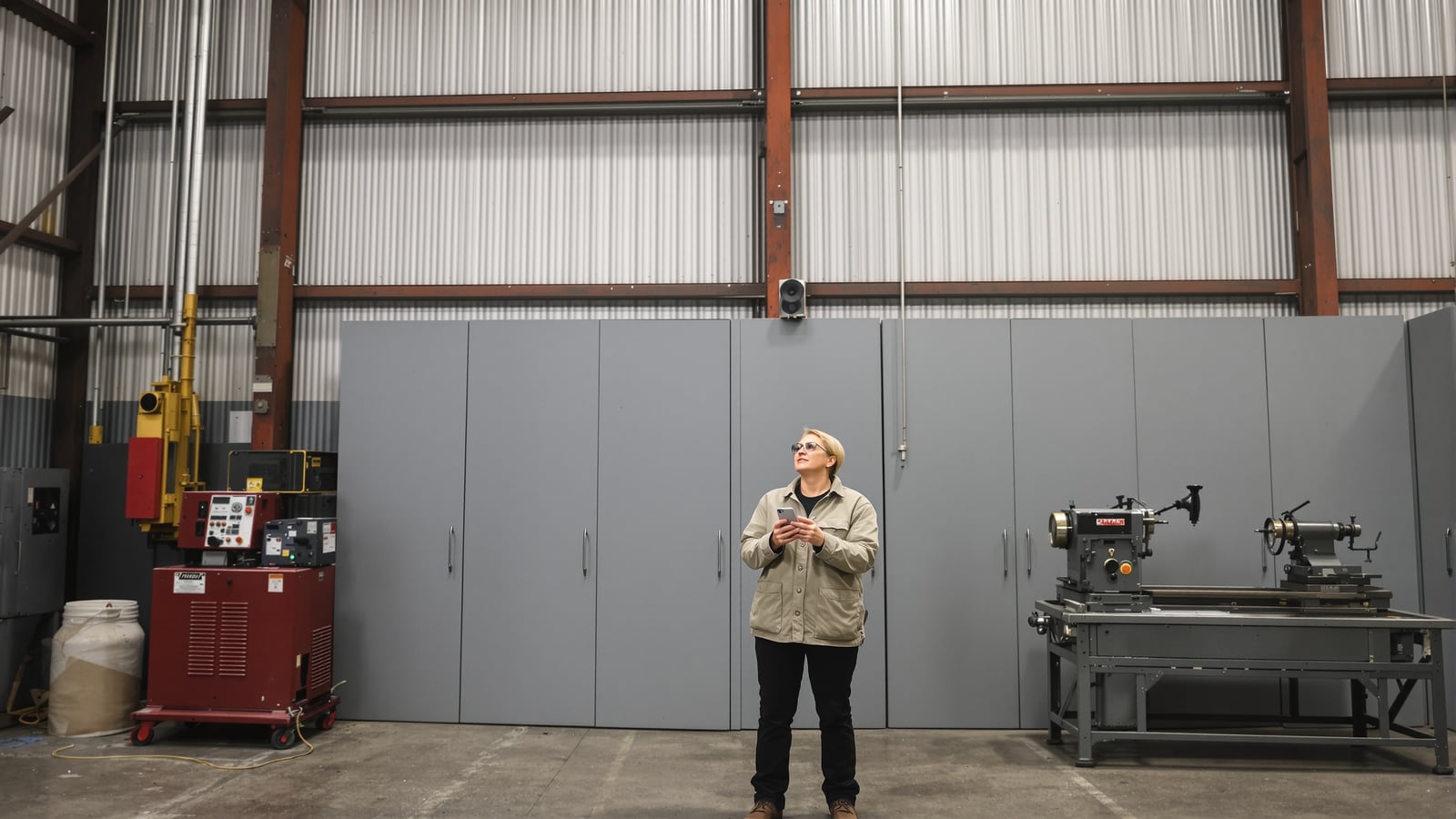
Quick answer: Bluetooth speakers rarely fail because they're cheap. They fail because of where the phone and speaker sit and what's between them. Move the phone to the middle of the room, get the speaker up high, and if it still drops out, stop fighting Bluetooth and use Wi-Fi or a wire.
The number on the box isn't your shop
Picture a 24-by-30 steel building. Phone on the bench by the door, speaker on a shelf in the back corner, thirty feet away. The box said 100 feet. The music stutters every time you walk past the lathe.
That 100 feet is a line-of-sight figure, measured with nothing in between. Your shop has a steel roof, metal siding, a row of steel cabinets and a few hundred pounds of cast iron. Metal reflects and blocks the 2.4 GHz signal Bluetooth uses. A concrete block wall does the same job. So does you. The human body absorbs that signal, which is why a phone in your back pocket drops out when you turn around.
Two more facts explain most of the confusion.
Most consumer speakers are built to the Class 2 standard, which is about 33 feet in open air. Class 1 runs far longer, but you mostly find it in industrial adapters, not the speaker on a store shelf.
And the headline range gains in Bluetooth 5 came from a low-energy mode that regular music streaming has mostly not used. A "Bluetooth 5" label is a fair tie-breaker when you're choosing between two speakers. It isn't a promise that you'll cover the building.
Fix the placement first
This costs nothing and solves more dropouts than any purchase.
- Move the phone, not the speaker. Put it on a shelf near the middle of the room at chest height, not in your pocket and not on the bench behind a vise and a toolbox.
- Get the speaker up. Higher is better. A shelf at head height beats a workbench, and a workbench beats the floor.
- Keep it out of metal. A speaker sitting inside a steel cabinet, behind the compressor or under the bench is wearing a signal blanket.
- Give it a clear shot. If you can see the phone from the speaker, you're most of the way there.
- Don't stack electronics. A router, a charger brick and a phone jammed together on one shelf can crowd each other.
Then do a five-minute walk test. Start a podcast, since music hides gaps better than speech does. Walk the whole shop and note where it breaks. Run it again with the table saw, the compressor or the dust collector going. Motors and welders put out electrical noise, and arc welding can swamp the 2.4 GHz band nearby. A speaker that behaves in a quiet shop can fall apart the moment the work starts.
What to look for when you buy
Nobody can promise a particular speaker will clear your back corner, and I won't pretend to have tested a shelf of them. You can still shop smart by reading the box for features that help.
A recent Bluetooth version. Version 5 or newer is a sensible baseline. Don't pay extra for the number alone.
A dust rating. In an IP rating, a first digit of 6 means dust-tight. Sawdust and drywall dust get into everything, and a speaker that's sealed against them lasts longer than one that isn't.
A wired input. A 3.5 mm line-in jack is the cheap insurance of the speaker world. When the wireless signal gives up, a cable doesn't.
Speaker linking. Some models talk to each other, so a second speaker in the back picks up from the first instead of from your phone. That puts a speaker near the dead zone to work. Check the box, because the feature differs by brand, and these links run over Bluetooth and can drop too.
Battery you'll actually see. A shop speaker that dies mid-afternoon gets left in a drawer. If you plan to keep it plugged in, say so when you buy, and confirm it plays while charging.
When Bluetooth is the wrong tool
Sometimes the shop's too big, too metal or too noisy, and no speaker will fix that. Three options work better.
Wi-Fi speakers. These stream over your router instead of straight from the phone, so coverage depends on your network, not on a 33-foot radio. Look for AirPlay or Chromecast built-in. The catch is that your Wi-Fi has to reach the shop, and a detached building often gets a weak signal. The home internet numbers that matter will tell you whether that's your real problem. Setup also takes longer than pairing a Bluetooth speaker, and when the router goes down, so does your music.
A Bluetooth transmitter on a wired system. If you've got an old stereo receiver and a pair of speakers, plug a small Bluetooth receiver into the stereo and wire the speakers with ordinary speaker cable. The wireless hop is now a few feet from your phone, and the long run to the back wall is copper. Cable and a staple gun are less glamorous than a gadget, and they don't drop out.
A radio. A job-site radio has been reaching the back corner of garages since before most of us were born. If you mostly listen to the game or the news, it's the right answer.
Setting up a few devices to work together is where a smart home that earns its place comes in. It's worth reading before you buy a second speaker you may not need.
The part that isn't about range
If you run loud tools and loud music at once, you'll turn the speaker up to hear it over the saw. Don't. Wear hearing protection when the machines run, and keep the volume where you can still hear a motor change pitch or a blade bind. Ears don't grow back. If you want music in your head while you cut, a good pair of headphones matched to your week beats cranking a speaker over a planer.
Leave the shop better than you found it
Set it up so the next person can use it. Put the phone shelf in an obvious spot. Label the charging cable. Keep the wired backup coiled on a hook. If a buddy borrows the shop, he should be able to play something without calling you from the parking lot.
And when the music finally reaches the back corner, you'll know why. It wasn't the speaker. It was the shelf.
Dean Shaw
Gear & Garage
Reads the warranty, the parts list and the long-term owner reviews before anything else. Trucks, tools, watches, and the cheap version that costs more.

Watch
Watch how it's done
Picked for this article.
From channels we rate. Plays on YouTube.
AJ LoDato
Garage Speakers - The Best Bluetooth Audio Setup!
Tested nd True
DEWALT DCR010 Bluetooth Speaker Review – Tough Jobsite Audio with 100ft Range & 20V Power!
Read next