

Buy the worklight that doesn't carry its own battery
A sealed battery turns a good light into trash the day it fades. Here's how to buy one that outlasts it and doesn't mind a wet garage floor.
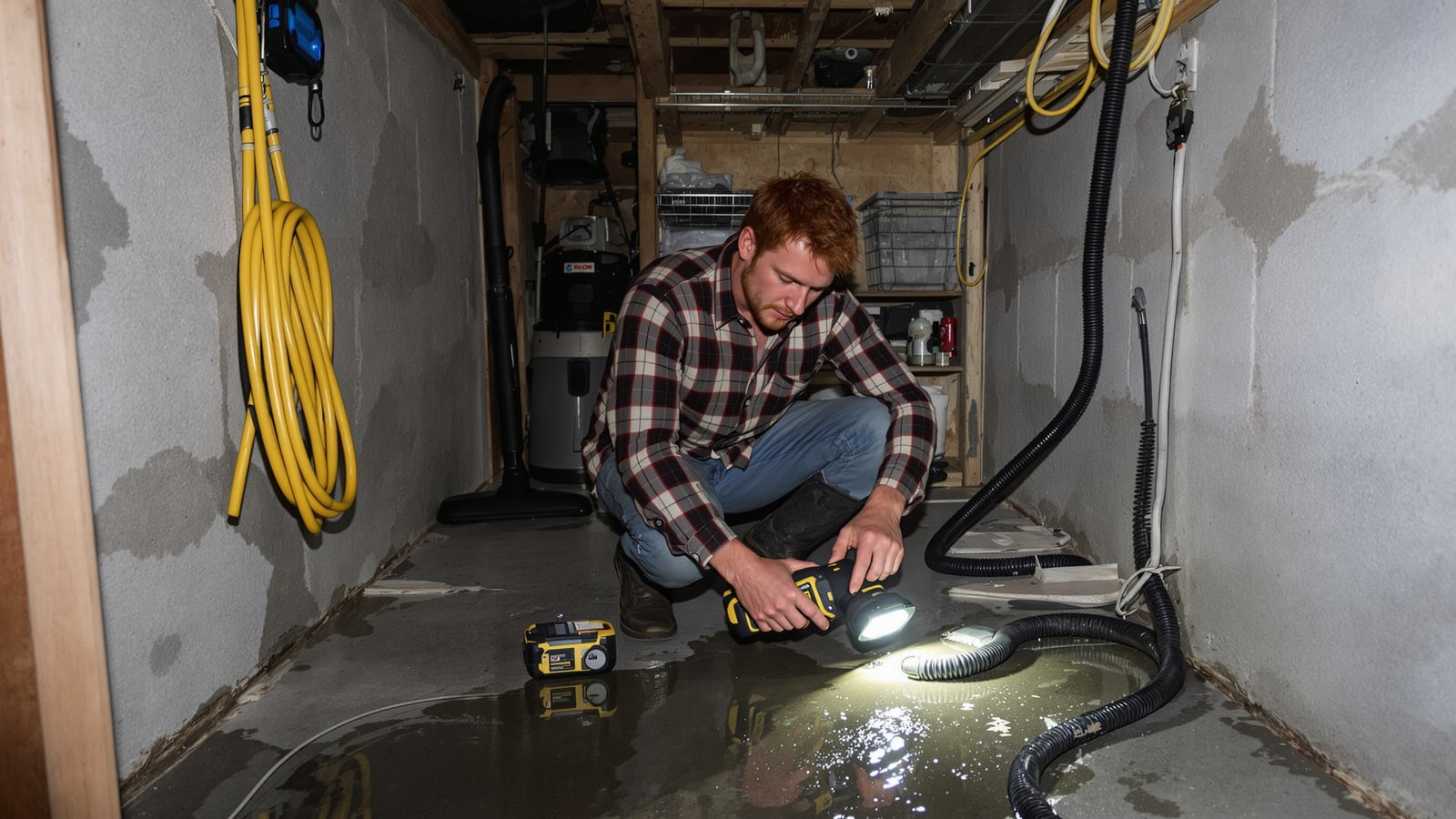
Quick answer: Buy a light that runs on a cord or on the battery from the cordless tools you already own, not one with its own sealed pack. Look for a water-resistance rating on the box, plug it into a GFCI outlet, and keep every connection off the floor.
The battery is what kills the light
The LED will run for years. The battery inside the cheap one won't.
Most inexpensive rechargeable worklights have a lithium pack sealed behind screws, or glued in. Lithium wears out with age and charge cycles, and a pack that held a full evening when new gives you a fraction of that a few winters later. You'll notice it the night you're lying under a car with the oil draining and the light goes dim. Replace the battery? Often you can't. The light is fine, the lens is fine, and the whole thing goes in the trash.
That's what the cheap one really costs. Not the price on the shelf. The price of buying it again, probably at the worst moment.
So the first question isn't how bright it is or how long it claims to run. The first question is what happens to this light when its power source gives out. You want the answer to be "I swap the power source and keep working."
Two designs that pass the test
Corded LED. No battery to age. Plug it in and it works the same in year ten as day one. The trade-off is the cord, which gets in the way, and you need an outlet close by. For a garage with an outlet on the wall and a car in the middle, that's a small price.
A light that takes your tool batteries. If you've got cordless drills or a saw on one brand's battery platform, buy the work light that uses that same battery. When the pack wears out, you replace it the way you'd replace one for the drill, and the light keeps going. You also never hunt for a charger, because the one you own already fits.
A few more pieces of the same logic live in buy-it-for-life should mean repairable, not expensive. A tool you can fix or re-power beats a pricier one you can't.
If you own no cordless tools and the light will live in one garage, buy corded and stop thinking about it.
What a wet floor changes
A garage floor gets wet more than people admit. Snow melts off the truck. A hose gets dragged through. The washer hose lets go. Some winter mornings the concrete just sweats.
Water and a worklight that sits on the floor is the combination to plan for.
Read the IP rating. It's a two-digit code on the packaging or the spec sheet. The first digit is dust protection. The second is water. A second digit of 4 means it handles splashing. A 5 means water jets. A 7 means it survives being briefly submerged. For a light that lives on a garage floor, aim for at least a rated splash-proof body. If the box has no rating at all, assume it has none. "Weather resistant" in the marketing copy is a phrase, not a standard.
Check the cord for a W. If you're buying a corded light or an extension cord to go with it, the jacket carries printed letters. A "W" in the code, such as SJTW, means the cord is rated for outdoor and wet use. A cord without it is meant to stay dry.
Use a GFCI. A ground-fault circuit interrupter outlet cuts power in a fraction of a second if current leaks where it shouldn't. If your garage outlet isn't one, a plug-in GFCI adapter is cheap and takes five seconds to install. If you want an outlet added or changed, that's a job for a licensed electrician, not a weekend guess.
Keep the junction dry. The weak point on any corded setup is where the light's plug meets the extension cord. Don't let that connection lie in a puddle. Hang it from a hook, tape it up off the floor, or run the cord so the join sits on a shelf or the bumper.
Mounting beats power
Most buyers get this backward. They shop on brightness and then set the light on the floor, where it throws a glare in their eyes and a shadow under everything.
Light from above and to the side works best. A stand with a wide, stable base, a magnetic back that sticks to the hood or a steel shelf, and a hook that lets you hang it from the raised lift gate all matter more than another thousand lumens. I covered why the headline number is so often misleading in Lumens are the least useful number on a flashlight box. For a garage, a couple thousand lumens aimed correctly beats a monster light shining straight up from the concrete.
Pick one with rubber feet or a stand with a flat bottom. A light that tips over onto a wet floor is a light you'll be dragging out of a puddle.
When the cheap one is right
Sometimes it is.
A clamp light with a plain bulb and a cord costs very little, has nothing to wear out except the bulb, and clips onto anything. For a dry bench, a shelf, or lighting up a hole behind the water heater, it's the right tool. Put an LED bulb in it, rated for the fixture, and it'll run cool.
A small battery light is also fine as a backup. Keep one in the truck and one in the glove box. If it dies in three years, you've lost very little, and a backup you can afford to lose is a good kind of backup. The same thinking sits behind the truck kit that handles almost every roadside problem, where several cheap things beat one expensive thing.
Skip the cheap one for the main light. The sealed battery, the unrated body and the cord with no W are all the same bet: that you won't need it to work hard, long, or wet.
What to buy, what to skip
Buy:
- A corded LED light with a stand, a hook and a magnet, rated for water, on a cord marked W
- Or the light that takes your existing tool battery, with an IP rating on the box
- A plug-in GFCI adapter if your outlet doesn't have one built in
Skip:
- Anything with a battery you can't remove or replace
- Anything with no IP rating and a phrase like "water resistant" in place of one
- A light bought for its brightness number and nothing else
- Daisy-chained, cracked or taped-up cords on a wet floor
Before you buy
Stand in the garage and decide where the light will actually sit. High, low, on the hood, on the floor. Then check where the nearest outlet is, and how far the cord will have to run through the wet part.
If you can answer those three things, you can pick the right light in the store in two minutes. And ten years from now, when the first one you bought is still on its hook, you'll be glad you didn't buy the one with the battery in it.
Wes Dunbar
Country & Skills
Grew up on an acreage and never quite left. Covers trucks, trades, land, and how to do the thing yourself.

Watch
Worth an hour of your evening
More from Gear.
From channels we rate. Plays on YouTube.
Read next