

The 200-piece socket set is mostly packaging
Most of the sockets in a big boxed set will never touch a bolt you own. Here's what to buy for the truck, the mower and the fence gate hinge.
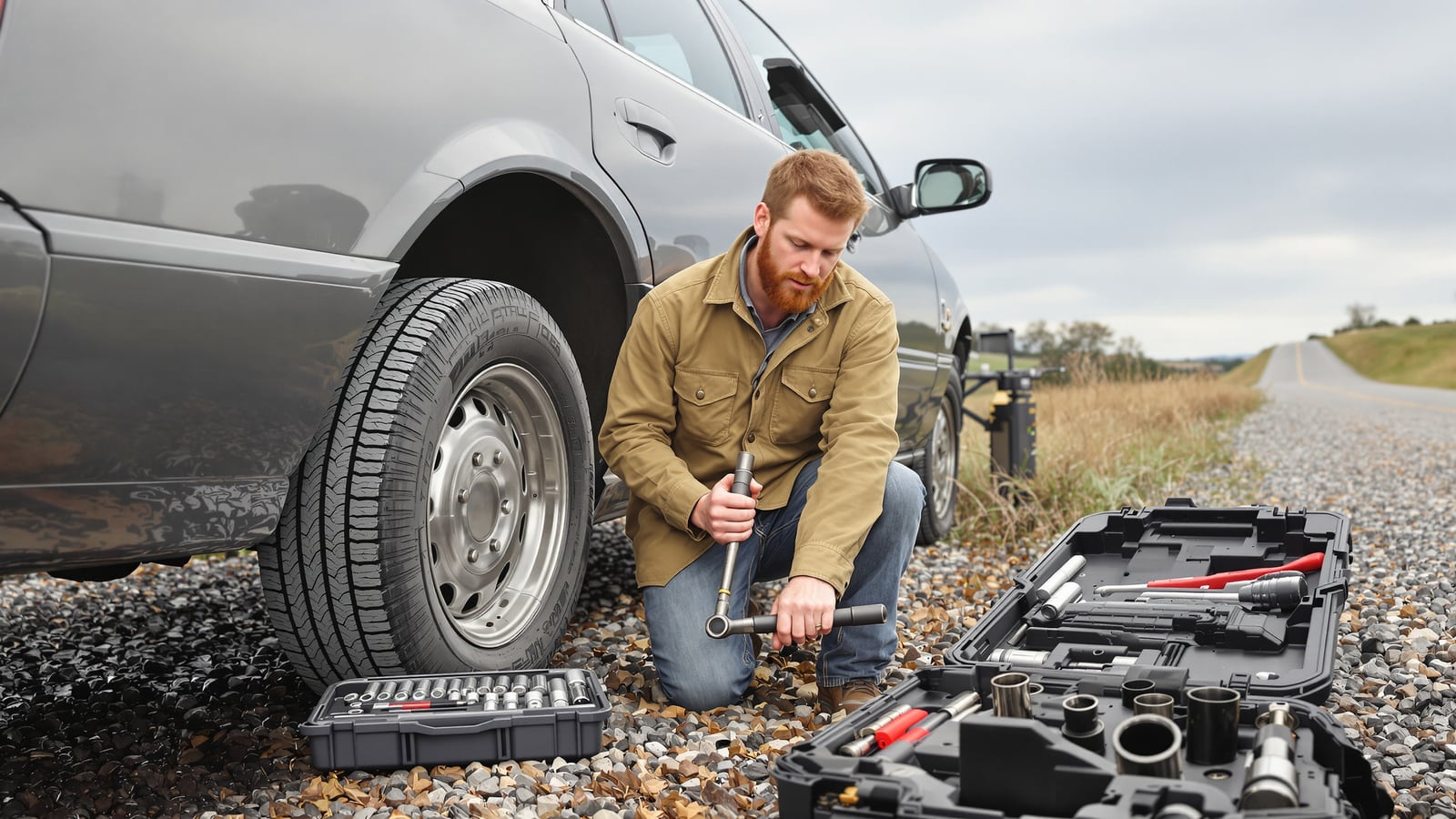
Quick answer: Buy one 3/8-inch drive set with 6-point sockets, in both SAE and metric, shallow and deep. Add a 1/2-inch breaker bar and a lug nut socket that fits your vehicle. Ignore the piece count on the box.
The 10mm problem
You're under the mower deck on a Saturday morning. The blade bolt is rusted tight, and the socket in the cheap set is a hair loose. You lean on it anyway. The corners round off, the socket spins, and now a ten-minute job is a trip to the hardware store with a ruined bolt in your pocket.
That's what the cheap set really costs. It's rarely the sticker price. It's the bolt you ruined, the knuckles, and the afternoon.
The 10mm socket, by the way, is the one that disappears. It fits battery terminals, interior panels, and half the small stuff under a hood. Buy a set that lets you spot a missing one at a glance, with a tray or rail where each size has a labeled slot. A loose pile in a blow-molded case hides the gap until you need it.
Why piece count is a trap
A 200-piece box counts every extension, every bit, every adapter, and every socket in both shallow and deep, in two measuring systems. Most of the pieces are sizes you'll use once, or never. Meanwhile the ratchet, which does the actual work, is usually the weakest thing in the box.
You don't need 200 pieces. You need roughly 6mm through 19mm in metric and 1/4 through 3/4 inch in SAE, with deep sockets for bolts that sit on long studs. That's a small set, and it covers nearly everything on a modern vehicle, a lawn tractor, a trailer, a deck, and a swing set.
Drive size: pick 3/8 and stop thinking
Sockets come in three common drive sizes.
- 1/4-inch is for small fasteners, interior trim, and tight spots. Handy, but you'll snap it if you lean on it.
- 3/8-inch is the working size. Brakes, water pumps, mower blades, bicycle racks, the lot.
- 1/2-inch is for big torque. Lug nuts, suspension bolts, crank pulleys.
If you can only own one set, make it 3/8. Everything smaller or larger can be a cheap add-on later.
6-point beats 12-point
A 12-point socket slips onto a bolt head more easily, and that's the only advantage it has. A 6-point socket grips the flat sides of the bolt instead of the corners, so it's far less likely to round off a stubborn fastener. It also takes more force before it slips.
On a clean, loose bolt, you won't feel the difference. On a seized one, you will. Buy 6-point and accept that you'll rotate the ratchet a bit more to get it seated.
The ratchet is where to spend
If you have forty dollars of discretionary money to spend on a socket set, put it on the ratchet. A bad ratchet fails at the worst possible moment, usually with your hand in a tight spot. Look for a smooth reversing switch, a comfortable handle, and a mechanism that doesn't skip under load.
Teeth count matters a little. More teeth means a shorter swing arc, which helps in cramped engine bays. The trade-off is that finer teeth are smaller and can be less forgiving under hard use. For general work, a 72-tooth ratchet is plenty.
Tekton, GearWrench, Husky and Craftsman all sell serviceable 3/8 sets. Whichever you pick, check the warranty before you buy. A tool you can swap at a counter is worth more than one with a nicer finish.
What to add the first month
A base set won't do everything. Buy these as you need them, and in this order:
- A 1/2-inch breaker bar, 18 inches or longer. Length is leverage. A rusted lug nut that beats your ratchet will give up quickly to a breaker bar.
- A lug nut socket that fits your vehicle. Lug nuts are usually 19mm, 21mm, 22mm or 13/16 inch, but check your owner's manual. Use a thin-wall one if the nuts sit in a recess.
- A torque wrench. Your owner's manual lists the lug nut torque. Over-tightening can warp a rotor. Under-tightening is worse. This is the one place a guess isn't good enough.
- A spark plug socket, if you own anything with a small engine. It has a rubber insert that holds the plug, so it doesn't fall into the cylinder.
- A set of extensions and one universal joint. Half the bolts you want to reach are around a corner.
If you're building a roadside kit as well, the truck kit that handles almost every roadside problem is a good companion to this one.
Chrome versus impact sockets
Chrome sockets are polished, thinner, and meant for hand tools. Impact sockets are black, thicker, and made of softer steel that flexes under the hammering of a power tool instead of cracking.
Here's the rule. Never put a chrome socket on an impact wrench or driver. Chrome is hard and brittle, and under impact it can shatter into pieces. Impact sockets are safe to use by hand, though, so if you own a cordless impact, buy impact sockets for the sizes you use most, like lug nuts and mower blades.
When the cheap one is right
Sometimes it is, and being honest about that saves money.
- The set that lives in the truck. If you only need it for a roadside emergency, a budget set is better than none. Keep it in a bag, not the cab.
- Extensions and adapters. They hold up fine in cheaper versions, since they take torque but don't have moving parts.
- Sizes you'll use once a year. A cheap 1-1/8 inch socket for one job is a fair bet.
- A loaner set. Lend the cheap one to the neighbor. You'll sleep better when it comes back bent.
When the cheap one isn't
The ratchet. The breaker bar. The torque wrench. Anything where the tool gets leverage, or where a failure costs you a part, a finger, or a wheel. A cheap torque wrench that reads wrong is worse than none, because it gives you confidence you haven't earned. If it takes a hard fall, have it checked or replaced.
The same logic runs through buying it for life. Repairable beats expensive, and a decent warranty beats a pretty finish. For another example of where cheap is fine and where it isn't, see buy the cheap pry bar, never the cheap ladder.
Take care of it
Wipe the sockets down before they go back in the case. A rag with a little oil keeps rust off, especially if you live near the coast or store tools in a shed. Put each one back in its slot, particularly the 10mm.
And if you borrow a socket from a neighbor, return it clean, with the slot it came from wiped out too. That's how a tool lasts three generations and a friendship lasts longer.
Wes Dunbar
Country & Skills
Grew up on an acreage and never quite left. Covers trucks, trades, land, and how to do the thing yourself.

Watch
Worth an hour of your evening
More from Gear.
From channels we rate. Plays on YouTube.
Read next