

Johnny Appleseed Was Real, and the Truth Beats the Legend
The barefoot saint with a pot on his head is mostly myth. The man behind him was tougher, shrewder and a good deal stranger.
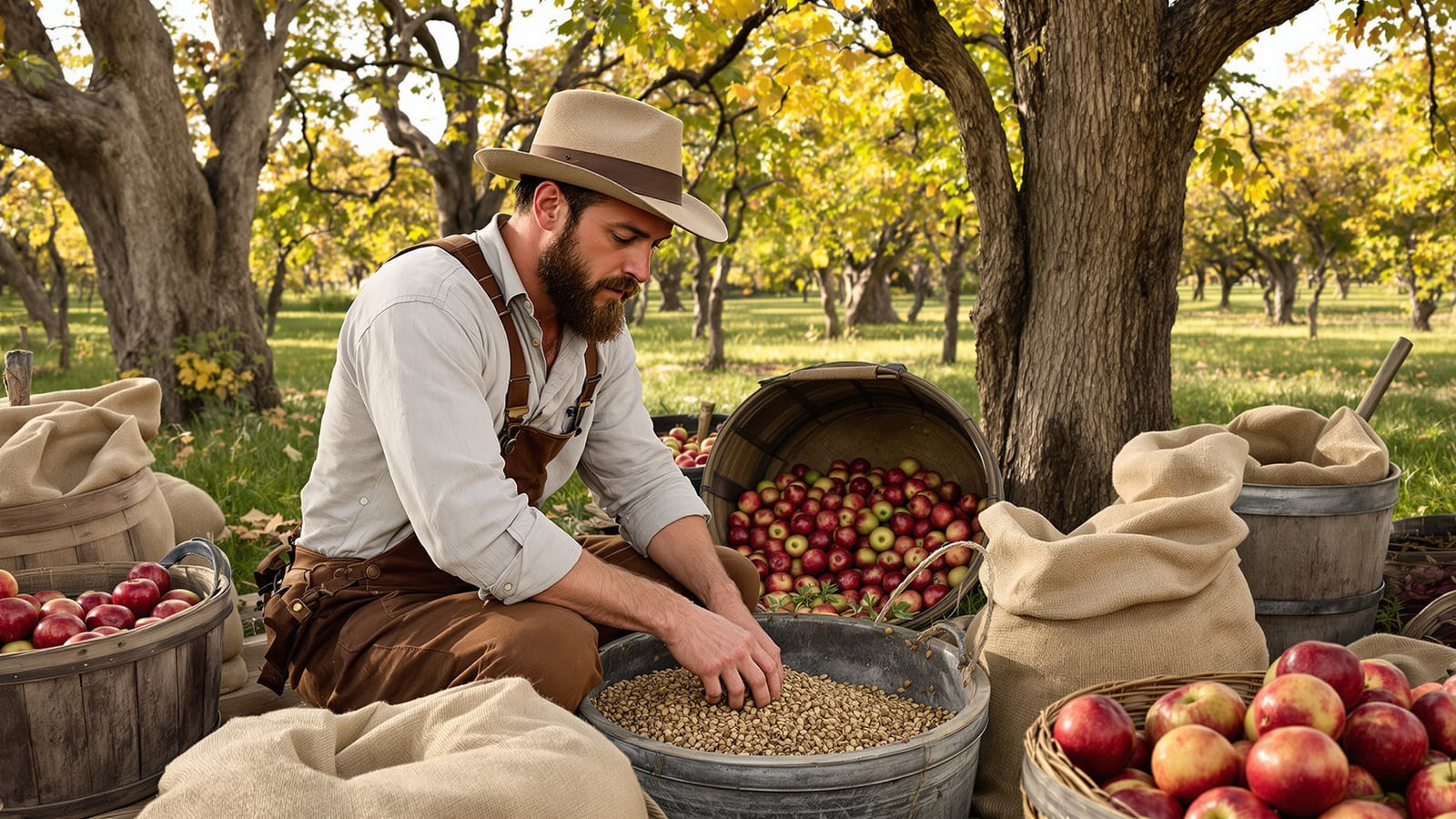
Quick answer: Johnny Appleseed was John Chapman, born in Leominster, Massachusetts, in 1774. He spent roughly four decades walking the Pennsylvania, Ohio and Indiana frontier, planting apple nurseries ahead of the settlers. He wasn't a wandering hippie scattering seeds. He was a working nurseryman who understood the land rules better than most men of his day.
The Man Under the Cooking Pot
The cartoon version is a barefoot dreamer with a tin pot for a hat, tossing seeds over his shoulder as he skips along. Disney helped lock that picture in, and the studio put him in Melody Time in 1948.
The record is different. By the 1790s a young man named Chapman turns up in western Pennsylvania. By around 1800 he's on the Allegheny River, collecting apple seeds from the cider presses, where the pulp left over from pressing was thrown away. That pulp was free seed. He washed it out, bagged it, and carried it west.
A commonly cited account from around 1806 has him floating down the Ohio River with two canoes lashed together, heavy with seed. That's the image to hold onto. Not a skipping dreamer, but a man hauling cargo with a plan.
His own start was rough. His father, Nathaniel, fought at Lexington and Concord as a minuteman and later served in the Continental Army. His mother died in 1776 after childbirth, when John was about two. He grew up in a broken, remarried household. Whatever drove him west, he went alone and he stayed alone.
He Was Running a Business
Here's the part the legend cuts out. Chapman didn't scatter seeds and hope. He planted nurseries.
He'd pick a spot with good soil along a creek or river, clear it, plant the seeds in rows, and fence the whole thing with brush and logs to keep the deer and cattle out. Then he'd leave it with a neighbor to look after and come back on his rounds. When settlers arrived, he sold them young trees. Prices were small, and by most accounts he'd often take payment in old clothes or on credit, or give trees to families who had nothing.
Timing was the genius. In parts of the Ohio country, settlers claiming land under the Ohio Company had to plant fifty apple trees and twenty peach trees to prove they meant to stay, as Michael Pollan notes in The Botany of Desire. Chapman put his nurseries where the settlers were headed. When the wagons arrived, the trees were ready and waiting.
He also bought land. By most accounts he owned more than a thousand acres by the end, spread across several states. The saint of the legend gave everything away. The man of the record gave a great deal away and kept a good deal too.
The Hard Parts
Two honest points belong here.
First, those apples weren't mostly for pies. Apples grown from seed don't come true. Plant a seed from a sweet apple and you usually get something small and sour. The good eating varieties come from grafting, which Chapman reportedly disliked. So his seedling orchards mostly produced cider apples, and hard cider was an ordinary drink on the frontier, where plain water could make a family sick. Later generations, especially in the temperance era, cleaned that story up. The record doesn't need cleaning up. It needs telling straight.
Second, the frontier he served was somebody else's home. Chapman's nurseries rode just ahead of settlement, and that settlement pushed Native peoples off their land. Accounts say he was welcomed in Native communities, that he treated people there with respect, and that he was considered a harmless oddity. That reputation may be earned. But his orchards still helped fill the country behind him, and that's part of the story too.
Faith, Feet and Frontier Fables
The eccentric details have some basis. Chapman was a follower of Emanuel Swedenborg, an eighteenth-century Swedish thinker, and he reportedly carried pages from Swedenborg's books and left them with families he met, splitting them up so more people could read them. He was said to go barefoot even in cold weather, wear rough clothing, and sleep outdoors. Several accounts mention a kindness to animals that bordered on the odd.
Then there's the legend pile. He supposedly ran miles to warn settlers of an attack in the War of 1812. He supposedly put out a campfire to spare mosquitoes. He supposedly never married because of a lost love. None of that can be pinned to a solid contemporary source. Many of those stories trace back to a single piece, W. D. Haley's "Johnny Appleseed: A Pioneer Hero," in Harper's New Monthly Magazine in November 1871. Haley was writing from the memories of old settlers, a quarter century after Chapman was gone. Memory improves a good story. It always has.
This is how a man can be real and still feel like he wasn't. The tales grew so tall that people half-assumed the whole thing was folklore, like Paul Bunyan. It wasn't. The paper trail is there: land deals, deeds, the memories of people who actually met him.
The End in Indiana
In March 1845, Chapman died near Fort Wayne, Indiana, in his early seventies. He'd been walking his rounds almost to the end. He was buried there, and a local newspaper noted the passing of "Johnny Appleseed," which tells you the nickname had already outrun the man.
That's an unusual kind of success. He wasn't rich in the way a land baron is rich. He had no family at his funeral to speak of. But when he started, much of the Ohio country was close to wilderness, and when he stopped, there were orchards from Pennsylvania to Indiana that he'd planted. Families were eating from them, pressing cider from them, and claiming land because of them.
What He Left
A man who plants a tree he won't see mature is doing something that doesn't pay off for years. Chapman did it for decades, alone, without a pension or a crowd, and without any guarantee that anyone would remember him at all.
That's the code worth learning from him. Not the pot on the head. The fences he built around the saplings, and the walk back every year to check on them.
If you want more of that frontier character, read The Pioneer Women Who Wrote It All Down, and The Men Who Built Your Ordinary Tuesday for the long list of people who did the unglamorous work so you wouldn't have to.
He left the country better than he found it. And he did it one fenced acre at a time.
Marcus Vale
Editor-in-Chief
Twenty years in magazines, most of it deciding what to cut. Writes about work, discipline and the decisions that compound.

Watch
Worth an hour of your evening
More from History.
From channels we rate. Plays on YouTube.
Read next