

The Oregon Trail Killed Roughly One in Ten and They Kept Coming
Five months, two thousand miles, and a danger list that looks nothing like the movies. The real story is better than the legend.
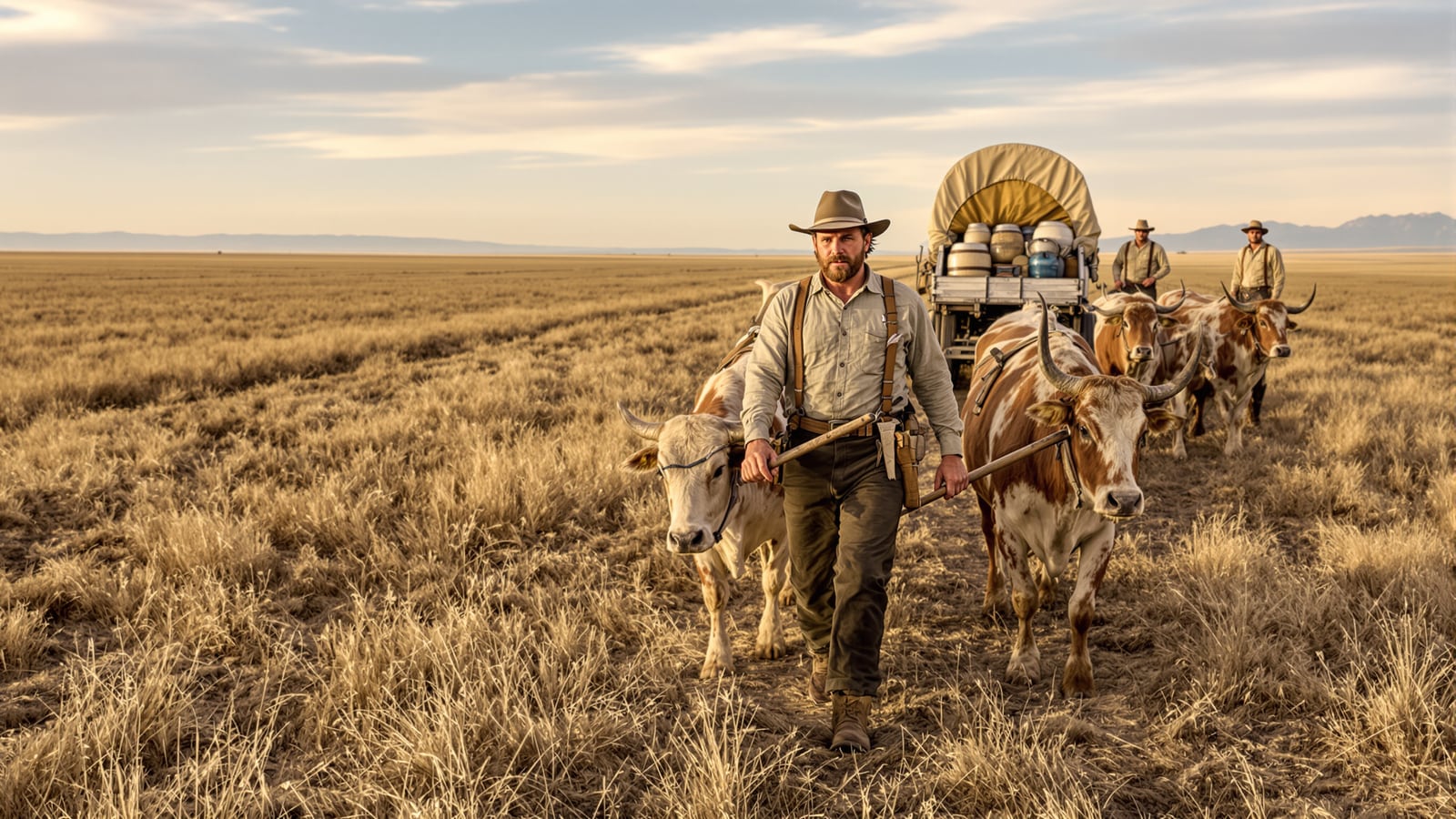
The most common killer on the Oregon Trail wasn't an arrow. It was water. Bad water, mostly, the kind that gave you cholera at breakfast and a grave by supper.
Historians who've gone through the diaries and counted the graves keep landing on the same ranking. Disease first. Accidents second. Drownings third. Violence a long way back. The figure that gets cited most is about one in ten emigrants dead before the end of the road. Some scholars put it lower. Nobody kept a census, so treat it as a careful estimate and not a ledger.
One in ten is still a number that would stop most of us at the front gate. They went anyway.
The math of leaving
The trail ran roughly two thousand miles from the Missouri River to Oregon's Willamette Valley. A wagon train covered about fifteen miles on a good day, and the whole trip took five to six months.
The calendar was a trap. Leave too early and the prairie grass wasn't up to feed the oxen. Leave too late and you'd hit the Blue Mountains and the Cascades with snow coming. Most trains left Missouri in April or May and spent the summer racing a deadline they couldn't see.
The wagon wasn't the huge Conestoga from the movies. It was a farm wagon with a canvas top, pulled by oxen, and it was packed with food, tools, seed and whatever the family couldn't stand to leave. Nearly everybody walked. The wagon had no springs, and riding in it was a punishment.
The outfit cost more than a lot of farm families had in cash, which is why many sold the farm to pay for the trip. There was no coming back to it.
What actually killed them
Cholera swept the trail hard in the years around 1849, when gold-rush traffic crowded the Platte River road and fouled the water. Dysentery and fevers followed. Measles and smallpox came along with the crowds.
Then the ordinary stuff. A child slips off the wagon tongue and the wheel rolls over. A loaded rifle gets pulled out of a wagon by the barrel. A river crossing goes wrong. Diary after diary records a death that had nothing to do with anyone's enemy.
Historian John Unruh's The Plains Across (1979) is still the standard study of the overland emigration. He concluded that the danger from Native attack was far smaller than later legend made it. In many places, the larger harm ran the other direction, through disease, trampled grass and vanished game.
People who died on the trail were often buried in the middle of the road itself. The wagons then drove over the grave to hide it from wolves. Think about that. A family digs a grave at dawn, fills it, and rolls the whole train across it so the body stays put. And then they keep walking.
Seven children and a doctor's door
In 1844 Henry and Naomi Sager started west with seven children. Henry died of fever on the trail. Naomi died weeks later, near Fort Boise, worn out and sick. That left seven orphans in a wagon train, the oldest about fourteen and the youngest an infant.
The train didn't abandon them. Other families fed them and drove their wagon. When the party reached the Whitman mission near present-day Walla Walla, Washington, the missionary couple Marcus and Narcissa Whitman took all seven in and raised them.
Catherine Sager, one of the girls, later wrote down what she remembered. It's among the plainest accounts of the trail we have, and it keeps the cost in view without any complaining.
The story doesn't end warmly. In 1847, after a measles epidemic killed many Cayuse children, a group of Cayuse men attacked the mission and killed the Whitmans and eleven others. Two of the Sager boys were among them. The record is what it is, and it's not tidy.
The shortcut that wasn't
Everybody on the trail was tempted by a shorter road. Most of the worst disasters came from taking one.
In 1845, a large train followed the so-called Meek Cutoff across central Oregon's high desert. It was meant to save time. Instead the wagons spent weeks lost, short on water and burying their own. Most of the people made it out, but not without a bill.
The year after, the Donner party took Lansford Hastings's shortcut toward California and ran into the Sierra Nevada winter. The Donners are the story everybody knows, and they're the exception that distorts the picture. The ordinary emigrant's story was slower and less grisly. Walk the road other people have already walked, don't be clever, keep the oxen alive.
That's not a bad rule for a lot of things.
The proven route was getting better. In 1843, about a thousand emigrants made what's often called the Great Migration, and the wagons got through to the Willamette Valley, proving it could be done. In 1846, Samuel Barlow opened a toll road around Mount Hood, which spared people the worst of the Columbia River's rapids. Each year's train left the next one a little more road.
The hard part
The land at the end of the trail wasn't empty. It belonged to Native peoples who had lived on it for generations, and the flow of settlers, from the first wagons onward, brought disease and pressure that the tribes didn't ask for and couldn't stop. That is part of the record, and the record is better when it's told straight.
The legal reward was also unevenly handed out. The Donation Land Claim Act of 1850 gave a married couple 640 acres in Oregon, half of it in the wife's own name, which was a striking provision for its day. But it applied to white settlers and to people of mixed Native ancestry. Oregon had also passed exclusion laws aimed at Black residents. Not every family that went west was welcome at the end.
None of this cancels the courage. It just means you shouldn't tell the story as if it were a postcard.
Why they went
The land was the answer. A farmer who couldn't scrape together a decent acreage in the East could, if he lived, own a farm that would still be in his family a century later. Whole extended families came: grandparents, widowed sisters, a hired boy. They carried tools and seed, and the things they couldn't bear to leave, and they threw those things out when the oxen began to fail.
The trail itself is the evidence. Along stretches like the Sweetwater River in Wyoming, diarists recorded stoves, trunks, anvils and furniture abandoned beside the road. People sure they'd need a piano learned, around mile eight hundred, how much they needed one.
The wagon had room for the family, the plan and the tools. Everything else went out the back, one hard decision at a time. Read the pioneer women's diaries and you'll see who made most of those decisions at the tailgate.
If you want the same kind of steadiness from a leader, look at Washington keeping his tent until his men had roofs. If you want to know who built what came after the road, start with the men who built your ordinary Tuesday.
The Oregon Trail wasn't won by anyone who thought it would be easy. It was won by people who looked at one in ten, did the arithmetic on their children's future, and hitched up the oxen.
Marcus Vale
Editor-in-Chief
Twenty years in magazines, most of it deciding what to cut. Writes about work, discipline and the decisions that compound.

Watch
Worth an hour of your evening
More from History.
From channels we rate. Plays on YouTube.
Read next