Whittling Starts With a Knife, a Stick and Ten Minutes a Day
A fifteen-dollar knife, a bag of basswood and a cheap strop get you started. Here's how to spend the first week without losing a thumb.
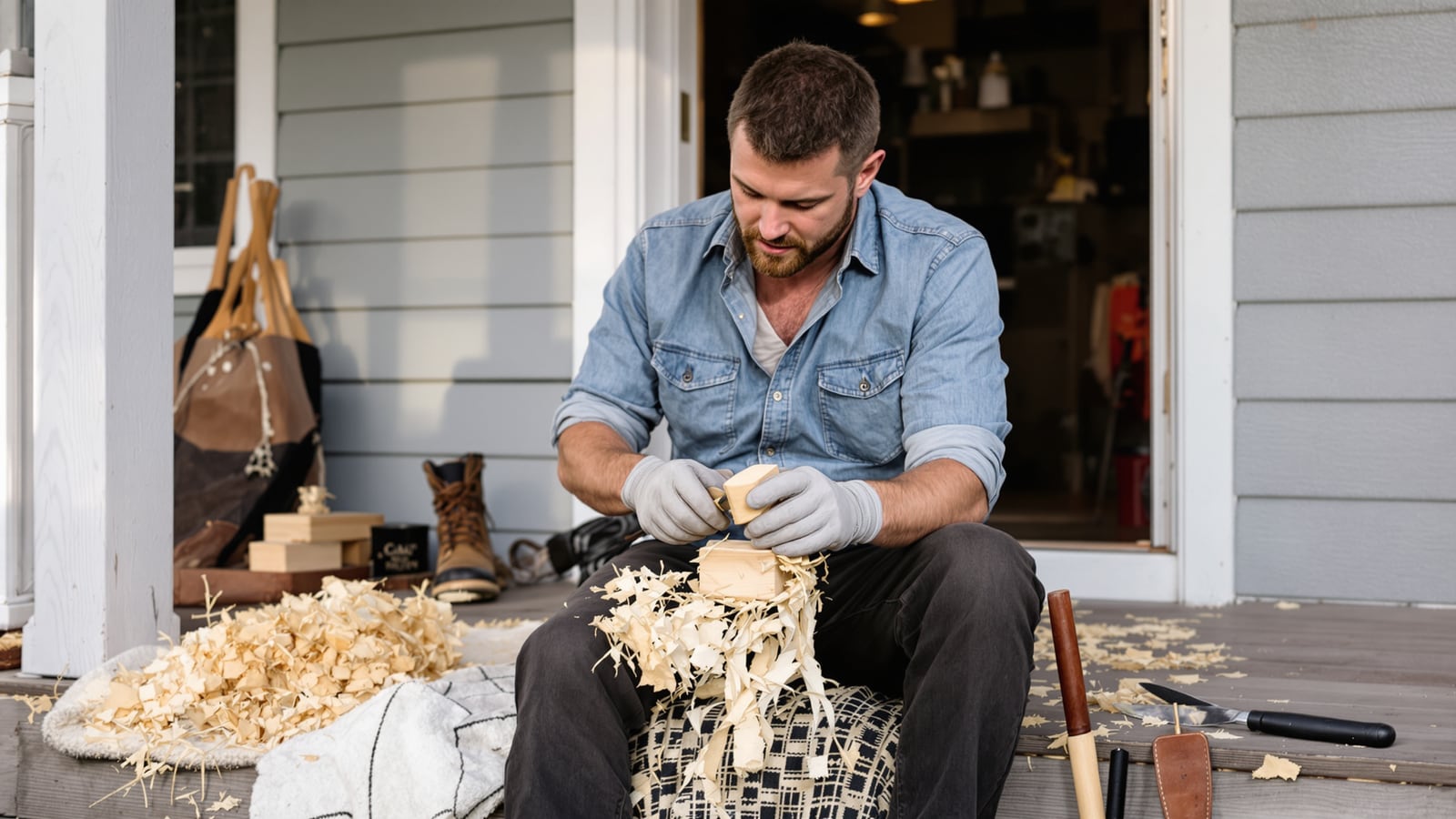
Quick answer: Buy a Morakniv Companion or a similar fixed-blade knife, a cut-resistant glove and a few basswood blocks. Plan on about fifty dollars all in. Carve ten minutes a day, learn four cuts, and make a pointed stick before you try to make a bear.
Why it gets its hooks in you
You pick up a stick. Ten minutes later you're holding a different stick.
That's the whole appeal. Whittling is the rare hobby where the first session produces something you can hold, and where the sound is half the reward. Basswood peels off a sharp blade with a soft little whisper. Shavings pile up on your boots. The phone is somewhere across the room and you haven't thought about it once.
It's also portable. A knife, a block and a towel fit in a gym bag. You can do it on the porch, at a campsite, or next to your kid while he does homework. Plenty of men find it's the first thing in years that quiets their head without asking for anything in return. Plenty of women find the same, and they tend to be better at the patience part.
What it really costs
You don't need a workshop. You need four things, and you'll want to spend a little on the first one.
- A fixed-blade knife. The Morakniv Companion is the standard beginner answer and usually runs about fifteen to twenty dollars. It comes sharp, the handle is grippy, and you won't cry if you drop it. If you want something built for carving, the Flexcut KN12 Pocket Jack folds, has two blades and runs roughly thirty dollars. Prices drift, so check the current number.
- A cut-resistant glove for your holding hand. Ten to fifteen dollars. You'll wear it for the first month, and then you'll keep wearing it, because you'll have noticed how often the blade lands there.
- Basswood. Craft stores like Hobby Lobby and Michaels sell small carving blocks, and woodworking stores carry them too. Ten to twenty dollars buys you weeks of practice. Basswood is soft, even-grained and forgiving.
- A strop and honing compound. About ten to fifteen dollars together. A dull knife is the most dangerous knife you own.
Total: right around fifty dollars. Skip the forty-piece carving sets. You'll use two of those tools and resent the rest.
A leather strop is also a fine first project if you ever pick up leatherworking. Two hobbies, one bench.
Your first three things this week
1. Make a pencil point. Day one, ten minutes. Take a dowel or a basswood stick about the size of a thick marker. Sit down with a towel across your lap. Brace the stick against your chest or your holding thumb and push the blade away from you in short, shallow strokes, shaving the end to a cone. It will look rough. It will also teach you the grip, the angle and how much force the wood actually needs, which is less than you think.
2. Learn the four cuts. Days two through four. Three strokes cover most of what you'll do. The push cut uses your carving thumb to drive the blade away from the body. The pull cut draws the knife toward your gloved thumb, which is why you wear the glove. The stop cut sets the blade straight down to define an edge. Practice each one on scrap until you can make a clean, even shaving about the thickness of a potato chip.
3. Make a roasting stick. Days five through seven. Take a longer stick, peel the bark and give it a four-sided point. Then use it that weekend, with marshmallows or hot dogs. It's your first finished piece, and the family will notice. (The sticks don't have to be pretty. They have to be pointy and clean.)
The mistakes everybody makes
Starting with a hard wood. Oak, maple and hickory will wear you out and make you think you're bad at this. You aren't. Use basswood, butternut or eastern white pine for the first month.
Carving toward your body. Every stroke should end with the blade moving into open air, not toward your thigh or your belly. The inside of the leg is where the bad stories come from. Sit down. Keep a clear zone around you, at least an arm's length, with no one in it.
Skipping the strop. A dull knife makes you push harder, and force is what slips. Give the blade ten or fifteen passes on the strop whenever it stops slicing cleanly. If it won't shave a curl off basswood with almost no pressure, strop it again.
Carving a figure on day one. Faces, animals and Santa Clauses look easy in videos because the person on screen has done two thousand hours. Do planes, tapers and a simple spoon-shaped scoop first. Fundamentals look boring until you notice you can do them.
Carving unknown wood off the ground. Don't whittle vines or branches you can't identify, and stay clear of anything near poison ivy, oak or sumac. Buy your first few blocks. Once you know what you're looking at, a fallen basswood or willow limb from your own yard is free practice.
Quitting after a bad hour. Carving is mostly small errors, corrected. The wood forgives that. You can too.
Where the carvers are
Whittlers are some of the friendliest people you'll meet, and they love a beginner holding a knife wrong.
Start with a search for "woodcarving club" plus your county or nearest city. Many towns have a chapter that meets at a library, a senior center or a community hall, and a lot of them meet weekly with a pile of shavings on the floor and coffee on the table. Woodcraft stores run beginner carving classes in many areas, and some local lumber yards and hardware stores keep a bulletin board worth reading. The National Wood Carvers Association also lists clubs and events.
Scouting leaders are another good door. Troops teach knife safety through the Totin' Chip, and a dad carving beside his son at a campout fits right in.
Makerspaces, county fairs and craft shows are good places to see what's possible and meet people who do it. Walk up and ask what they're working on. They'll tell you for twenty minutes.
If you like making things with your hands and want a second hobby that sits on a table, a model railroad on a sheet of plywood is a natural next step.
Start tonight
Order the knife. When it comes, grab the nearest stick, put a towel on your lap and spend ten minutes making it pointier.
Don't make anything good yet. Make a pile of shavings. The good stuff comes later, and it's built out of exactly that pile.
Dean Shaw
Gear & Garage
Reads the warranty, the parts list and the long-term owner reviews before anything else. Trucks, tools, watches, and the cheap version that costs more.

Watch
Worth an hour of your evening
More from Hobbies.
From channels we rate. Plays on YouTube.
Read next