

How to get a ham license and actually key the mic
Thirty-five questions, one $35 fee, and a radio that costs less than a tank of gas. Your first contact can happen this month.
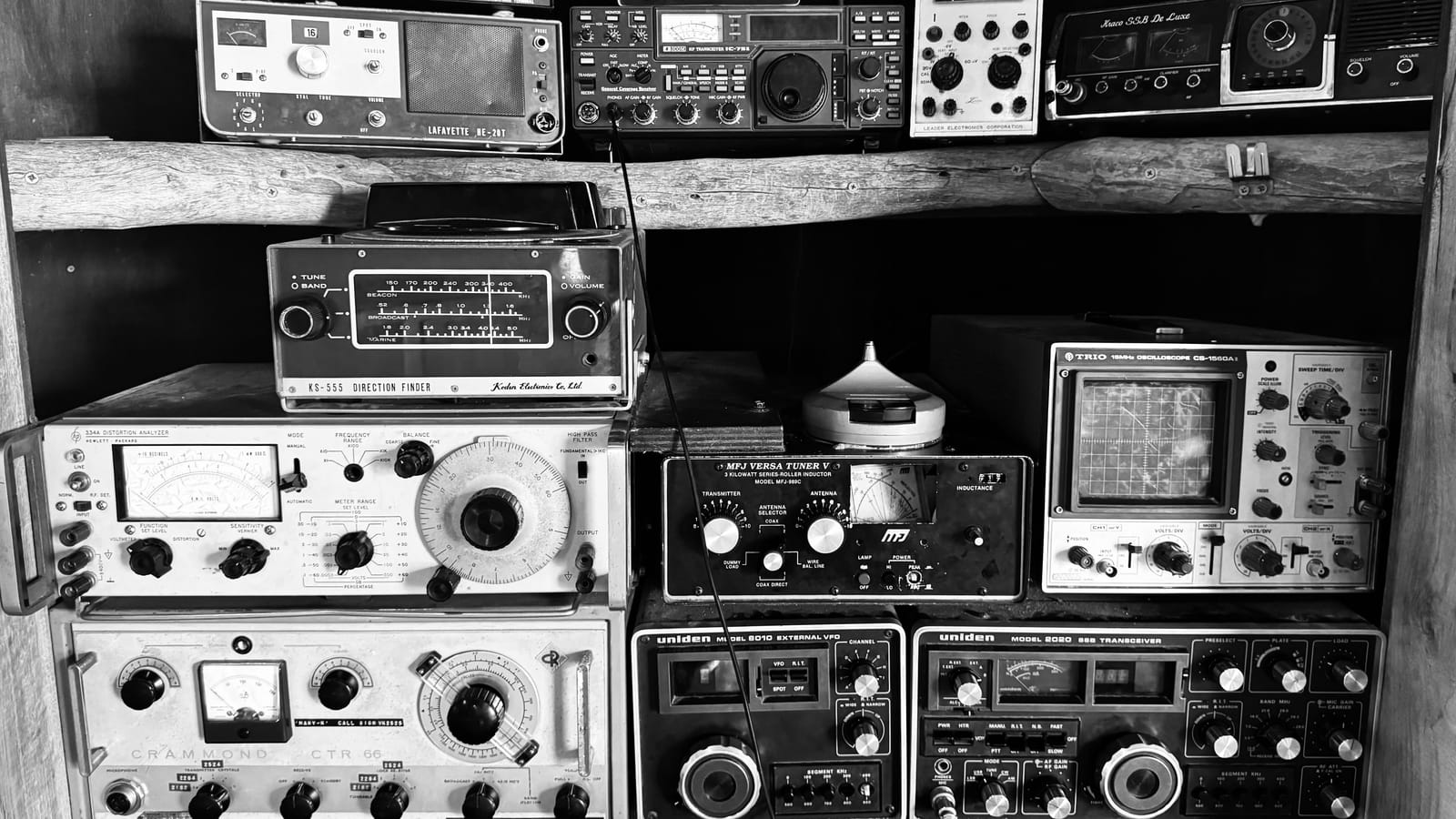
Thirty-five questions. Twenty-six right. No Morse code, no electronics degree, no age minimum. That's the entire gate between you and a Technician class amateur radio license, and the whole question pool is published in public so you can study the exact questions you'll be asked.
People hear "FCC license" and picture a bureaucratic swamp. It's a multiple-choice test you can pass in two weeks of light studying, plus a $35 application fee to the FCC. The volunteer examiner team that administers the test usually charges a modest session fee on top, and some VE groups run their sessions for free. That's it. That's the barrier.
The hard part isn't the license. The hard part is the first time you push the button and say your own callsign out loud.
Study the pool, not the theory
The Technician question pool is a fixed, published list that rotates on a four-year cycle. Every question on your exam comes from it, word for word, with the same four answer choices. This isn't a loophole. It's how the service is designed, because the FCC would rather you knew the rules than guessed at them.
Use a flashcard site that drills the actual pool. HamStudy.org is the one most people land on, and it tracks which questions you keep missing so you stop wasting reps on the ones you own. Twenty minutes a night for two weeks gets most people into the high 80s on practice tests. If you want the reasoning behind the answers, the ARRL Technician manual is the standard and reads like a decent shop manual.
Three sections will annoy you. The band chart, because it's pure memorization. The formulas, because Ohm's law shows up whether you like it or not. And the RF exposure questions, which feel like paperwork until you realize you're about to own a transmitter.
Don't chase 100 percent. Chase 85 percent on three consecutive practice exams, then go book a session.
Book the exam, including from your kitchen table
Find a session through the ARRL's exam search or through a VE group like GLAARG or Laurel VEC. Plenty of teams now run remote sessions over video, with a proctor watching you on camera and a second camera showing your room. Others meet in a church basement or a fire hall on a Saturday morning, and those are worth going to in person, because the guy grading your paper has a 40-foot tower in his yard and will happily tell you how he got it there.
Bring photo ID and your FRN. Get the FRN first, from the FCC's CORES site, before test day. If you show up without one, the team has to walk you through registration while everybody waits, and you'll feel like the guy holding up the checkout line.
Pass it, and you'll get an email from the FCC with a link to pay the $35 fee. You have ten days. Miss that window and your application gets dismissed and you're re-testing. Pay it the same afternoon. Your callsign typically shows up in the FCC database within a week or two, and you're not allowed to transmit until it does. Watch the license database, not your inbox.
And if you fail? You can retest the same day, usually for another session fee. Most teams will let you sit right back down.
Buy the license first, the radio second
The temptation is to order a radio while you're still studying. Fine, but know what you're getting.
A basic Chinese handheld runs about $30 and will do everything a beginner needs, which is mostly listening. The catch nobody mentions on the product page is that the stock rubber antenna is the weakest part of the package. Swapping it for a better whip in the $20 to $25 range does more for your range than anything else you can buy at that price. The programming software is also a small ordeal. Budget an evening, a USB cable that actually works with your radio, and some patience.
Spend $150 to $200 on a Yaesu FT-60R or similar and you get a radio with buttons that make sense, a better receiver, and a build quality that survives a truck door. If you already know you'll stick with this, start there.
What a handheld won't do is reach across the state on five watts from inside your living room. Handhelds talk to repeaters, and repeaters do the heavy lifting. Your job is to find them.
Find your local repeaters before you talk
Download RepeaterBook. It'll show you the 2 meter and 70 centimeter repeaters near you with the three numbers you need: the output frequency, the offset, and the CTCSS tone. Program four or five of the closest ones, plus 146.520 MHz, the national 2 meter simplex calling frequency.
Then listen for three days. Drive around with it on. You'll learn which machines are busy at 7 a.m. and which ones have been silent since the last presidential administration. That's the annoying truth about repeaters. Some are genuinely dead. Others have a morning commute crowd that's been talking to each other for twenty years and will absolutely make room for a new callsign.
Also find a net. Almost every club runs a weekly on-air check-in, usually a set night at a set time, with a net control operator who calls for stations. That's the single easiest on-ramp in the hobby, because somebody is literally asking you to speak.
Your first contact, word for word
On a repeater, you don't call CQ. That's for HF and simplex. On a repeater you say your callsign and that you're listening.
Key up, wait half a second, then speak across the microphone rather than into it. Say: "KD9XYZ, monitoring." Use the phonetic alphabet for the letters. Kilo Delta Nine X-ray Yankee Zulu. Then let go and wait ten seconds.
Somebody will come back. When they do, you'll forget your own callsign. Everybody does. Write it on a piece of tape and stick it to the radio.
What follows is the most gloriously ordinary conversation of your life. Your name, your town, what radio you're using, how the weather is. They'll tell you whether you are "full quieting" into the repeater or a little scratchy. You'll thank them, say your callsign again, and hang up the mic with your heart going like you just ran stairs.
That's the contact. Log it. Date, time, frequency, their callsign, their name. Paper notebook is fine and honestly better.
Where it goes from there
Technician privileges include a slice of 10 meters for voice, all of 6 meters, and the VHF and UHF bands where the repeaters live. Upgrade to General, which is another 35-question exam from another published pool, and 20 and 40 meters open up. That's when you start talking to Portugal from a folding chair.
The outdoor version is Parks on the Air. You drive to a state park, throw a wire in a tree, run 10 watts off a battery, and work stations across the country while your kids climb rocks. No repeater, no club, no infrastructure. Just a wire and the ionosphere.
And there's the reason your wife will stop rolling her eyes. When the cell network goes down in a storm and the power's out for four days, the guy with a charged handheld and a local repeater list is the guy relaying information for his street. Amateur operators have done exactly that after hurricanes and wildfires, over and over, because radio doesn't need a tower that somebody else maintains.
Go pass the test. Then go listen for a week, key up once, and find out how loud your own name sounds coming back at you.
Marcus Vale
Editor-in-Chief
Twenty years in magazines, most of it deciding what to cut. Writes about work, discipline and the decisions that compound.

Watch
Watch how it's done
Picked for this article.
From channels we rate. Plays on YouTube.
K0LWC
Ham Radio Basics - Making Your First Contact on a Repeater
Ham Radio Prep
How to Make Your First Contact on Ham Radio The EASY Way [Using Simplex]
Read next