

Don't tighten that loose cabinet hinge. Do this instead.
A sagging cabinet door usually means a stripped screw hole. Toothpicks, glue and a hand screwdriver fix it in five minutes of work.
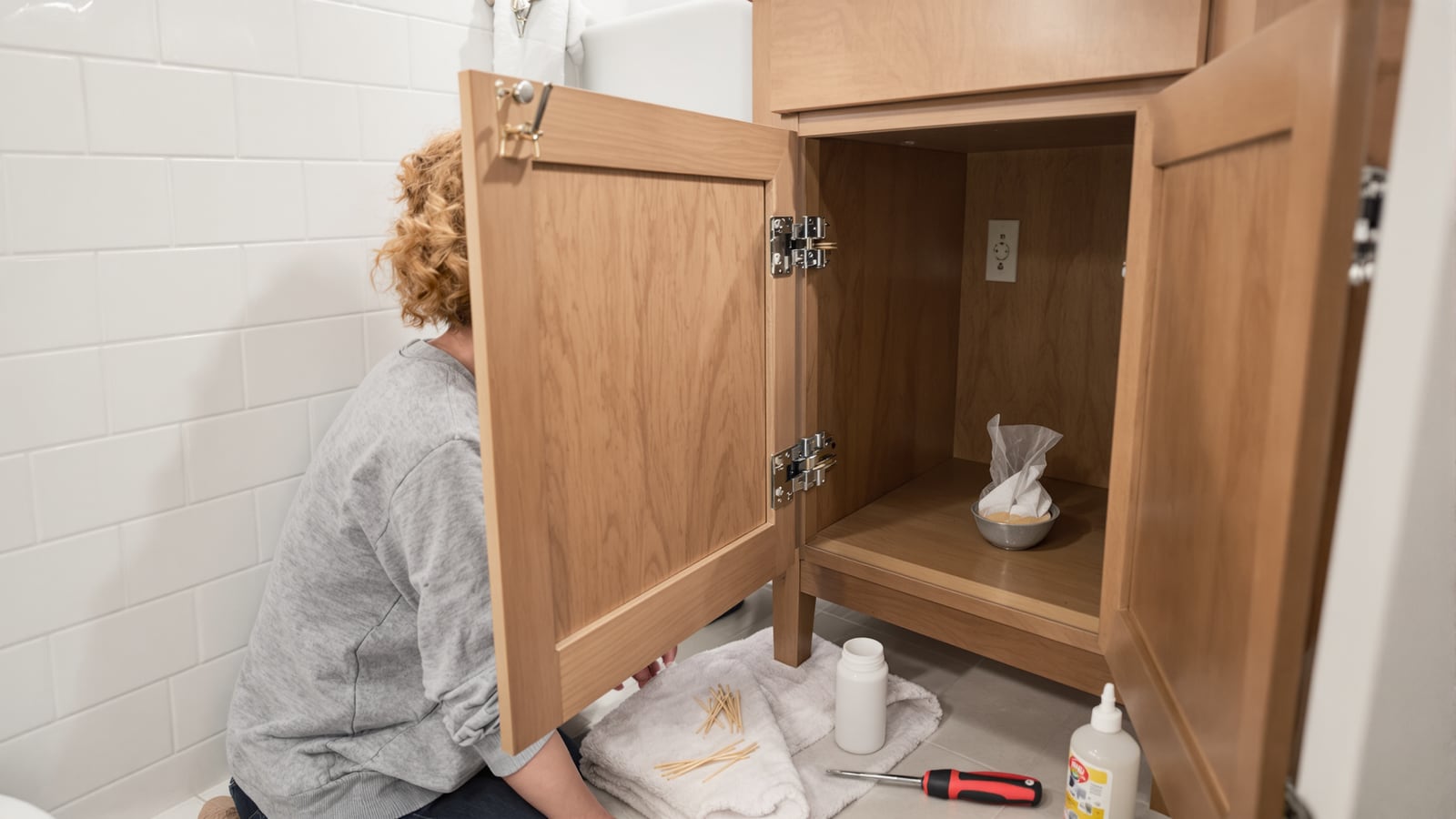
Quick answer: Back the loose screw out. Dip three or four wooden toothpicks in wood glue, pack them into the hole, snap them off flush, wait an hour, and drive the same screw back in by hand. The door hangs true again.
The five minutes is the work. The glue needs its own time, and you can't hurry it.
Why the door sags in the first place
Most kitchen cabinets aren't solid wood. The doors and the boxes are usually particleboard or MDF, which is wood chips or fibers pressed together with glue. It holds a screw fine on day one. After ten years of a door swinging open and shut forty times a day, the threads pack the hole out. The screw spins. The hinge loosens. The door drops a quarter inch and starts rubbing the one next to it.
Then comes the mistake. You grab a screwdriver and crank the screw harder.
That works for about a week. Then it strips the hole completely, and now you've got a screw that turns forever and bites nothing. Every extra turn chews out more of the material you need to save.
Find the loose screw before you touch anything
Open the door and look at the hinge. A standard concealed hinge, the kind with a round cup set into the back of the door, has two sets of screws.
- The cup screws hold the hinge into the door itself.
- The mounting plate screws hold the hinge arm to the cabinet frame or side wall.
Wiggle the door gently. Watch the hinge, not the door. Whichever part moves is the one that's failed. Nine times out of ten it's one or two screws that spin freely. You can feel it when you turn them: no resistance, no tightening, just a screw going around in the dark.
While you're looking, check the other hinges on that door. If one has gone, the one beside it is carrying extra load and is probably not far behind.
What you'll need
You likely have all of it already.
- A hand screwdriver that fits the screw head. Many hinge screws take a Pozidriv bit, which looks like a Phillips with extra small marks between the arms. A plain Phillips will slip in it and chew the head.
- Wooden toothpicks, or hardwood matchsticks with the heads cut off. Golf tees work too for bigger holes.
- Yellow wood glue.
- A utility knife or a pair of flush-cut pliers.
- A rag.
Use a hand screwdriver, not a drill. A drill on a high clutch setting will strip a repaired hole faster than the original did. If you only have a drill, set the clutch to its lowest number and stop the second the screw seats.
The fix, step by step
1. Take the screw out. Hold the door with one hand so it doesn't drop onto the hinge below it.
2. Clear the hole. Blow out the sawdust and any crumbled particleboard. Don't dig. You want solid walls left around the hole.
3. Glue the toothpicks. Dab glue on three or four toothpicks and push them into the hole, tip first, until it's packed tight. It should take some force to get the last one in. If it goes in easily, add another.
4. Cut them flush. Snap the sticks off at the surface or slice them with the knife. Wipe any glue that squeezed out with a damp rag.
5. Wait. Give it at least an hour before you drive the screw. Overnight is better. Wood glue grabs fast but doesn't reach full strength for about a day, and a rushed screw will push the whole plug out.
6. Drive the screw back in. Same screw, same hole. The new material gives the threads something to bite. Tighten until snug. Not until it squeaks.
If you're repairing the cabinet door the same afternoon you start, do it one hinge at a time and leave the others holding the door in place.
When toothpicks aren't enough
Some holes are too far gone. If you pack the toothpicks and the screw still spins, you've got two options.
Go bigger. Swap the screw for the next size up, which is often a #8 where a #6 failed, same length. A fatter thread grips fresh material beyond the damaged hole. Don't go longer if you're fixing a screw in the door itself. A typical door is about three-quarters of an inch thick, and a screw that pokes out the front is a mistake you can't undo.
Move the hinge. If the old hole is shredded and the door has room, shift the hinge a few millimeters and drill a new pilot hole into solid material. This only works when the cup is held by two screws and you can make the mounting plate slots work in your favor.
If the particleboard is swollen, soft, or crumbling like stale cake, that's water damage. Packing the hole won't last. The panel needs replacing, and the source of the water needs finding. A dishwasher seal and a sink-base leak are the usual suspects.
Then fix the door, not just the hinge
Once the screws bite again, the door may still hang crooked. Concealed hinges are made to adjust, which is the part most people never discover.
Look at the hinge arm. You'll find two or three small screws. Roughly, one moves the door side to side, one moves it in and out, and the mounting plate lets you slide it up or down. The exact layout varies by brand. Turn each screw a quarter turn, close the door, and look. You're aiming for an even gap all the way around, roughly the thickness of a nickel.
Adjust slowly. Quarter turns. One screw at a time. Overshooting is how a two-minute adjustment becomes twenty.
Leave it better than you found it
While the screwdriver's out, go around the kitchen and snug every hinge screw on every door. Wipe the hinge arms with a rag to pull off the grease and dust that collects there. It takes ten minutes, and it catches the next failure before it becomes a sagging door.
If you're doing this at your parents' place, or a friend's, do their kitchen too. Nobody ever complained about a cabinet that closed right.
When to put the screwdriver down
A loose hinge is a small job. Some cabinet problems aren't.
- The whole cabinet is pulling away from the wall. Upper cabinets hold a lot of weight, and a dropped one can injure someone. Empty it, support it, and read how to hang heavy things so they never come down before you do anything else. If the wall is damaged, call a carpenter.
- The face frame is cracked or split where the hinge mounts. That's structural, and glue and toothpicks won't hold it.
- You see mold, soft wood or a musty smell behind the cabinet. That's a moisture problem, and the cabinet is the symptom.
Knowing when to stop and how to get a quote you can trust covers how to hire someone for the part that's beyond you, without getting taken.
For everything else, this is a repair you can do yourself. It belongs on the short list in five house repairs you should stop paying someone else to do. A handyman will charge you a trip fee to do exactly this, and a pack of toothpicks costs less than the gas to get him there.
Do it tonight. Check it in the morning. The door will still be straight.
Wes Dunbar
Country & Skills
Grew up on an acreage and never quite left. Covers trucks, trades, land, and how to do the thing yourself.

Watch
Worth an hour of your evening
More from Home.
From channels we rate. Plays on YouTube.
Read next