

Hand your son a ukulele before you hand him a guitar
Four nylon strings, one-finger chords and songs he'll know by Sunday. Here's how to start a boy on the ukulele and keep the door open to every other string.
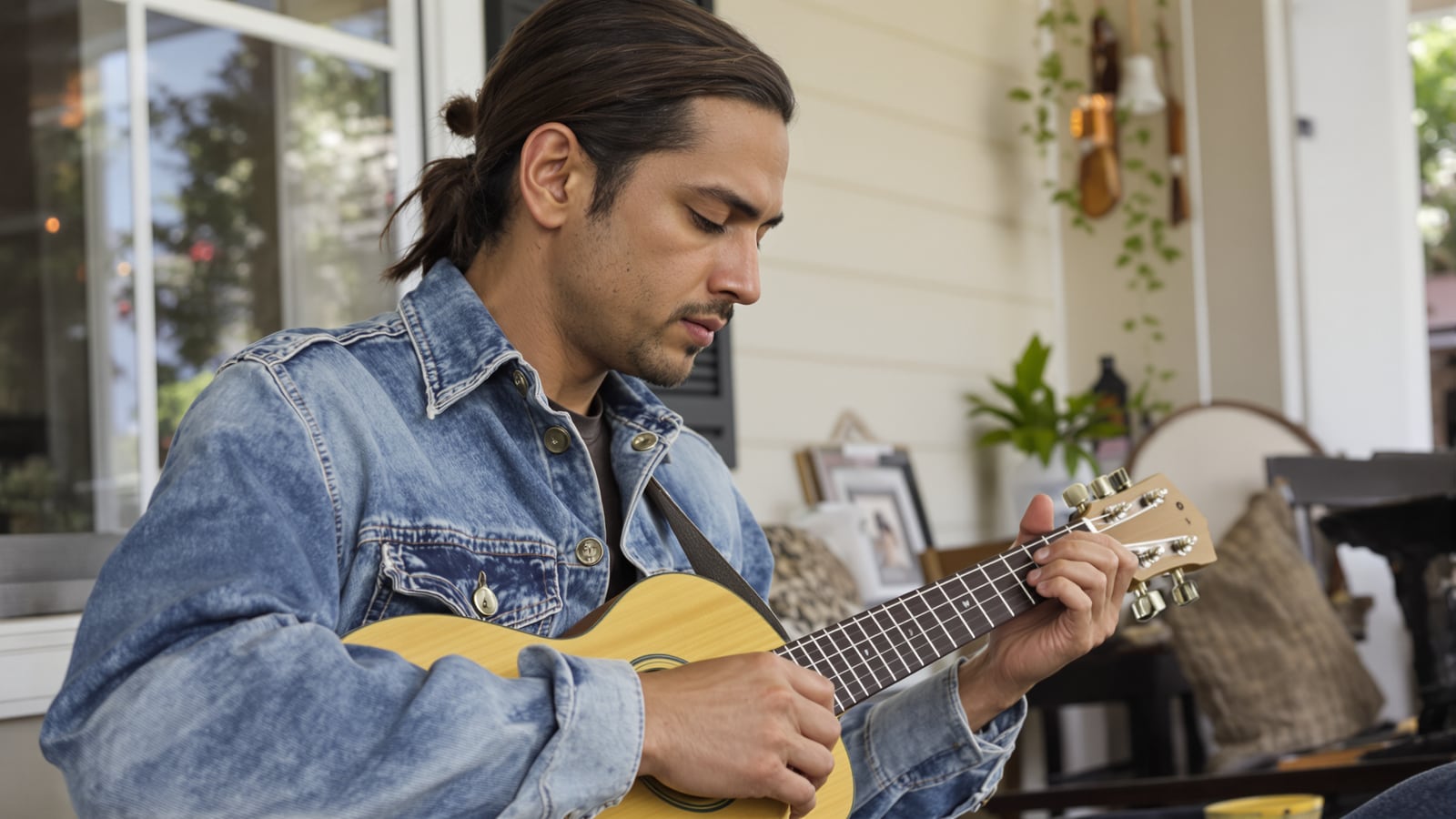
Quick answer: Buy a soprano ukulele set up by a real music shop, learn C, Am, F and G together on the couch, and play ten minutes a night. Most songs you both know run on those four chords. The habits carry over to guitar, banjo and mandolin.
The guitar is where boys quit
A seven-year-old with a full-size steel-string guitar has a bad week coming. The neck is too wide, the strings bite his fingertips, and the first chord that sounds like anything takes real hand strength.
He'll blame himself. Then he'll stop.
A ukulele fixes the whole problem. It's small enough for a boy's lap. The strings are nylon and soft on the fingers. And some chords take one finger. That's the point. In the first ten minutes he's making music, not failing at it.
You're not settling for a toy. You're picking the shortest road to the thing you want, which is a son who still plays at fifteen.
Get one that stays in tune
Skip the novelty ukulele with the cartoon on the front. Cheap ones have tuning pegs that slip, and an instrument that's out of tune every time he picks it up teaches him that he's bad at music. He isn't. The ukulele is.
Go to an actual music store. Ask for a soprano, or a concert if your son is on the bigger side. Ask them to set it up and tune it while you stand there. A decent beginner ukulele doesn't cost a fortune, and a shop that cares will tell you if something is junk.
Buy a clip-on tuner at the counter too. Tuning is the first skill he'll learn, and it matters more than any chord.
The first night
Hold it yourself first. Show him how the ukulele sits against his chest and how the right hand strums down with the pad of the first finger. Nothing fancy. Down, down, down, down.
The four strings, from the one closest to his face, are G, C, E, A. Teach him the old rhyme if he likes: "Good Cats Eat Animals." It sounds silly. He'll remember it for life.
Then show him C. One finger, the third fret of the bottom string, or none at all if you want to start with the open strings. Strum. It sounds like a song already.
Add the other three:
- Am: one finger on the second fret of the top string (G)
- F: two fingers, second fret on G and first fret on E
- G: three fingers in a little triangle: second fret on C, second fret on A, third fret on E
Give him a week on C and Am before you push the other two. The jump from one shape to the next is the real lesson, and it takes longer than it looks.
Songs, not exercises
A boy won't practice scales for fun. He will practice a song he can sing to his grandfather.
In the key of C, the progression C, Am, F, G is the engine behind "Stand By Me." Move to C, Am, G, F and you've got "Take Me Home, Country Roads." Both are songs a boy can sing with his dad. If you want something with a little dust on it, "You Are My Sunshine" is three chords and has been played on porches for generations.
Pick one song and play it every night for two weeks. It'll sound rough on Monday. By the second Sunday he'll be showing it off to the family, and that's when you'll know it took.
Ten minutes, and you're sitting there
Ten minutes a night beats an hour on Saturday. Put the uke on a stand or a wall hook where he walks past it, not in the case under the bed. If it's in his way, he'll pick it up. If it's out of sight, he won't.
Here's the part most dads skip: sit down with him. Don't supervise from the doorway. Learn the same four chords yourself, badly, in front of him. A boy who watches his father struggle through an F chord learns more than any lesson can give him about what it looks like to keep going at something hard.
If you've ever wanted to play guitar and never started, this is your opening. The First Ninety Days of Learning Guitar as a Grown Man lays out what to expect, and a lot of it applies to the ukulele too.
Hold a line on the schedule. Ten minutes is ten minutes, and "I don't feel like it" isn't a reason to skip. But don't turn it into a fight. If he's miserable, play one song and put it down. Tomorrow counts.
And teach him the old code with the instrument itself. He wipes it down when he's done. He tunes it before he hands it to somebody else. He puts it back where he found it. Respect for a thing starts with how you leave it.
What carries over to every other string
The ukulele isn't a dead end. It's a bridge, and a lot of real skill walks across it.
Baritone ukulele to guitar. A baritone ukulele is tuned D, G, B, E, the same as the top four strings of a guitar. Every chord shape he learns on a baritone is a real guitar chord. A standard soprano sounds a fourth higher but uses the same logic, so the transition is short and the finger memory doesn't start from zero.
Guitar to the rest. Once he has a guitar in his hands, bluegrass is open to him. Flatpicking, the old Carter-style strum and the Nashville chord numbering all grow from what he already knows. When you're ready for that step, What Actually Matters When You Buy Your First Acoustic will keep you from buying the wrong one.
Banjo and mandolin. These tune differently, and he'll have to learn new shapes. But the left-hand habits stay: pressing cleanly, switching without looking, keeping time. The five-string banjo even has a short high-G string, a cousin of the ukulele's high G, which gives the instrument its bright, ringing sound.
What he's really learning is how to hear a chord change coming, how to keep a steady beat, and how to sit with something that doesn't work yet. Those travel to any instrument in the world.
When he starts writing his own
It'll happen sooner than you expect. A boy who knows four chords will make up a song about the dog by the end of the month. Don't correct it. Ask him to play it again.
When he's ready to get serious about it, Turn a Story Into a Song Without Losing the Story is a good next read for both of you.
Someday he'll pick up a guitar at a campfire and know what to do with it. He won't remember the cheap four strings that got him there. You will.
Dean Shaw
Gear & Garage
Reads the warranty, the parts list and the long-term owner reviews before anything else. Trucks, tools, watches, and the cheap version that costs more.

Watch
Worth an hour of your evening
More from Music.
From channels we rate. Plays on YouTube.
Read next