

What Grandpa Kept in His Shop Apron, Pocket by Pocket
The old canvas apron wasn't a costume. It was a system, and you can build your own this week for the price of a few small tools.
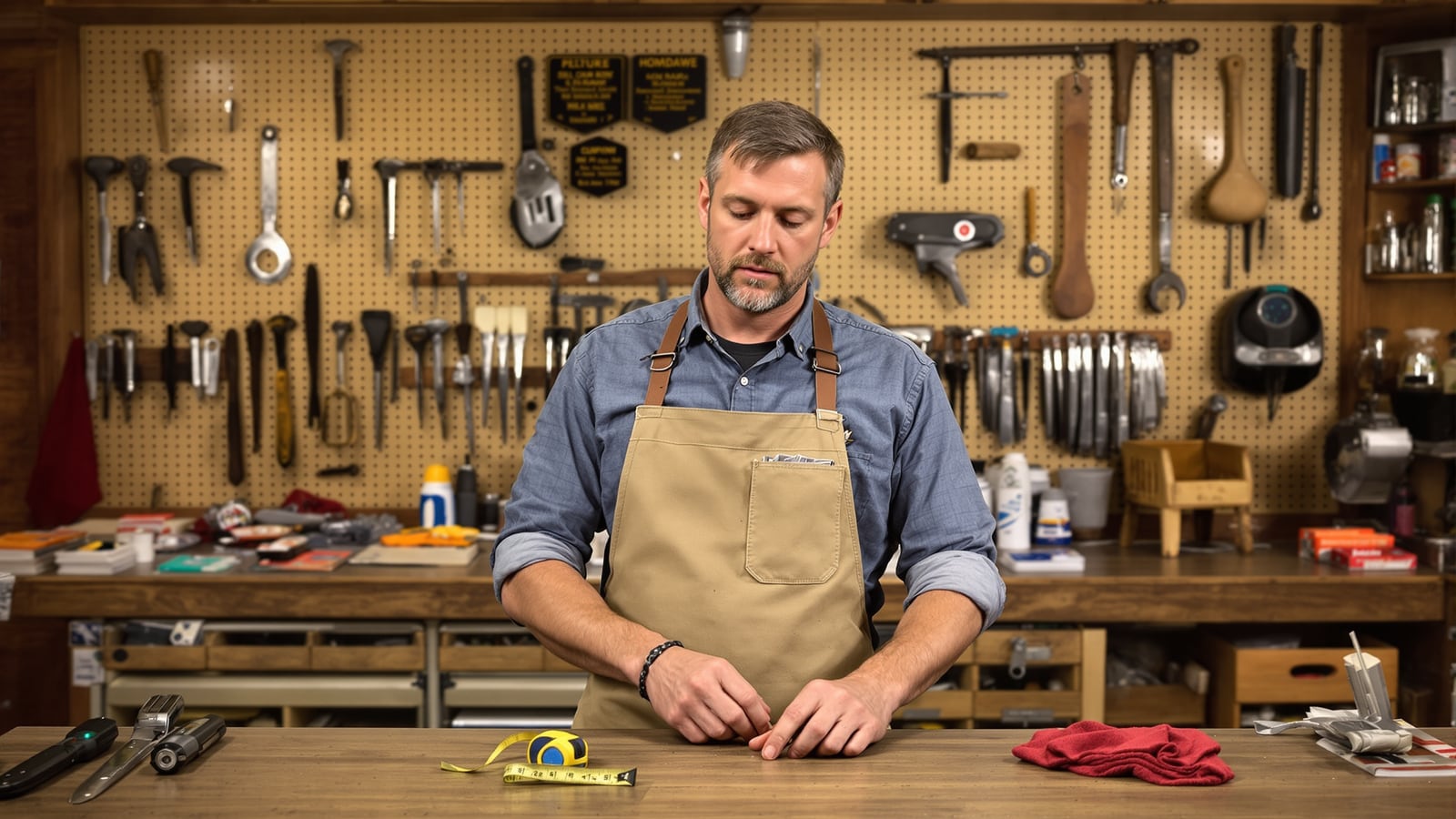
Quick answer: Carry a small, fixed set of tools in the same pockets every time, so your hands find them without your eyes. Keep it to a pencil, a tape, a knife, a rag, a few fasteners and ear protection. Everything else stays on the bench.
My grandfather's apron was heavy canvas the color of a paper bag, with five pockets, and every one had a job. I know because I once put his pencil in the wrong pocket. He found the mistake from across the garage without looking up. "Left chest," he said. "Always left chest." I was nine. I've never put a pencil anywhere else since.
The apron was never about carrying more
People look at an old shop apron and see a man loaded down. He wasn't. He was carrying less than you'd think, and carrying it in exactly the same place every day.
The point was to stop walking. A man who crosses the garage to the bench eleven times for a pencil, a tape and a screw has done a lot of exercise and very little work. Worse, every trip is a chance to get distracted. Grandpa would start a cut, need the square, and the square was always on him.
"A place for everything and everything in its place" sounds like a poster. On him it was a physical fact you could pat down.
The pocket map
His layout was simple. Copy it or change it, but pick one and stick with it.
Left chest: pencil. A flat carpenter's pencil, because it doesn't roll off a board and the lead is wide enough to mark a line you can see from three feet away. Behind it, a folded index card for measurements. He didn't trust his memory and he didn't pretend to. He wrote the number down the second he had it.
Right hip: tape measure. A 25-footer, one inch wide, because that width stands out straight when you reach across a gap. A narrow tape flops. He'd say that a tape you can't read at arm's length is a tape you'll guess with.
Left hip: pocketknife. Not for show. It cut string, opened boxes, scraped glue, sharpened the pencil and peeled the occasional apple at ten o'clock. He kept it sharp enough that he never had to press hard. Dull knives are how people get cut, because they slip.
Right bib pocket: the small stuff. A little canvas pouch with a few common screws and finish nails, a short stub screwdriver with a couple of bits, and a pair of foam ear plugs. He bought the plugs in bulk and kept a spare pair in the truck.
Back, hanging from a loop: the rag. A clean one, torn from an old flannel shirt. More on that in a minute.
That's it. No gadget he'd seen on a late-night commercial. If he used something once a year, it lived on the shelf.
What stayed out
The test he gave me was blunt. "Did you reach for it three times today?" If not, it stayed on the bench.
The hammer is the interesting case. Most days it hung on a hook within an arm's reach of the workbench, not on him. Carrying a hammer all day pulls an apron sideways and your neck pays for it. He only carried one when he was framing or hanging something, and then he switched to a belt for the job.
That's the other thing worth knowing. An apron is a shop tool for bench work and small jobs. A tool belt is for ladders and framing, where you can't walk back to anything. Grandpa owned both and never confused them.
Today's version has one more rule: your phone stays out of the apron. It scratches, it falls out when you bend over, and it's the one item guaranteed to pull your attention away from the cut. Put it on a shelf, face down, and answer it between steps.
The part where he'd tell you to be careful
An apron is safe at a workbench. It is not safe near spinning machinery.
A drill press, a lathe, a grinder or a table saw will grab loose fabric faster than you can react. If you're running any of those, tie the neck strap short, cross the back straps and cinch them, and tuck in anything that dangles. Better yet, take the apron off and put on a snug shirt. Grandpa did exactly that, every time, and he had all ten fingers at eighty-one.
Wear safety glasses too. He did, and he'd have told you the same thing: you only get the one pair of eyes.
The rag deserves its own paragraph
The rag is the pocket nobody copies, and it's the best one.
He wiped his hands before he touched a finished surface. He wiped the blade before he put it away. He wiped the bench before he left. When he borrowed a tool from a neighbor, it went back cleaner than it came, usually with a drop of oil on the hinge. That's the old rule of leaving a thing better than you found it, and the rag was how he followed it. The habit of cleaning as you go is the same one in Waste Nothing, Feed Everyone, Clean As You Go, just in a garage instead of a kitchen.
There's a practical payoff too. A clean rag means you can check your work without smearing it, and you don't leave glue prints on the cabinet door.
Build yours this week
You don't need an heirloom. You need a Saturday.
- Buy a plain canvas or duck apron with at least four pockets. Cross-back straps beat a neck loop. You'll feel the difference by noon.
- Pick your five. Pencil, tape, knife, small fasteners, rag. Add ear protection if you run loud tools.
- Assign each one a pocket and don't move it. For the first two weeks you'll reach for the wrong place. By the third week your hand will know.
- Empty it when you're done for the day. Put the knife and tape back where they live, wash the rag and refill the fastener pouch. The apron should start tomorrow ready.
- Add one item at a time. If you keep reaching for something that isn't there, it earns a pocket. If something hasn't been touched in a month, it doesn't.
The trade-off is real. A system like this feels fussy for about a week. You'll hang it on the same hook, put the pencil in the same spot, and wonder whether you're turning into your grandfather. Yes. That's the idea.
If you're ready to show up to the job as someone who's prepared, The first truck in the lot got the good jobs makes the same argument for the whole workday. And if you're stuck wondering what else the older guys would have told you, What Old Men Wish Somebody Had Told Them at Twenty-Five is a good next stop.
When Grandpa finally hung the apron up for good, the left chest pocket still had a pencil in it. Sharpened. Ready for a job he didn't get to finish, and for whoever came next.
Nina Castellan
BRO for Her
Runs the women-facing desk. Same standard, same tools, written for a different reader — not a softer one.

Watch
Worth an hour of your evening
More from Old School.
From channels we rate. Plays on YouTube.
Read next