

Get licensed and insured before the first job, not the first claim
The paperwork feels like red tape until a small job goes wrong. Here's what to set up first, in what order, and why your personal policies won't cover you.
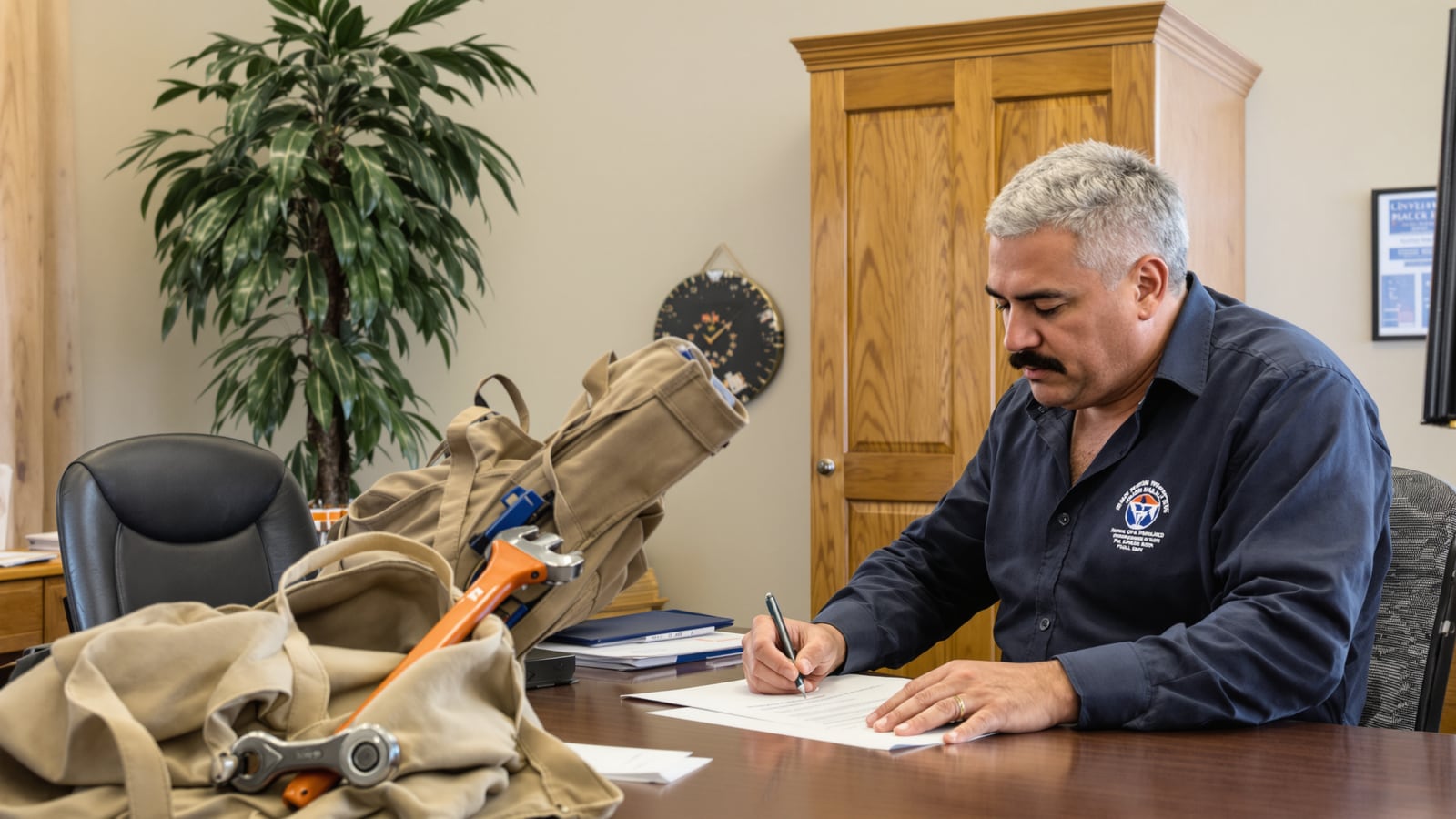
Quick answer: Get the license your state and county require, then a general liability policy, then a certificate of insurance you can email in five minutes. Do it before you take the first dollar. This is general education, not legal advice, so confirm the details with your state licensing board and a licensed insurance agent.
The small job is the dangerous one
Picture a hypothetical. You swap a water heater on a Saturday for your neighbor's brother-in-law. Four hundred dollars, cash, done by noon. Two weeks later a fitting weeps behind a finished basement wall. By the time anyone notices, the drywall, carpet and a home theater are soaked. Say the repair bill is $38,000. That's an invented number, but nobody who's seen a flooded basement will call it unrealistic.
Whose problem is that?
Yours. Not the brother-in-law's, and not your cousin's who said you'd be fine. You were the guy with the wrench. At $400 for the job, you'd need to work for roughly ninety-five more Saturdays just to cover it, and that's before taxes and materials.
Experienced hands don't lose sleep over the big jobs, because those come with contracts, permits and inspections. The small, casual, favor-for-cash job is where men get hurt. Nobody wrote anything down, and nobody's carrier is involved.
Your own policies probably won't cover it
Most men assume their homeowner's and auto insurance will stand behind them. Usually they won't.
Personal auto policies commonly exclude or limit business use. A truck loaded with ladders and tools, headed to a customer's house, is business use. Homeowner's policies typically exclude business activities as well. Read your own policy, and then ask your agent the blunt question: "If I work for pay and something goes wrong, what's covered?" Better to hear the answer on a quiet Tuesday than in a claim denial letter.
It's a fair rule. Your family's coverage was priced for a family, not for a working shop. You wouldn't want a neighbor's business losses driving up your premiums either.
What you're actually buying
Insurance talk gets foggy quickly. These are the pieces that matter for a one-man outfit.
- General liability. Pays when your work injures someone else or damages their property. This is the water heater policy. It doesn't cover your own tools or your own injuries.
- Commercial auto. For the truck that's really a rolling shop. Ask whether your personal policy can be endorsed instead. Some carriers allow it for light use, and some don't.
- Tools and equipment coverage. Often sold as inland marine. A stolen trailer of tools is a week of lost income plus a few thousand dollars to replace what's in it. Check whether your tools are covered at the job site, in the truck and overnight.
- Workers' compensation. Rules vary a lot by state. Many states exempt a sole owner, but most require it once you have employees, and some require it even for certain helpers you'd call subcontractors. Our piece on why your first helper is probably an employee, not a 1099 guy covers where that line tends to fall.
Get quotes from at least two agents, and tell each one exactly what you do. Premiums swing widely by trade, state and claims history, so any number I gave you would be a guess. Here's a labeled example to work the math: if a policy ran $1,200 a year and you bill $75 an hour, that's sixteen billable hours. Two working days. Put it in your overhead, which is the whole argument in why $45 an hour is a pay cut when it's your own truck.
The license side, in order
"Business license" isn't one thing. Depending on where you live and what you do, you may need several layers.
- Trade or contractor license. Issued by the state, and sometimes the county or city. Many trades require one, often with a dollar threshold on what you can do without it. Call your state licensing board. Don't guess, and don't ask a buddy who works in a different state.
- Local business license or registration. Usually the city or county clerk. Often cheap, and often the thing people forget.
- Entity registration. If you form an LLC, you file with your state, typically through the Secretary of State.
- EIN. The IRS issues it free. Be wary of any site that charges you for one.
- Sales tax permit. Needed in many states if you sell materials or taxable services. Your state revenue department tells you.
In some states, an unlicensed contractor can't enforce a payment in court. A customer can keep your work and your invoice both. In others, there are fines and stop-work orders. The rules differ, which is exactly why you call before you quote.
The paper is also how you get hired
Here's a part that surprises new guys. Insurance isn't only protection. It's access.
General contractors, property managers, commercial clients and a lot of careful homeowners ask for a certificate of insurance before they let you on site. Your agent can usually send one the same day. Have it ready and you look like a man who's done this before. Say "I'll have to get back to you" and the job goes to the guy who didn't.
The same goes for a license number printed on your estimate and your truck. A homeowner deciding between two quotes will pay more for the one that doesn't feel like a gamble. That's one way to hold your price when somebody offers to do it cheaper.
What the paper doesn't do
Be honest about the limits.
An LLC isn't a force field. It can separate your business debts from your house, but it generally won't shield you from your own negligence, and it won't help if you mix business and personal money. Keep a separate account. The habit in one business account and a Friday habit beat any software is the cheapest protection you'll ever buy.
Insurance also won't fix sloppy work. Carriers pay claims, but they can raise your rates or drop you after a few. The policy backs up your craftsmanship. It doesn't replace it.
And the first-year costs sting. Fees, premiums and a trade license exam add up before you've invoiced anybody. It's real money. It's also the price of being a business instead of a man with a truck and a lot of hope.
Do it in this order
Call your state licensing board and the county clerk this week. Get your EIN. Open a business account. Get two insurance quotes with an agent who writes policies for your trade. Buy the policy, then ask for a certificate with your name already on it. Only then quote the first job.
Leave every customer's house cleaner than you found it. Then make sure that if you ever can't make it right yourself, there's a policy that will. That's what standing behind your work means.
Ray Okonkwo
Money & Business
Former commercial banker turned small-business owner. Covers salary, credit, margins and the arithmetic nobody does before signing.

Watch
Worth an hour of your evening
More from Self-Employed Men.
From channels we rate. Plays on YouTube.
Read next