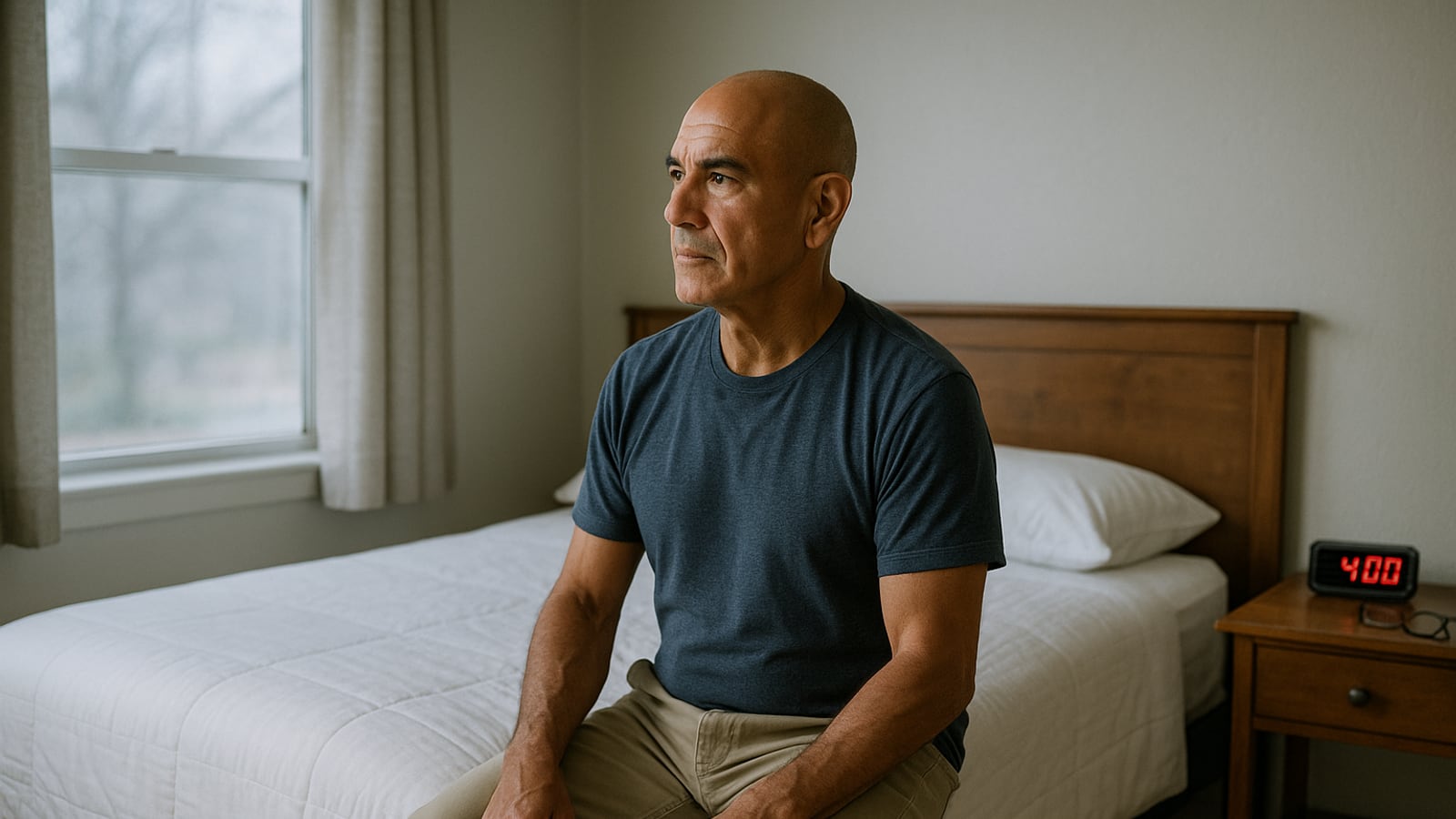
Fix your wake time first. Same time every morning, weekends included, whether the night went well or badly. Everything else in this piece works better once that's nailed down, and several things won't work at all until it's.
That's the unglamorous center of it. Most people over sixty who sleep badly are doing the opposite — going to bed earlier to "catch up", lying in on a bad morning, napping at four in the afternoon because they're wrecked. Each of those feels like a repair. Each one loosens the clock a little more.
What actually changes
Three real shifts happen with age, and none of them mean something has gone wrong with you.
Your body clock moves earlier. You get sleepy sooner in the evening and you wake sooner in the morning. A man who was a natural eleven-to-seven at forty can be a nine-thirty-to-five at seventy without anything being broken.
Deep sleep thins out. The heavy, dreamless stage that dominates the first part of the night in your twenties gives ground to lighter sleep. Lighter sleep is easier to interrupt — by a bladder, a sore hip, a car door, a spouse turning over.
And you wake more often. Brief awakenings are normal at every age. What changes is that you now notice them, and once you're awake enough to check the clock, you're awake enough to start doing arithmetic about how little sleep you're getting. That arithmetic is the problem, not the awakening.
You're probably in bed too long
This is the single most common mistake I see, and the fix feels backwards.
If you're in bed nine hours and sleeping six and a half, you've built yourself five hours a week of lying in the dark being frustrated. Your brain learns the association. Bed starts to mean worry.
Shrink the window. Pick your wake time, count back roughly the amount you're actually sleeping plus about half an hour, and make that your bedtime. If you sleep six and a half hours and get up at six, don't get into bed before eleven.
You'll be tired for the first week. That's the mechanism working, not a sign it's failing. Sleep pressure builds, the sleep you do get gets deeper and more continuous, and once you're falling asleep quickly and staying asleep, you can start pushing bedtime earlier in fifteen-minute steps.
Don't do this without talking to your doctor if you have a seizure disorder, bipolar disorder, or a job or hobby that involves driving long distances or operating machinery. Short-term sleepiness is a real risk during the adjustment.
Light does the heavy lifting
Your clock takes its main instruction from light hitting your eyes, and the timing matters more than the brightness.
Get outside within an hour of waking. Twenty minutes is plenty. Overcast still counts — outdoor light on a gray day is far stronger than anything in your kitchen. A walk, the paper on the porch, coffee in the garden. Anything that puts you under open sky.
If you're waking far too early — three, four in the morning, wide awake, done for the night — bright light in the early evening can help pull the clock later. Sit somewhere well lit after dinner rather than dimming everything down at seven. It won't fix it in a night. Give it a couple of weeks.
The twenty-minute rule
When you wake in the night and it's clear you're not drifting back off, get out of bed.
Not in a dramatic way. Move to a chair, put on a lamp, read something undemanding on paper. When you feel heavy-eyed, go back. If you're awake again twenty minutes later, get up again.
This feels like a waste of a night. It isn't. It's how you keep bed meaning sleep instead of meaning vigilance. Three or four rough nights of doing it properly beats three years of lying there waiting.
Don't take your phone. Don't check the time. Turn the clock to face the wall.
Naps, coffee and the evening drink
A nap of twenty or thirty minutes, taken before mid-afternoon, is fine and often genuinely useful. An hour and a half on the sofa at five o'clock will cost you that night's sleep and you'll pay it back with interest.
Caffeine hangs around roughly five or six hours before even half of it has cleared, and that clearance tends to slow with age. A three o'clock cup is still working on you at nine. If you're a four-cup man who sleeps like a stone, carry on. If you're not sleeping, move the last cup to lunchtime for a fortnight and see.
Alcohol is the one nobody wants to hear about. A drink in the evening will get you to sleep faster and then break up the back half of the night as it metabolises. Lighter sleep, more awakenings, more trips to the bathroom. That's not a moral argument, it's just the trade. If you're going to have it, earlier and less does less damage than later and more.
Bathroom trips, snoring, and the things worth a doctor's visit
Getting up once a night is common. Getting up three or four times is worth a conversation, because it's often treatable and it's very often not primarily a bladder problem.
Front-load your fluids. Drink normally through the day and taper in the last two or three hours. If you're on a water tablet, ask your doctor or pharmacist about the timing — never change a prescription yourself. Swollen ankles during the day can redistribute overnight and turn into nocturnal bathroom trips; putting your feet up in the late afternoon sometimes helps.
Snoring deserves separate attention. Loud snoring, gasping, someone telling you that you stop breathing, morning headaches, falling asleep in the armchair every afternoon — that pattern points at sleep apnea, which gets more common with age and which is worth diagnosing. It's linked to blood pressure and heart trouble, and treatment works. Ask for a sleep study.
Crawling, restless feelings in the legs in the evening, relieved by moving them, are worth mentioning too. Iron levels and certain medications both play into that one.
Be careful with the sleep aisle
The over-the-counter products labelled "PM" or "night-time" mostly rely on an old antihistamine. Older adults often tolerate it poorly — next-day grogginess, dry mouth, confusion, constipation, urinary retention, and more falls. Ask a pharmacist before you buy any of it, and bring your full medication list, because the interactions matter more than the product does.
Prescription sleeping pills have their place, generally short-term and under supervision. The treatment that has the best track record for chronic insomnia in older adults isn't a pill at all — it's cognitive behavioural therapy for insomnia, which is essentially a structured version of what's in this piece delivered over a handful of sessions. Ask your doctor about it by name. Many people have never been told it exists.
Give the night something to do
Move during the day, preferably outdoors and preferably not in the two hours before bed. Keep the bedroom cool and properly dark. Fix the pain that's waking you rather than working around it — a hip that hurts at 3am is a hip problem, not a sleep problem.
And make peace with the early hour. A lot of men over sixty are simply awake at five now, and no amount of discipline is going to argue the clock back. The hours before the house stirs are quiet, uninterrupted and entirely yours. Coffee, a Bible, a notebook, the door open to the cold.
Plenty of people spend decades trying to buy that hour back. You've been handed it.
Marcus Vale
Editor-in-Chief
Twenty years in magazines, most of it deciding what to cut. Writes about work, discipline and the decisions that compound.

Watch
Worth an hour of your evening
More from BRO Seniors.
From channels we rate. Plays on YouTube.
Read next