

Sell the crack fill, not the shiny black coat
Driveway sealing pays only if you do the prep nobody sees. Here's the real math on hours, gear, taxes, insurance and when to walk away.
Quick answer: Driveway sealing is a seasonal, weather-bound, hard-on-the-back job. It can pay decent money per hour if you sell crack repair and prep along with the coat. Startup is a few hundred dollars in tools, plus insurance. Skip it if you can't give up good-weather Saturdays or your knees and back won't take it.
The driveway nobody should seal
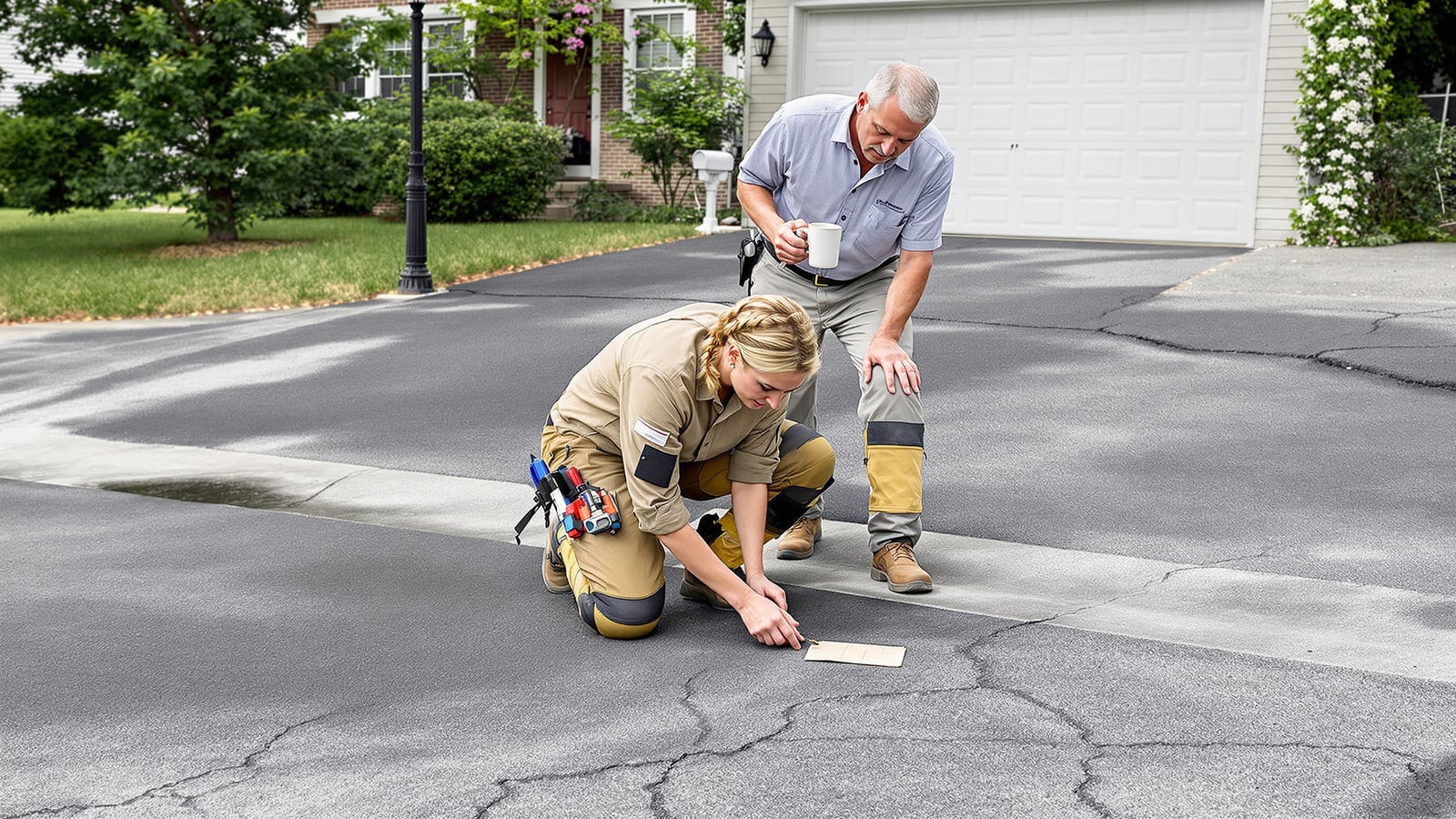
You pull up to a quote. The asphalt is gray and faded, and it looks like the job you came for. Then you walk it. Water is pooling near the garage. There's a web of cracks shaped like alligator skin. One section flexes a little under your boot.
Don't seal that driveway.
Sealer is a coating. It slows oxidation and keeps water from soaking in, but it doesn't rebuild a failed base. Put a black coat over alligator cracking and you've sold the homeowner a nice-looking problem that comes back in a year, with your name on it. Tell them so, and point them to a paving contractor. You'll lose that job and keep the referral.
That's the angle for this whole business. The money isn't in the shiny part. It's in knowing which driveways are worth saving and fixing them properly before winter does its work. Water gets into a crack, freezes, expands, and widens it. Every freeze makes the next repair cost more. Summer is the window to stop it.
What the work actually is
A proper job runs in this order:
- Clear the surface. Blow off debris, pull weeds out of the cracks, scrub oil spots with a degreaser made for the purpose.
- Rinse and let it dry fully. Sealing over damp asphalt is how you get peeling.
- Fill the cracks with a crack filler rated for the width you're dealing with.
- Treat oil stains with a primer so the sealer will stick.
- Apply the sealer in thin, even coats with a squeegee or brush, working back toward the street so you never trap yourself.
- Cone and tape off the driveway, and leave it alone for the cure time on the label.
Read the sealer label for every number that matters: coverage per bucket, minimum air and surface temperature, how long before foot traffic, how long before cars. Those vary by product and they're your schedule. Newer asphalt also needs to age before it's sealed, so ask the homeowner who laid it and when.
A typical two-car driveway is something like 20 by 30 feet, or about 600 square feet. Measure every one. Don't guess from the curb.
What you'll spend to start
Plan on these. Price them at a local supply store, not online guesses:
- Squeegee applicator and a stiff brush for edges
- Cold-pour crack filler to start. Hot-pour needs a melter, and that's a big purchase for later, if ever.
- A backpack or handheld blower
- Wire brush, scraper and a weed killer
- Cones, tape and a few signs
- Gloves, eye protection, a respirator rated for the fumes and boots you'll ruin
- Drop cloths and a tarp for the truck bed
Sealer itself isn't startup cost. You buy it per job, and you charge for it. Collect a deposit that covers materials so you're never fronting a customer's driveway out of your own pocket.
The tools are the small number. Insurance is the one people skip, and it's the one that can end you.
The math, with placeholder numbers
Run this with your own quotes. These figures are made up to show the shape, not what your market pays.
Say you quote one driveway at $400. Materials come to $120. Gas and supplies take another $30. You spend five hours, counting the drive, the prep, two coats and the cleanup. That leaves $250 for five hours, or $50 an hour, before taxes, insurance and tool replacement.
Now fix the weak spots in that picture. The five hours assumed dry weather. Rain pushes the job a week and eats a Saturday. If you can only finish one driveway most weekends, that's roughly four or five jobs a month in season. Multiply your own profit per job by that, and then subtract the months you can't work.
Get three real quotes from established local sealers before you set a price. Then check your supply-store cost on sealer, and don't price against the guy with the $99 special. He's either skipping prep or won't be around next year.
Taxes and insurance
Self-employment income is taxed, and you owe self-employment tax on top of income tax. Set money aside from the first dollar. What to Set Aside for Taxes on Side Income From Dollar One walks through how. A CPA can tell you the actual percentage for your situation.
Insurance is the part that surprises people. Your homeowner's and auto policies generally aren't written to cover paid work for customers. Call your agent and ask directly. You'll likely need general liability, and you may need coverage for the vehicle you haul gear in. The risks are specific. Sealer tracked onto a new carpet, overspray on a garage door, a car that rolled over the surface too early, a slip on a wet apron. One bad claim costs more than a year of premiums. Ask a licensed agent what fits. Check your state and city too, because some places require a contractor license or registration even for small jobs.
Where it goes wrong
The honest failures are boring.
Weather. Most mistakes happen when you're rushing to beat a rain front. Don't. Reschedule.
Cure time. A homeowner pulls the car out early and leaves tire marks. Write the cure time on the quote and on a card you leave on the door. Put cones at both ends.
Tracking. Sealer comes off your boots into their house. Keep a pair of dedicated boots, and stay off their porch.
The surprise. You open the bucket and the label wants dry weather for twenty-four hours and the forecast shows a shower. Believe the label.
Your body. You're bent over a squeegee for hours, then lifting five-gallon buckets. If you've got a bad back, this is a bad side hustle.
When it isn't worth it
Skip it if you live where sealing season is a handful of weeks and you can't flex your schedule. Skip it if your market is flooded with cheap operators and you won't compete on quality. Skip it if you're unwilling to turn down a driveway that's past saving. And skip it if you can't buy the insurance, because without it you're one mistake from losing what you've built.
If you already own a pressure washer, there's an easy bridge. Weekend Pressure Washing and What It Actually Pays covers that side of the work, and washing is the first step of every sealing job anyway. If this starts working and you're booking weeks out, read When a Side Hustle Should Become a Business and When It Shouldn't before you quit anything.
This is general education, not financial, tax or legal advice. A CPA and an insurance agent in your state can run your actual numbers.
Leave it better than you found it
Do the small things that earn the next job. Sweep the stray gravel off the apron. Hose any splatter off the curb and the sidewalk. Pull your cones when the cure time is up, not when it's convenient. Take your empty buckets with you.
The neighbors watch you work. The driveway next door is your next quote.
Ray Okonkwo
Money & Business
Former commercial banker turned small-business owner. Covers salary, credit, margins and the arithmetic nobody does before signing.

Watch
Worth an hour of your evening
More from Side Hustles.
From channels we rate. Plays on YouTube.
Read next