

Pick the trigger for leaving before the fire picks it for you
Wind decides where a wildfire goes. You decide when you're gone, and that call is best made weeks ahead, at the kitchen table.
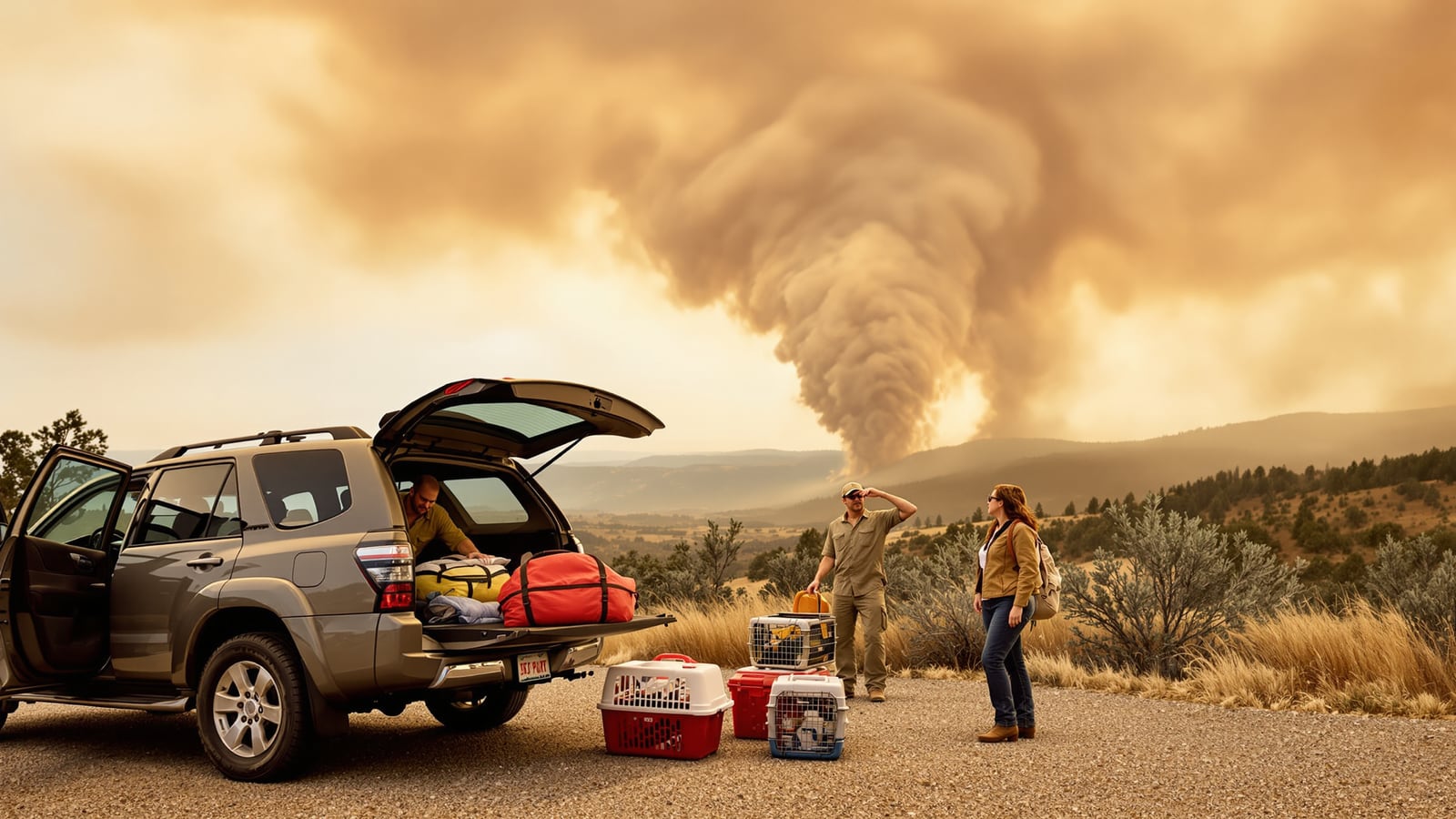
Quick answer: Know three ways out of your area before you need any of them. Write down the trigger that means you leave, and agree on it with your family. When the trigger hits, go. Waiting for certainty is how people end up on a jammed road in smoke.
The road you'd pick is the road your neighbors will pick, at the same hour, with smoke thick enough to cut a daytime drive down to headlight range. That's the picture to plan against. Fire alone isn't what turns an evacuation into an emergency. A late start does it, because it turns a drive into a queue.
Read the wind first
Fire goes where the wind pushes it. Picture a cone that starts at the flames and widens downwind. You don't want to be anywhere inside it, and you don't want your only road to run through it.
Three things are worth knowing cold:
- Wind shifts. A cold front can swing it ninety degrees in an afternoon. The safe side of the fire at noon can be the front line at four.
- Fire climbs. It runs uphill much faster than it moves across flat ground. A steep draw or canyon works like a chimney, so a house at the top of one has less time than the map suggests.
- Embers travel. Burning debris can land well ahead of the main fire, sometimes a mile or more. The fire doesn't have to reach your fence to start something in your yard.
You don't need instruments. Watch the smoke column. If it leans toward you, you're downwind. Tie a strip of bright flagging tape, about two dollars a roll, to a fence post or the porch rail, and you'll see wind direction at a glance. On any day the National Weather Service issues a Red Flag Warning for your area, treat it as a day to have the car ready and the plan fresh in your head.
Know three exits, not one
Pull up a map of your area and find two roads out that head in different directions. Then find a third way that isn't a regular road. That could be a graded fire road you have the key for, a wide paved lot in town, or a big body of water. Gated roads only count if you hold the key.
Then drive each one in daylight. Note the one-lane bridge, the stretch that dead-ends in a subdivision, the curve where a single stalled car blocks everybody. Pick your primary by asking which route leads away from the fuel, toward towns, pavement and open ground, and which runs crosswind or upwind of the likely fire. Don't pick the one that follows the same drainage the fire would climb.
Keep a paper road atlas in the car, about $20 to $30. Cell service gets overloaded or knocked out in a big evacuation, and a navigation app will happily send you down the road that's already on fire. The atlas doesn't care.
Drive your primary route once after dark. You'll learn more in twenty minutes than a map shows you.
Set the trigger, and write it down
This is the part nobody does. The mistake is deciding in the moment, because in the moment there's always one more reason to wait. So make the decision ahead of time and put it on paper:
- An evacuation warning is issued for your zone.
- A fire is reported in the same drainage or upwind of you on a Red Flag day.
- You see a smoke column leaning your way, or embers in the air.
- The power goes out during an active fire nearby.
Any one of those means you leave. You don't need two. Learn what your county calls its alert levels, because the terms for "get ready" and "go now" differ from place to place. Sign up for your county's free emergency alerts, and don't count on a knock at the door. Alerts miss people, and the knock may never come.
Say it out loud to your wife or husband, and to the kids if they're old enough. Who grabs the children, who grabs the dog, who grabs the bag. Same principle as a household plan for a 2 a.m. break-in: everybody knows their job before the stress hits.
The cost of leaving early is a tank of gas and maybe a night in a motel. If the fire turns and spares your neighborhood, you lost a little sleep and some money. That's a bargain.
A man who plans to stay behind with a garden hose is making a bad trade. Untrained residents who stay can get in the way of the crews trying to save the neighborhood. If a neighbor leans over the fence and wants to debate it, you don't have to win the argument. Say "We're leaving, I'll check on you later," and go. Taking the elderly couple next door with you is a better use of your truck than defending the lawn.
The bag by the door
Keep it packed and keep it where you'll trip over it. Rough costs:
- Respirator. A P100 half-mask runs $25 to $40. Boxes of N95s are cheaper, a dollar or two each. Cloth masks and bandanas do almost nothing against smoke.
- Sealed goggles, $10 to $20. Smoke and ash in the eyes ends your driving.
- Leather gloves, $15 to $25.
- Clothes: long sleeves and pants in cotton or wool. Synthetics melt onto skin.
- Hand-crank or battery weather radio, $30 to $60.
- A wool blanket, $30 to $60. Wool resists flame far better than synthetics.
- Headlamp, $20 to $30, spare batteries.
- Water: a case, about $6, in the trunk.
- Documents, medications, spare glasses and phone chargers, including one for the car.
Your car matters as much as the bag. Keep the tank at least half full, always. Park nose-out in the driveway on any red-flag night, keys where everyone knows, windows up.
If you own firearms
Make the plan part of your responsibility as an owner, not an afterthought. Neither kids nor pets go on the list after a rifle, but if you keep firearms, decide ahead of time what happens to them.
If you have time to take them, they go in a locked case or small portable safe, with ammunition stored separately and also locked. They stay locked and out of children's reach wherever you land, whether that's a hotel or a relative's spare room. Handle them with the four rules every time: treat every firearm as loaded, keep the muzzle pointed in a safe direction, keep your finger off the trigger until you've decided to shoot, and know your target and what's beyond it. Rushing is when people break them.
If you can't take them, a fire-rated safe, starting at a few hundred dollars and rated for a stated time at a stated temperature, beats a closet shelf. Read the rating. Many cheap safes are rated against theft, not fire.
Transport laws change at every state and provincial line, and sometimes at the city limit. What's legal in your driveway may not be across the county line you cross while fleeing. Read what your carry permit actually does at the state line, then check current local law with a qualified attorney or instructor. Nothing here is legal advice. If you've never had formal training, a hands-on class is the right next step. Your first firearms class isn't a test you can fail.
When you're trapped anyway
This is a last resort, not a plan. If fire cuts off the road and you can't turn around, park in the clearest ground you can find, away from brush and trees. Keep the engine running, close the windows and vents, and lie on the floor below window level under the wool blanket. Stay put until the fire front has passed. Don't run through flame on foot.
If you end up stranded on foot, the rules change. Read what to do in the first hour you're lost in the woods.
Get hands-on
Your local fire department or fire district likely runs a free wildfire preparedness program, and many will do a defensible-space walkthrough on your property. Take it. A trained eye will spot the dead juniper by the porch and the firewood stacked against the house in about two minutes. A first aid and CPR course from a certified instructor is a good companion, because smoke inhalation and burns are the injuries you're most likely to see.
Tonight, write the trigger on an index card and tape it inside the pantry door. Next time you're staring at an orange sky, you won't have to decide anything. You'll just read the card and go.
Wes Dunbar
Country & Skills
Grew up on an acreage and never quite left. Covers trucks, trades, land, and how to do the thing yourself.

Watch
Worth an hour of your evening
More from Survival & Self-Defense.
From channels we rate. Plays on YouTube.
Read next