
Quick answer: If you know exactly where you are and you're on a trail you can follow, a headlamp and a slow, steady pace will get you out. If you don't know where you are, stop, get warm, and wait for daylight. Make that call while there's still light to make it by.
Say it's late November. Sunset is 4:55 and it's already 4:15. You've got two miles of ridge between you and the truck, a good headlamp in your pack, and a strong feeling you'll be fine.
You probably will be. The trouble starts when "probably" turns into the only plan you've got.
Make the call at the last good light
Dusk is when you decide, not when it's full dark and you're tired, cold and a little embarrassed. Daylight fades faster than people expect, and in the woods it goes earlier than the sunset time on your phone.
Before any hike, look up sunset and write down a turnaround time. Work backward: how long will it take to get out, and then add an hour of cushion. A rule of thumb many hikers use is about two miles an hour on easy ground. Plan on roughly half that speed after dark, because you're picking each step instead of striding.
When you hit your turnaround time, you turn around. No negotiating with the summit, the view, or the buddy who wants to see just one more ridge.
The move-or-stop test
Ask three questions. You need a yes on all three to keep walking.
- Do I know where I am? Not "about here." You can put a finger on the map within a couple hundred yards.
- Is the way out something I can follow? A trail, a road, a fence line. One you've already walked or can see clearly.
- Am I in shape to do it? Warm, uninjured, with working light and spare power.
One no, and you stop. A stream crossing between you and the truck is a no. So is a ridge with drop-offs, or a trail you lost twenty minutes ago and have been "pretty sure" about since.
Concede the other side: sometimes moving is right. A partner who's injured and getting cold, rising water, smoke from a fire. Or you're half a mile from the trailhead on a wide, obvious path. Then you walk, carefully. And if you have a signal, call 911 first and do what the dispatcher says. Don't assume you're out of options until you've told someone.
Notice that the test is about your position, not your confidence. Confidence is the thing that gets people into trouble at night.
The gear that matters after dark
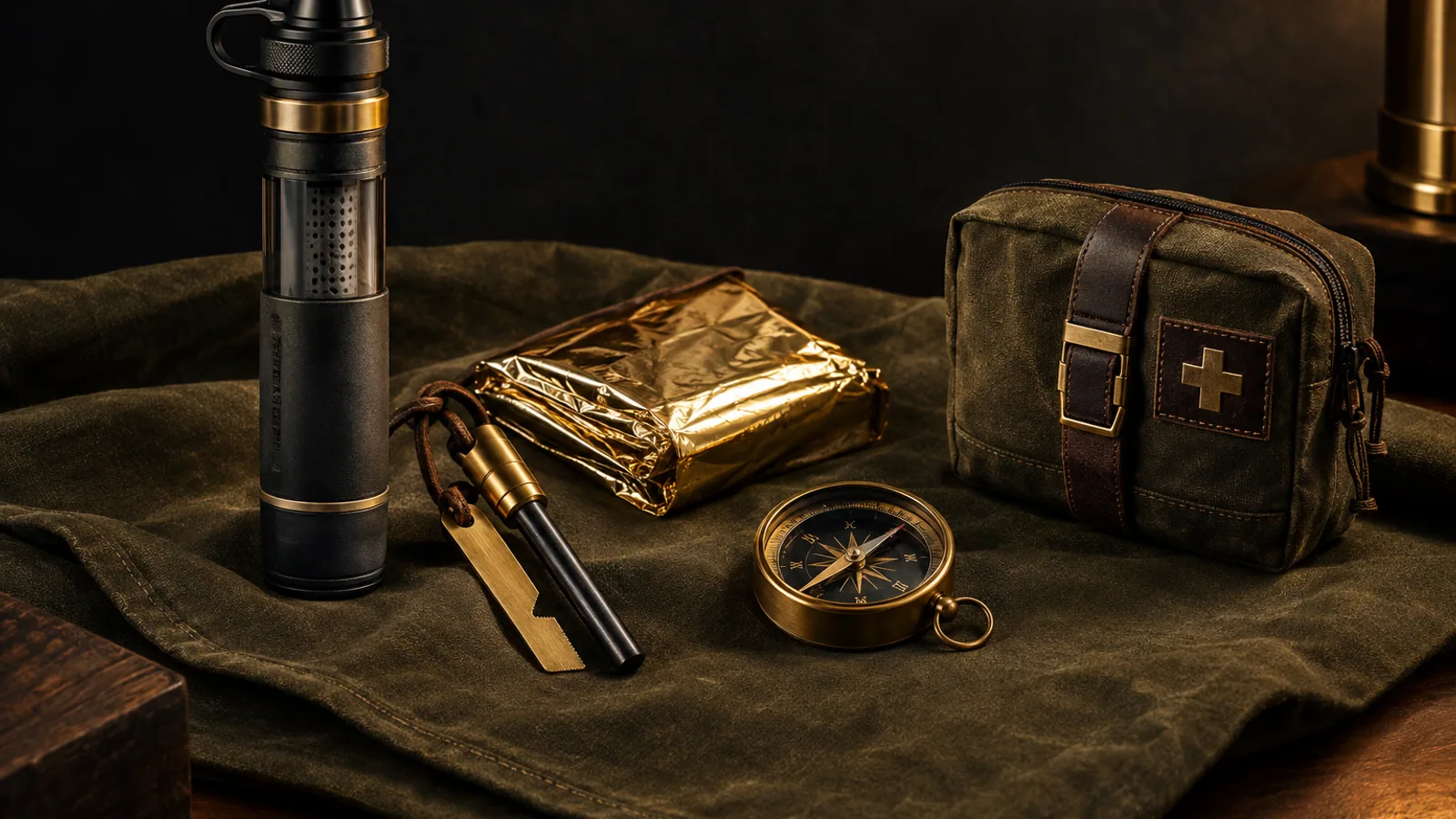
None of this is exotic. Rough costs:
- A headlamp with a red mode: $25 to $60. Carry spare batteries, or a second small light for $10 to $15. One light is a plan with a single point of failure.
- A baseplate compass: $15 to $30. Silva and Suunto both make solid ones. Learn it in daylight, because you won't learn it by headlamp when you're stressed.
- A phone with offline maps downloaded. Free to cheap. Keep it inside your jacket, since cold drains batteries fast, and put it in airplane mode while you walk.
- A whistle: about $5. Three blasts is the universal distress signal, and it carries farther than your voice.
- An emergency bivy or space blanket: $5 to $40 depending on how serious you want to get. It weighs next to nothing.
- A lighter, and an insulating layer you didn't wear on the way up.
Keep all of it in the pack every time, not just on the long trips. The short hikes are the ones that run late.
How to move if you're moving
Your eyes need twenty to thirty minutes to fully adapt to the dark, and one blast of white light resets the clock. Use the red setting for reading the map and low white for your footing. Let your eyes do the work between checks.
Shorten your stride. Test each step before you commit weight to it, because depth perception goes flat at night and shadows lie about how deep a hole is. A trekking pole ($25 to $80) is a third leg and a probe, and it earns its place on a night walk.
Check your position every ten to fifteen minutes against something you can name: a trail junction, a stream, a saddle in the ridge. If you can't name it, you've drifted from the plan.
And here's the line worth keeping: shortcuts are daylight ideas. The straight line down the hillside looks fine on the map. In the dark it's a cliff band you couldn't see.
If you lose the trail and can't find it again within a minute or two, stop. Go back to the last place you were sure of, or stay put.
Hunters, one more thing. If you're walking out after legal shooting hours with a rifle or shotgun, unload it before you start. Keep the muzzle pointed in a safe direction and your finger off the trigger, every step, tired or not. Those are the same four rules you follow at the range, and fatigue plus darkness is exactly when they get dropped. Check your state's hunting-hour rules while you're at it, since they vary.
Making the stop count
Stopping isn't giving up. It's the move that rescuers are counting on. A searcher can find a stationary person with a whistle and a light far more easily than someone who's been stumbling across the map. If you're lost, the first hour matters most, and the first hour is when you decide to stay.
Pick your spot while you can still see it.
- Get off the low ground. Cold air pools in hollows. Stay out of the bottom of a draw.
- Look up. Dead branches overhead are a bad bet in wind.
- Insulate from the ground first. It takes your heat faster than the air does. Leaves, boughs, your pack under your feet.
- Put on every dry layer you have. Eat something. Drink something.
- Fire only if it's allowed and safe. Check restrictions. A small one, with a cleared ring, and never unattended.
A dry, dressed adult can get through a cold night. It's miserable, not the end. Wet and cold with wind is a different problem, which is one more reason the dry layer and the bivy live in the pack.
Blow the whistle in sets of three at intervals. Turn your phone to low power. Then wait. Morning arrives on schedule, and the light will show you the way out.
The best navigation tool is a note
Before you leave, tell someone the trailhead, the route, your turnaround time and when to call for help if you're not back. Put it in a text. That single message is worth more than any piece of gear on this list.
Then take a hands-on land navigation class from a qualified instructor. Local search and rescue groups, outdoor clubs and community college programs often run them. Practice at night in a park you know, with your headlamp and a map, where being wrong costs you nothing.
Land and fire rules vary by agency, state and province, and nothing here replaces an instructor or your local land manager's word.
The sun sets on its own schedule, and it won't wait for you. Decide before it does. Morning is free.
Wes Dunbar
Country & Skills
Grew up on an acreage and never quite left. Covers trucks, trades, land, and how to do the thing yourself.

Watch
Worth an hour of your evening
More from Survival & Self-Defense.
From channels we rate. Plays on YouTube.
Read next