

Four screwdrivers and ten bits cover nearly every job
Most of your screwdrivers and bits are dead weight. Here's how to sort what you grab from what you hoard, and where each one should live.
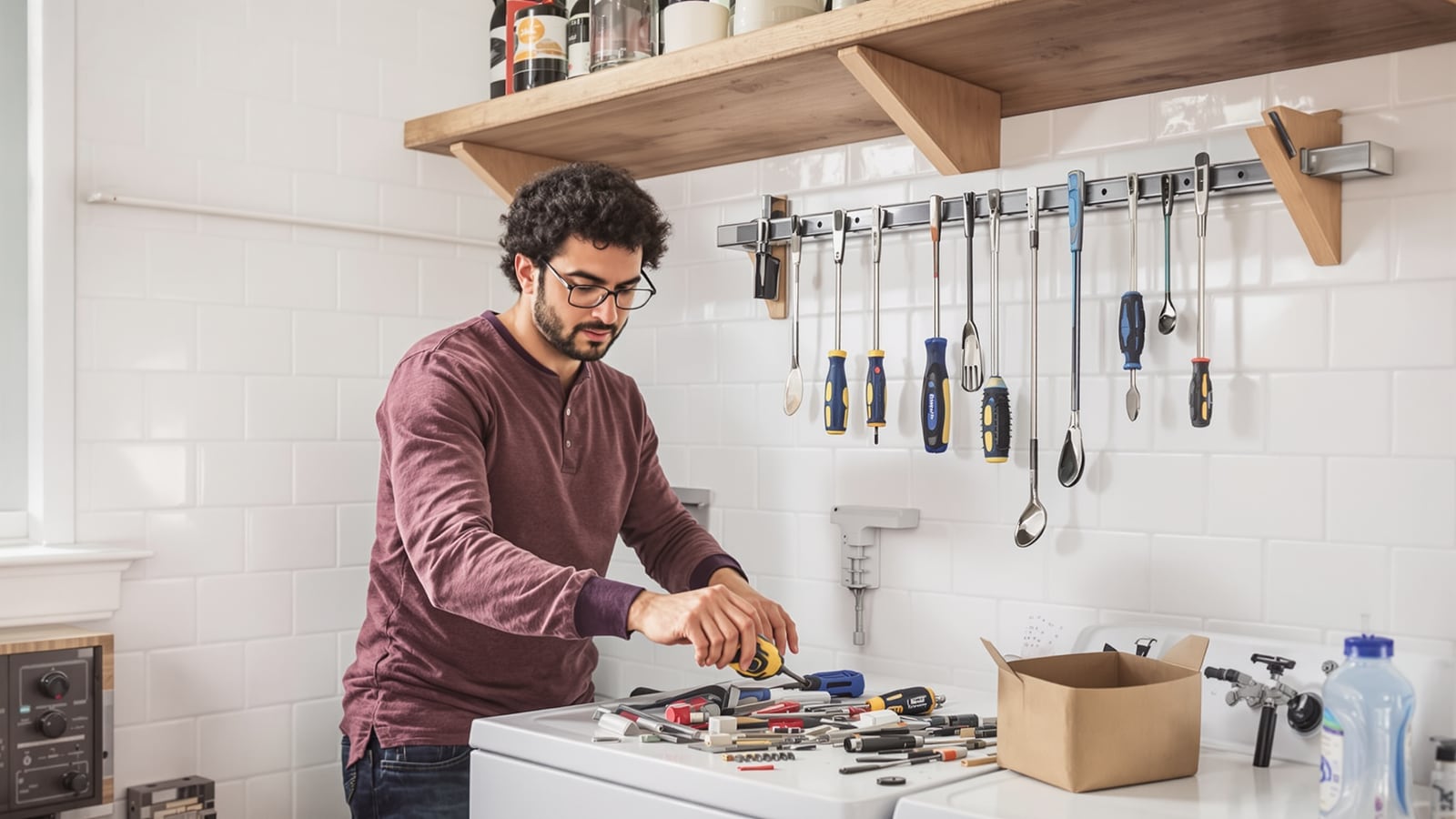
Quick answer: Keep four screwdrivers on a wall rack where you can see them, and ten bits in a holder that clips to your impact driver or belt. Everything else goes in one labeled box. Budget about $60 to $120 total, depending on how much you upgrade.
Open your junk drawer and count the screwdrivers. Eleven, maybe fourteen. Now think about the last five you actually used. It was probably the same two, over and over, while the rest sat there like extras in a movie.
Bits are worse. They live loose in a coffee can, a cup holder, the bottom of a tool bag, and one rolled under the water heater in 2019 and is still there.
The fix isn't more storage. It's deciding what you grab, and making that stuff impossible to lose.
The grab list
Four screwdrivers do the bulk of household work:
- Phillips #2. Cabinet hinges, outlet covers, deck screws, most things with a cross in the head.
- Phillips #1. Smaller hardware, electronics covers, a lot of light fixtures.
- Slotted, about 1/4 inch. Prying paint lids, outlet plates, old fixtures, and the odd screw that's actually meant for it.
- Square (Robertson) #2 or Torx T25. Pick based on what your decking and construction screws use. Check the box in your garage. Square drive is common on the Canadian side of the border, and Torx has taken over a lot of deck and cabinet screws here.
Add a 4-in-1 or an 11-in-1 for the glovebox or the kitchen drawer, because the right tool is always in the other building. Klein makes a well-known 11-in-1 that typically runs somewhere around $15 to $25.
That's the whole front line. Anything beyond it is a specialist and lives in a drawer.
What the cheap one gets right, and wrong
A $3 screwdriver from a bargain bin does one job fine: it turns a screw that wasn't tight to begin with. That's real, and it's why a cheap one belongs in the junk drawer, the truck, and the car.
What it gets wrong is the tip. Soft steel and sloppy machining mean the tip doesn't seat in the screw head. It slips, chews the head, and now you own a stripped screw and a bad afternoon. Handles are usually the next casualty, going slick or cracking at the ferrule.
The step up is a name-brand single or a small set. Wiha and Wera sit at the premium end, and a good six-piece set from either typically costs somewhere around $30 to $60. Klein, Milwaukee and DeWalt are the solid middle, often $15 to $35 for a few pieces. Husky and Craftsman cover the budget-but-decent range at the big-box stores. Prices drift, so read the shelf tag.
Don't buy a 40-piece screwdriver set. You'll use four of them and pay for thirty-six.
Why the bits scatter
The giant bit set is the culprit. The 100-piece case in the plastic clamshell looks like a bargain at $20 to $30. In practice you use a Phillips #2, a square #2 or Torx T25, and a couple of others. The other 90-odd bits sit there as padding, and the case spills the first time you open it on a tilt.
Two more problems with the cheap ones.
The first is soft steel. A non-impact bit in an impact driver snaps, sometimes at the worst moment, with a screw half in. Buy bits labeled impact rated. Milwaukee Shockwave and DeWalt Impact Ready lines usually run about $10 to $30 for a decent assortment. They're built for the hammering action.
The second is length. A 1-inch bit is for driving into a recess. A 2-inch or 3-inch bit gets you into a stud pocket or through a thick bracket. Own two lengths of your two main bits and you've solved most problems.
The ten-bit belt set
Here's the set to carry, and it's short:
- Phillips #2 in 1-inch and 2-inch (two bits)
- Phillips #1 (one)
- Square #2 (two lengths)
- Torx T25 (two lengths)
- Slotted (one, mostly to keep you honest)
- A 1/4-inch hex socket adapter (one, for hex-head screws)
Ten pieces. Put them in a magnetic bit holder that clips to your belt or your impact driver, about $10 to $20 for a decent one. Some are built into the driver itself, and some are separate. A separate holder on the belt beats a case in the bag, because you don't have to bend down to find it.
Keep the rest of the bits, the weird ones, in a small labeled box: security Torx, tri-wing, Allen, the spare lengths. The label matters. Write "BITS, ODDBALL" on masking tape and you'll find it in a year.
Give the four a home
A magnetic strip or a wall rack, mounted near eye level where you work, is the best twenty dollars you'll spend. An 18-inch magnetic strip runs about $10 to $15. A small wall rack with slots for screwdrivers is about the same.
Put the four screwdrivers there, tips up or horizontal, in the same order every time: Phillips #2, Phillips #1, slotted, square or Torx. After a week your hand finds them without your eyes.
If you want a layout for the whole space, How to Lay Out a Real Shop in a One-Car Garage covers where the wall zone should go. And if the real trouble is that tools wander off, Where Every Tool Goes and Why You'll Actually Put It Back is the habit side of the same job.
Shopping list
- Phillips #2 and #1, slotted, plus square or Torx: $30 to $60 for decent ones, less if you pick up singles
- Impact-rated bit assortment: $10 to $30
- Magnetic bit holder: $10 to $20
- Magnetic strip or small wall rack: $10 to $15
- Small bin with a lid, plus masking tape and a marker: about $5
Skip the 100-piece set, the novelty ratchet handle, and anything that promises to "grab stripped screws" on its own. A rubber band or a drop of valve-grinding compound on the tip does that for nothing.
If you're running a cordless setup, What to Spend on a Drill and Impact Driver, and What to Skip covers the driver the bits go in.
One weekend
Saturday morning. Dump every screwdriver and bit onto a table. Sort into four piles: the grab four, keepers, junk, and borrowed. Anything borrowed goes back this week, with the tip wiped clean. That's how it should be done.
Saturday afternoon. Mount the strip or rack. Fill the bit holder with the ten. Put the oddballs in the labeled box. Toss or donate anything with a chewed tip or a cracked handle.
Sunday. Don't buy anything. Use the setup on a real job: a cabinet door, a loose outlet cover, a squeaky hinge. Notice where you reached and came up empty. If a fifth screwdriver kept coming up, put it on the strip. If one of the four didn't move, swap it for something you did grab.
Rent or buy
Nothing in this piece is worth renting. Screwdrivers and bits are cheap enough that buying once is the answer. Save the renting for the heavy stuff, and The Tools You Should Rent and the Ones You Should Just Buy sorts that out.
The real test comes in a month. Reach for a screwdriver without looking. If your hand lands on the right one, the system's working.
Dean Shaw
Gear & Garage
Reads the warranty, the parts list and the long-term owner reviews before anything else. Trucks, tools, watches, and the cheap version that costs more.

Watch
Worth an hour of your evening
More from Tools & Organizing.
From channels we rate. Plays on YouTube.
Read next