

Buy these four clamps, borrow the rest, skip the 20-pack
Most shops own thirty clamps and use five. Here's which types solve real problems, what they cost, and which ones are just hanging on your wall.
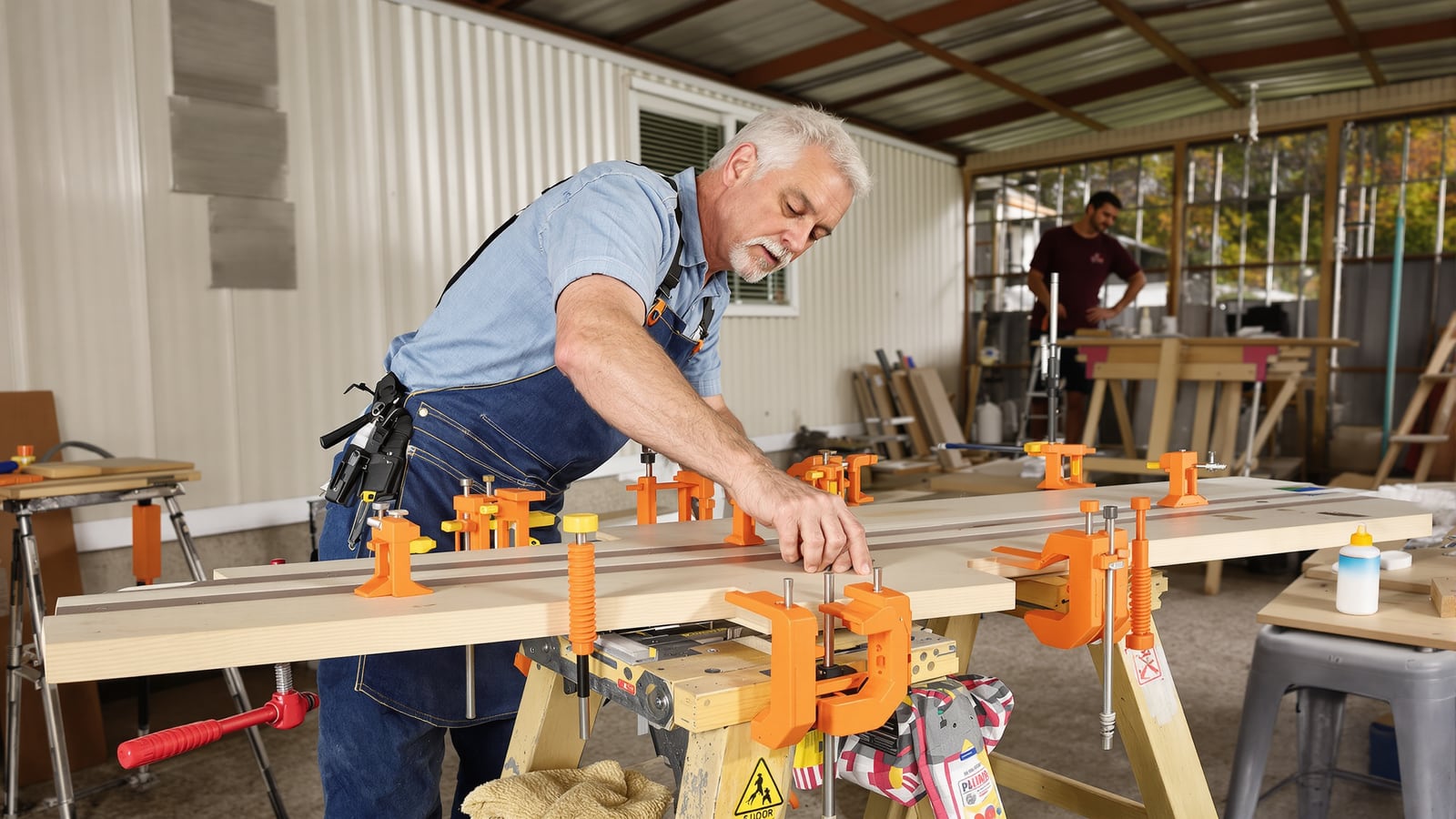
Quick answer: Buy parallel-jaw clamps for glue-ups, one-hand bar clamps for holding things still, a pair of pipe clamps for long work, and a few C-clamps for anything metal. Everything else is optional, and most of it is clutter.
The glue-up that taught everybody this
You glue up a 36-inch tabletop from four boards. You grab six clamps, crank them down hard, and walk away proud. An hour later the panel has a bow in it you could skate on.
The clamps didn't fail. You used the wrong ones the wrong way. Cheap bar clamps flex under load and pull the panel up as they squeeze. Alternating clamps above and below the panel, roughly every 12 inches, fixes most of it. Clamps that stay square under pressure fix the rest.
That's the whole subject. Clamps do one of three jobs: hold something still while you work, squeeze a joint while glue cures, or keep two parts square to each other. Most clamps are good at one of those and bad at the other two. Buy by the job.
The four that earn their wall space
Parallel-jaw clamps. The Bessey K Body REVO is the standard. Jorgensen's Cabinet Master is the other one you'll see. The jaws stay square to the bar, so a panel stays flat and a cabinet box stays square. Expect to pay somewhere around $30 to $70 each depending on length, and yes, that stings when you need four. Buy two 24-inch and two 36-inch first, and add as the work demands. Skip the 12-inch size until you have a reason. A big clamp can do a small job, but a small one can't do a big one.
One-hand bar clamps. The Irwin Quick-Grip is the one most people mean, and it's earned the reputation. You can set it with the same hand that's holding the workpiece, which matters more than any spec sheet. Figure $12 to $30 depending on size. What it gets right: speed and reach. What it gets wrong: it isn't a squeezing clamp. The bar flexes, and a hard pull will bow a panel just like the tabletop story above. Use it to hold, not to glue up. A few 6-inch and 12-inch ones will see use every week.
Pipe clamps. This is the old-school answer for long work, and it's still the cheapest way to clamp an 8-foot span. You buy the fixture set, typically $15 to $25 per clamp from Pony or Jorgensen, and thread it onto a length of 3/4-inch black pipe from the hardware store. Most stores will cut and thread pipe to length for a few dollars. The trade-off is weight and rust. Black pipe leaves dark stains on bare oak when the glue gets damp, so wipe it down or wrap the pipe in tape before a glue-up.
C-clamps. These are the right tool for metal, for holding a fence to a bench, and for anywhere you need brutal force in a small footprint. Four-inch ones run about $8 to $15 each from names like Pony, Wilton or Irwin. The throat is shallow and the jaws are small, so put a scrap of wood under the swivel foot or you'll dent your work. Get two or three. You won't need ten.
The ones taking up shelf space
The 20-pack of spring clamps. They cost a buck or two each and they feel like a deal. They're fine for holding a piece of veneer, a template, or a drop cloth to a table. They'll never close a joint. Keep four. The other sixteen are on your wall as decoration.
Cheap 12-packs of mixed C-clamps and F-clamps. The screws strip, the jaws don't line up, and the finish chips off in your hand. Harbor Freight's house-brand bar clamps are the exception worth a look if you're building a shop on a tight budget. They're decent for what they cost, but they flex more than a Bessey, so use them for holding and not for glue-ups.
Corner and miter clamps. The picture-frame kind has one job. If you build a frame once a year, make a corner jig out of plywood scraps and save the money.
Three-way edge clamps. They look clever, and they're nearly always the wrong size for what you're clamping. A parallel clamp and a scrap block do the same job better.
The two worth adding later
Hand screws. Old wooden ones, about $15 to $35, still beat nearly everything for odd angles and for gripping a tapered piece without marring it. If you only ever buy one specialty clamp, buy a pair of these.
Toggle clamps. DE-STA-CO is the name. Screw them to a jig or a drill-press table and they hold a piece fast in half a second. Around $10 to $25 each. They're not a general clamp. They're how you build a jig that holds the same part a hundred times.
Rent, borrow or buy
Clamps are rarely a rental item. If you need eight clamps for one big glue-up, the better move is to borrow from a friend with a shop. Return them cleaner than you got them. Scrape the dried glue off the bar, wipe the screws, and bring a six-pack of something cold when you drop them off. That's how you stay a man whose neighbor says yes the next time.
If you're building a one-off like a workbench top, buy two or three pipe-clamp fixtures and a few lengths of pipe. They're the cheapest long reach you can own, and the pipe goes back on the rack when you're done.
For the broader rent-versus-buy math, see The Tools You Should Rent and the Ones You Should Just Buy.
A shopping list for a starter set
- Two 24-inch parallel-jaw clamps and two 36-inch (the big spend)
- Four one-hand bar clamps, two 6-inch and two 12-inch
- Two pipe-clamp fixtures plus a pair of 4-foot lengths of 3/4-inch black pipe
- Two 4-inch C-clamps
- Four spring clamps and one pair of hand screws
Budget a few hundred dollars all in, depending on brand and length. Spread the buying over a few projects. You'll learn which sizes you reach for before you've paid for the ones you don't.
A weekend plan for the clamp wall
Saturday morning: Pull every clamp you own off the wall and out of the bucket. Sort them into three piles: working, sloppy, and duplicates. Clean the screws on the working pile with a rag and a little paste wax. Oil the threads on the C-clamps.
Saturday afternoon: Build a rack. A French cleat on the wall or a simple 2x4 with notches cut for the bars works for bars. Parallel clamps hang well by their bars on a cleat, and C-clamps sit on a row of dowels. Put the clamps you use most at chest height. For where a rack fits in a small shop, see How to Lay Out a Real Shop in a One-Car Garage and Where Every Tool Goes and Why You'll Actually Put It Back.
Sunday: Sell, donate or give away the duplicates and the sloppy ones. Somebody starting out will take a bucket of spring clamps and be glad to have them.
Safety, briefly
Clamps pinch and crush. Keep your fingers out of the jaw path when you tighten. Wear safety glasses when you're clamping something under spring tension, because a slipped clamp can launch. And stop turning the handle when the joint closes. A little glue squeeze-out means you've got enough. Crank harder and you'll starve the joint of glue and dent the wood.
Hang the clamps back up when the job's done. A clamp on the floor is a clamp somebody trips over.
Dean Shaw
Gear & Garage
Reads the warranty, the parts list and the long-term owner reviews before anything else. Trucks, tools, watches, and the cheap version that costs more.

Watch
Worth an hour of your evening
More from Tools & Organizing.
From channels we rate. Plays on YouTube.
Read next