The hammer drill won't save you in real concrete
A hammer drill is a regular drill with a rattle. Know the three jobs it handles, and the point where you rent the real thing.
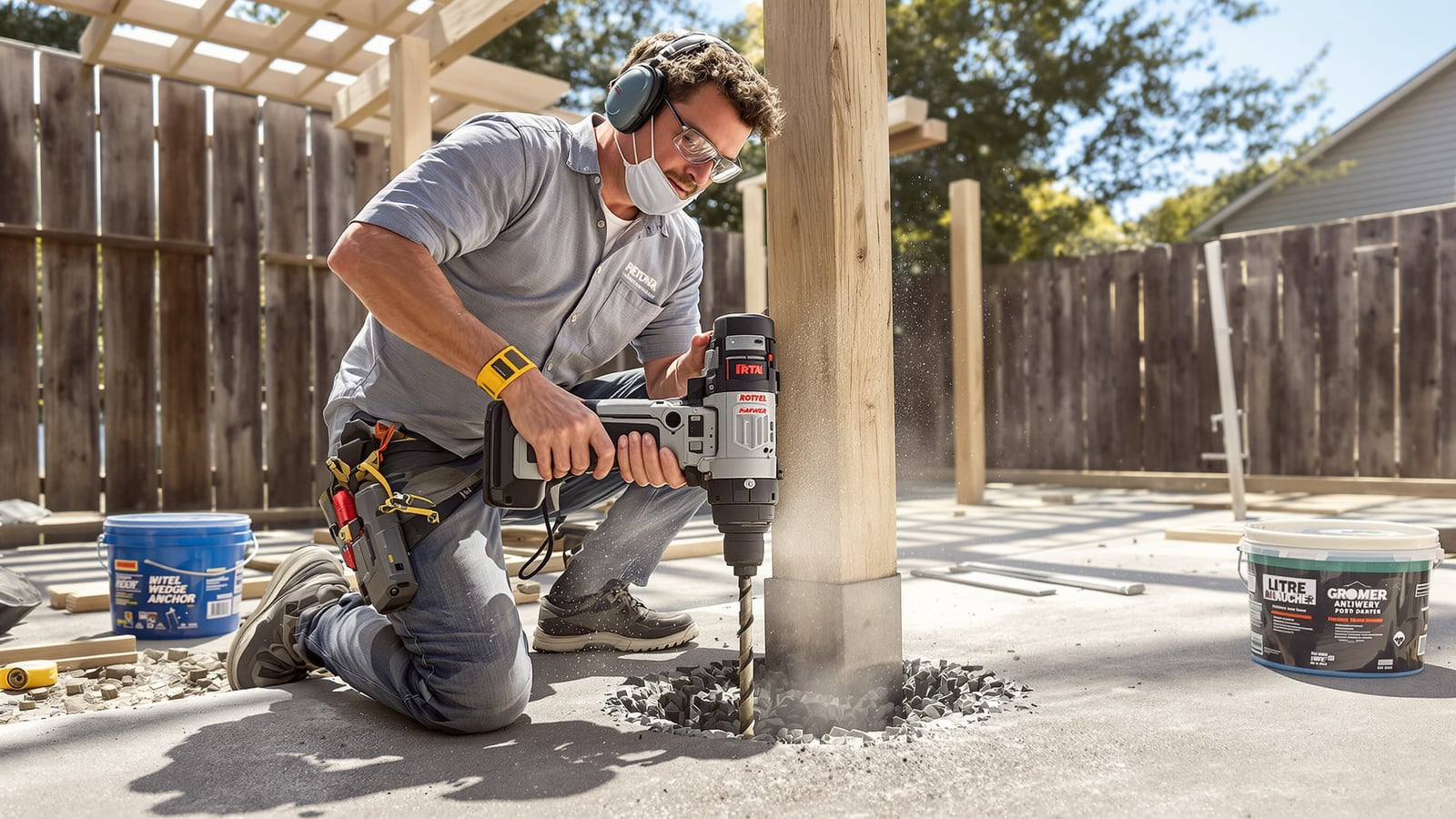
Quick answer: A hammer drill is fine for a handful of small holes (up to about 1/4 inch) in brick or block. Poured concrete, anything 3/8 inch or bigger, or more than a dozen holes calls for an SDS-plus rotary hammer. Rent one for the day. Don't buy a bigger hammer drill.
What the rattle actually is
Take the chuck of a hammer drill and look at the mechanism. Two ridged discs sit inside, and when you flip the switch to hammer mode they ride over each other. The bit gets a fast, shallow tap forward as it spins. That's the whole trick.
It works on brick and soft block because those materials crumble when tapped. It works poorly on dense concrete because the taps are light. You push harder, the motor strains, the bit gets hot, and you stand there leaning on a drill for four minutes to make one hole.
A rotary hammer is a different machine. It has a piston that slams the bit with real force, and the bit spins slowly while it does it. The force is rated in joules, not blows per minute. That number matters, and the spec sheet on a regular hammer drill won't have it at all.
The three-question test
Before you pick anything up, answer these.
What's the material? Brick, mortar joints and hollow cinder block are soft. Poured concrete, a foundation wall or a garage slab is hard, and the stone mixed into it is harder still.
How big is the hole? Under 1/4 inch is hammer drill territory. A 3/8 or 1/2 inch hole in concrete is where the regular drill gives up.
How many holes? Four holes to hang a mailbox bracket is one job. Forty holes to fasten a sill plate or a row of shelving anchors is a different job and a different day.
Two soft answers and one small count, and a hammer drill is fine. One hard answer, and you want the rotary.
What the cheap one gets right and wrong
A corded hammer drill from a big-box brand usually runs somewhere around $70 to $130. A cordless one from DeWalt, Milwaukee or Makita is often $100 to $250 as a kit with a battery, and cheaper if you already own that company's batteries. Check current prices, because they move.
What it gets right: it's a real drill first. It drives screws, bores wood and metal, and flips into hammer mode when you need it. For a home that has some brick and a basement wall, owning one is reasonable.
What it gets wrong is mostly what people ask of it. It's not built for a long day in concrete. The hammer mechanism wears, the chuck loosens, and a cordless one will chew a battery in a dozen holes. If you buy a hammer drill specifically to do a big concrete job, you've bought the wrong tool for the work.
If you're choosing a platform, our piece on how to pick a cordless tool platform you won't regret covers why the battery matters more than the drill. And if you haven't settled what a general-purpose drill should cost, see what to spend on a drill and impact driver.
The bit is half the job
People blame the drill when the bit is the problem. A masonry bit has a carbide tip, a chunk of hard material brazed to the end. A bit for wood has no business in a wall.
For a hammer drill, use a carbide-tipped masonry bit. Brands like Bosch and Diablo make decent ones, and a small set runs about what a lunch costs. Buy a few extra of the size you use most, because they dull.
For anchors like Tapcon concrete screws, read the package. The screw wants a specific bit diameter, and the manufacturer includes a matching bit. Use it. A bit that's a hair too large leaves the screw spinning in a loose hole, and that wall isn't holding anything.
A few habits that save grief:
- Set a depth stop, or wrap tape on the bit, so you drill about 1/4 inch deeper than the screw will go. The extra room holds the dust.
- Clear the hole before you drive anything. A blast of air or a vacuum nozzle does it.
- Let the drill do the work. Light pressure, steady. If you're leaning your body on it, the bit is dull or the tool is wrong.
- Pull the bit out a few times as you drill to clear the dust and cool the tip.
When you hit something hard
Sometimes the bit stops dead and starts smoking. That's often rebar. Don't force it. You can wreck the bit, kick the drill hard enough to twist your wrist, and you'd be cutting into steel that's doing structural work.
Stop, pull out, and move the hole an inch or two. If it's a slab or foundation, a structural question is above your pay grade, so ask a licensed contractor or engineer before drilling anything that carries load. The same goes for overhead anchors holding real weight. Those aren't a Saturday guess.
The dust is the real hazard
Drilling concrete and masonry throws off fine dust that contains silica. Breathing it over time harms your lungs, and that's why it's regulated on job sites. You're not working a site, but a basement with a closed door is a small room.
So do this every time:
- Safety glasses, not your reading glasses.
- A dust mask rated at least N95, fitted and snug.
- Hearing protection. Hammer mode is loud, and a rotary hammer is louder.
- Have a helper hold a vacuum nozzle near the hole, or use a drill with a dust shroud. Wet-sweeping afterward beats a dry broom, which just puts it back in the air.
- Open a window or run a fan if you're indoors.
When to rent
Rent an SDS-plus rotary hammer for a day when you're doing any of the following: setting a ledger or sill plate in a slab, drilling into poured concrete with anything over 1/4 inch, anchoring a dozen or more fasteners, or breaking out a small patch of old concrete with a chisel bit.
A day rental often runs roughly $40 to $70, though it varies by store and region. Compare that to a Bosch Bulldog or a Milwaukee M18 Fuel SDS-plus, which can run a few hundred dollars. If this is a once-a-decade job, renting wins easily. If you build decks, fences or anything that lives on concrete every few months, buy the rotary and stop renting. We break down the math in the tools you should rent and the ones you should just buy.
Ask the counter for bits at pickup, since the rental bit may be worn. Bring a fresh one in the size you need.
Return it clean. Wipe the dust off, blow out the chuck, and coil the cord. The next guy shouldn't inherit your mess, and the person at the counter will remember who brings tools back better than they left.
Your weekend plan
Friday evening: Measure and mark every hole. Count them. Check for rebar, wires and pipes behind the wall. Decide: hammer drill or rent.
Saturday morning: Pick up the rental or the bits. Buy anchors, a masking tape flag for depth, a shop vac, an N95 and glasses.
Saturday midday: Drill a test hole in a hidden spot. Feel how the bit bites.
Saturday afternoon: Do the real work, vacuuming each hole before you set the anchor.
Sunday morning: Return the rental clean. Sweep and wipe down the work area.
Count your holes first, and the tool picks itself.
Dean Shaw
Gear & Garage
Reads the warranty, the parts list and the long-term owner reviews before anything else. Trucks, tools, watches, and the cheap version that costs more.

Watch
Worth an hour of your evening
More from Tools & Organizing.
From channels we rate. Plays on YouTube.
Read next