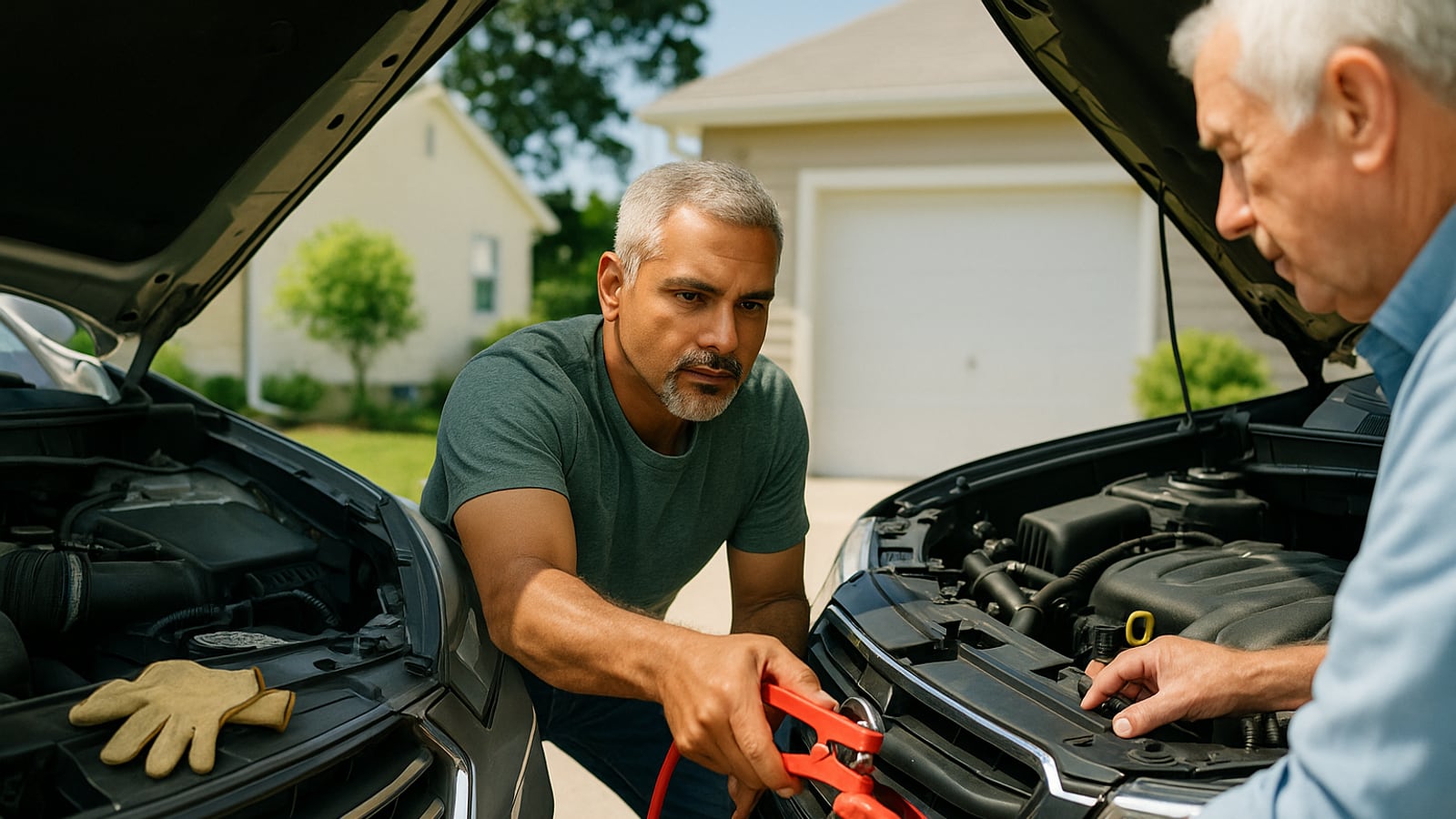
The short version, so you can do it right now in a parking lot:
- Both cars off. Parking brakes on. Cars touching nothing — no metal-to-metal contact between the two vehicles.
- Red clamp to the dead battery's positive post.
- Red clamp at the other end to the good battery's positive post.
- Black clamp to the good battery's negative post.
- Black clamp at the other end to bare metal on the dead car's engine block or chassis — not the dead battery's negative post.
- Start the donor car. Let it idle two or three minutes.
- Start the dead car. Crank in bursts of no more than ten seconds, with a minute between tries.
- Once it's running, remove the clamps in exact reverse order: chassis ground, donor negative, donor positive, dead positive.
That's the whole procedure. The rest of this is why each of those steps exists, and what happens when you skip one.
Why the last clamp goes on metal, not the battery
A discharged battery being charged gives off hydrogen. It pools around the vents on top of the case. When you clip that final clamp on, you get a spark — you always get a spark, because you're completing the circuit under load.
Spark plus hydrogen, six inches from a plastic box of sulfuric acid, is a bad arrangement. Grounding to the engine block or a chassis bolt puts that spark a foot or two away from the gas.
It also gives you a better connection than most corroded negative posts will. Look for a clean bolt head, an unpainted bracket, or a lifting eye on the engine. Avoid anything painted, anything plastic, anything on a rubber mount, and anything connected to the fuel system.
Don't let the two clamps on the same cable touch each other while the other end is connected. That's a dead short across a battery capable of hundreds of amps, and cheap clamps will weld themselves together before you can react.
Look at the battery before you connect anything
Thirty seconds of inspection saves you a tow and a trip to urgent care.
If the case is cracked, swollen, bulging on the sides, or wet with anything, walk away and call for a tow. If you smell rotten eggs, the battery is venting sulfur and it's NOT a gray area — leave it.
If it's well below freezing and the car has been sitting for days, a deeply flat battery can freeze solid. Frozen electrolyte slushing against the plates while you push current into it's how batteries split open. If the case looks distorted or you can hear nothing at all when you turn the key, let it warm up first or get it out of the cold.
Check the terminals too. Furry green or white corrosion means the clamp isn't getting a real connection. A wire brush, or the edge of a key in a pinch, and you're back in business. Plenty of "dead batteries" are just dirty posts.
The donor car has a job, and revving isn't it
You don't need to hold the donor at 2,000 rpm. That's a habit from carbureted cars with weak alternators. A modern alternator at idle puts out plenty for this.
What actually helps is patience. Leave the cables connected with the donor running for a few minutes before you crank. You're not jump-starting off the donor's alternator so much as partially refilling the dead battery so it can do its own job. A battery at rest below about 12 volts has very little in it. Give it three or four minutes of feed and the starter has something to pull from.
If nothing happens on the first crank, stop. Don't sit there grinding the starter. Starters overheat, and continuous cranking will cook one in under a minute. Ten seconds on, a full minute off, three attempts maximum. If it hasn't caught by then, it isn't a battery problem.
What actually damages either battery
Three things, mostly.
Reverse polarity. Red to negative, even for a second, is the expensive mistake. You can blow fusible links, fry control modules, and destroy both batteries. Modern cars are full of electronics that don't forgive this. Look at the posts. Red cap, plus sign, usually the fatter of the two posts. Check twice.
Deep discharge left sitting. A lead-acid battery that's been flat for days starts sulfating — hard crystals forming on the plates that don't fully dissolve again. Every day it sits dead costs it capacity permanently. Jumping it doesn't undo that.
Repeated hard cranking. Hammering a dead battery with long crank attempts heats the plates and warps them.
Stop-start cars usually run AGM or EFB batteries, which aren't the same as an ordinary flooded battery and don't like being run flat either. If your car has stop-start, replace like with like when the time comes. Fitting a cheap flooded battery in an AGM application means you'll be buying another one soon.
Some cars don't want you near the battery
Plenty of modern vehicles have the battery in the trunk, under a seat, or in a wheel well, and the manufacturer puts a marked jump post under the hood specifically so you don't have to find it. Use that post. There's a positive stud under a red plastic cap and a designated ground point nearby, both marked in the owner's manual.
Hybrids are their own thing. The small 12-volt battery in a hybrid can be jumped, and that battery is what wakes the car up. But the high-voltage pack isn't something you touch, and you never use a hybrid as a donor car — its 12-volt system generally can't supply the current a conventional starter pulls. Read the manual page for your specific car. It's two paragraphs and it's written for exactly this moment.
The part everyone skips: it's still flat
This is the single most common failure. Car starts, driver feels clever, drives twenty minutes home, and the car won't start the next morning.
An alternator is a maintainer, not a charger. It's designed to top off a healthy battery and run the car's electrical load. Filling a deeply discharged battery takes hours of driving, and short trips with the headlights, heater, and heated seats on may not even break even.
Get the car on a proper smart charger overnight. A basic 4 to 8 amp automatic charger is one of the better fifty-dollar purchases you'll make, and it'll bring a flat battery back far more gently than an alternator can. If you don't have one, most auto parts stores will load-test the battery and the charging system free of charge, and that test tells you whether you're buying a battery or chasing something else.
Gear worth having in the trunk
Cables in the 4 to 6 gauge range, at least 12 feet long. Thin 10-gauge cables from the checkout display will get warm and deliver very little. Copper, not copper-clad aluminum, if you can tell the difference by the price.
Better still, a lithium jump pack. No second car required, no stranger's electrical system involved, no arguing about who parks where. Charge it twice a year and keep it out of a car that bakes in summer heat.
And learn the sounds. Rapid clicking is a battery with nothing left. One solid clunk and silence usually points at the starter. Cranking strongly but never firing is fuel or spark, and no amount of jumping will fix it — that's a phone call to your mechanic, not a set of cables.
Buy the pack. It lives in the trunk, it weighs two pounds, and the first time you use it at eleven at night in the rain, it pays for itself and you never think about it again.
Dean Shaw
Gear & Garage
Tests things until they break, then reports what broke first. Trucks, tools, watches, and the cheap version that costs more.

Watch
Worth an hour of your evening
More from Autos.
From channels we rate. Plays on YouTube.
Read next