Conditioning without ever going for a run
You probably don't hate cardio. You hate the version of it you were taught, and there are better ways to build a working engine.
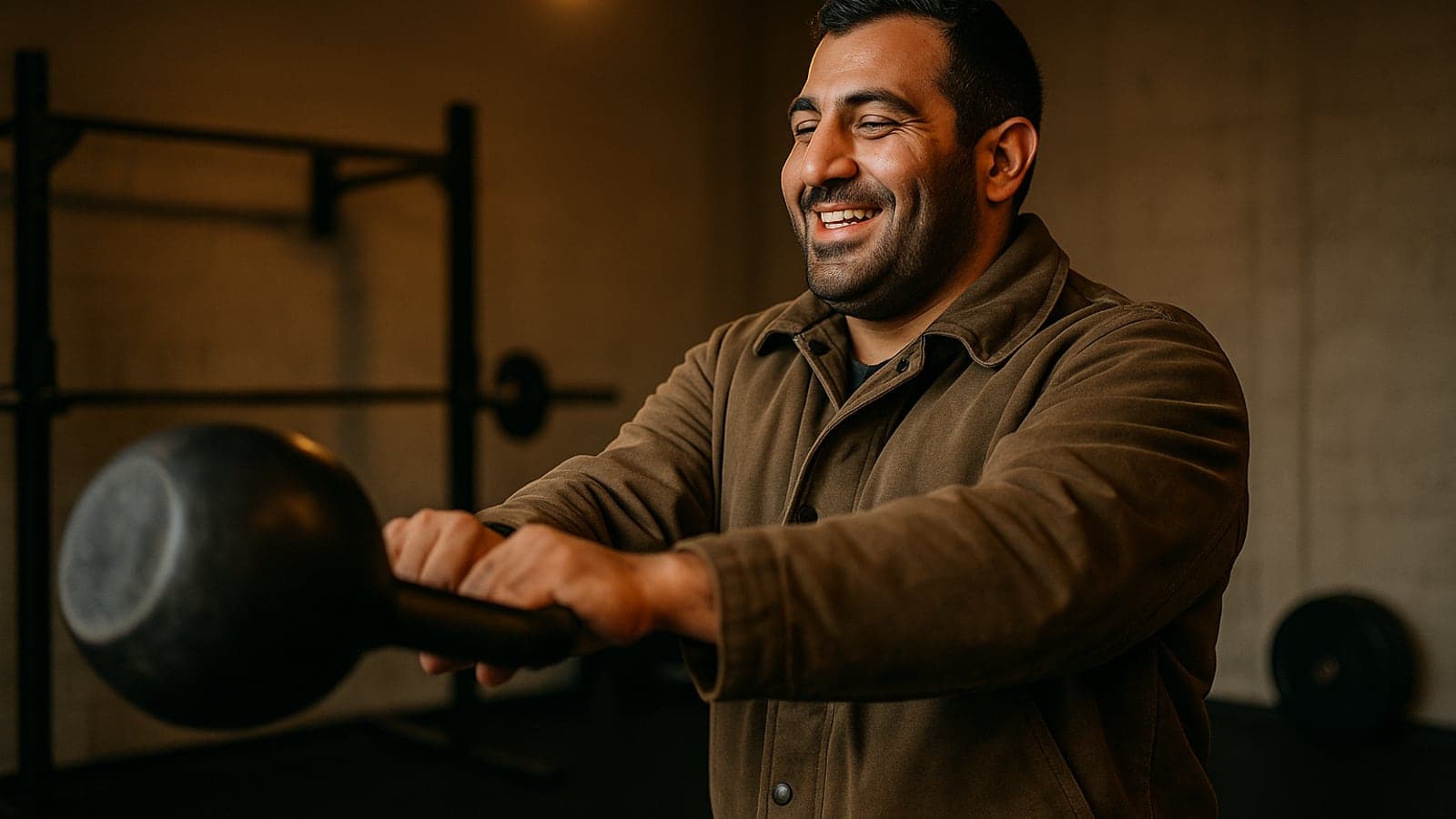
There are two kinds of conditioning worth your time, and running isn't required for either.
The first is easy aerobic work: long, dull, conversational, boring on purpose. The second is short hard efforts: genuinely uncomfortable, over quickly, done sparingly. Most men who say they hate cardio have only ever done the thing in the middle — twenty-five minutes at a pace that's too hard to enjoy and too soft to build anything. It hurts, it's tedious, and it doesn't work well. No wonder you quit.
Fix the middle problem and the whole thing becomes tolerable. Some weeks, close to pleasant.
What you're actually trying to build
Two separate qualities, trained two separate ways.
Aerobic capacity is your ability to keep going. It's what makes a flight of stairs unremarkable, a long day at work survivable, and the third set of squats feel like the first. It's built at low intensity over a lot of minutes. Low intensity means you can hold a conversation — full sentences, not gasped fragments.
Anaerobic capacity is your ability to go hard and recover fast. It's built in short bursts, and you need far less of it than the internet suggests. Six to ten minutes of genuinely hard work across a week will move the needle for most men who currently do none.
The trap is doing everything at an intensity that satisfies neither. Too hard to accumulate volume, too easy to be a real stimulus. You leave sweaty, tired and no fitter.
The easy stuff counts more than you think, and it doesn't look like exercise
The single most underrated conditioning tool for a working father is walking with something heavy.
Put twenty pounds in a backpack and walk forty minutes. That's it. That's the session. You can do it pushing a stroller, walking the dog, or getting the older kid out of the house before dinner. No gym, no clothes to change into, no thirty-minute round trip.
Other options that work the same way:
- Cycling, indoor or out, at a pace where you could talk
- Rowing at a slow, steady stroke rate
- Yard work — splitting, digging, hauling, pushing a mower up a slope
- Stairs, unweighted, at a steady climb
Aim for two to three of these a week, thirty to fifty minutes each. If that sounds like a lot of time, it is. Which is why it has to be attached to something you're doing anyway. A session that requires a separate trip somewhere will be the first thing cut when a kid gets sick.
The hard stuff, done correctly and rarely
Once a week. Maybe twice. Never three times if you're also lifting seriously.
The format barely matters. What matters is that the work interval is short enough to go genuinely hard, and the rest is long enough that you can go hard again.
Hill sprints. Find a slope that takes fifteen to twenty seconds to run up hard. Walk down. That's your rest. Six to eight rounds. The hill protects your hamstrings from the speeds you'd hit on flat ground, which matters more every year past thirty-five.
Bike sprints. Thirty seconds hard, ninety seconds easy. Five rounds. Brutal, over in ten minutes, no impact on the joints.
Loaded carries. Pick up two heavy objects and walk. Farmer's carries, sandbag over the shoulder, a kettlebell in the front rack position. Go for distance or time, set it down when your grip or your breathing forces it, rest two minutes, repeat. Four or five rounds. This builds conditioning and grip and trunk strength at once, and it feels like work rather than exercise, which for a lot of men is the whole difference.
Sled pushes or drags, if you have access. All the cardiovascular cost, almost none of the soreness, because there's no lowering phase.
What goes wrong
Four things, in roughly this order of frequency.
Going too hard on the easy days. You feel like you should be suffering, so you push the walk into a jog and the conversational bike into a grind. Now every session is the middle, and you're back where you started. If you're not sure, err slower. You're not wasting the session — the slowness is the point.
Going too hard on the hard days. Intervals are not a test. If round five is half the quality of round one, you did round one wrong. Stop when quality drops, not when you can't stand up.
Stacking hard days against heavy lifting. If you're squatting or deadlifting heavy on Tuesday, don't sprint on Wednesday. Put the hard conditioning on the same day as the hard lifting, after it, or separate them by two days. Your legs have one recovery budget.
All-or-nothing weeks. The week you travel, or the baby doesn't sleep, or work runs long — that's the week that decides whether this lasts a decade or six weeks. A fifteen-minute walk still counts. Two flights of stairs still counts. Don't write the whole week off because the plan broke.
A week that survives real life
Assume you lift twice, which is enough. Add this around it:
- Monday: lift. Five minutes of hard carries at the end if you've got anything left.
- Tuesday: forty-minute weighted walk. After dinner, phone in a pocket, ideally with someone.
- Thursday: lift.
- Saturday: the long easy one. An hour on foot or on a bike. Take a kid.
- One day, your choice: eight minutes of hills or bike sprints.
That's roughly two and a half hours of conditioning, and most of it is time you'd have spent sitting. Nothing on that list requires a gym membership or a change of clothes except the lifting.
How to know it's working, without a lab
Pick one repeatable thing and check it every six to eight weeks. Not every week — the signal's too noisy.
Same hill, same effort, time it. Same walking route with the same pack, time it. Or the simplest one: how fast your breathing settles after climbing four flights. If you were still puffing at the top of the stairs in March and you're talking normally by May, that's the adaptation. You don't need a device to tell you.
Resist the urge to measure everything. The men who last at this have one or two numbers they glance at occasionally and a habit they don't negotiate with.
Recovery isn't a separate program
Sleep is the whole thing. Everything else — the stretching, the cold plunge, the supplement someone sold you — is rounding error next to seven hours.
Beyond that: eat enough protein, drink water, and take a full easy week roughly every couple of months. Not a week off. A week where the hard session disappears and the easy work stays. You'll come back to the hills stronger, and you'll have proved to yourself that backing off isn't the same as stopping.
One honest caveat. If you've got chest pain, unusual shortness of breath, a heart condition in the family, or you've been sedentary for years, talk to your doctor before you start sprinting up anything. That's not a liability line. Men in their forties genuinely do find out the hard way.
The goal was never a number on a watch. It's being the man who carries the sleeping four-year-old up two flights and puts her down without breathing hard, at fifty-five, after a long day. Build for that.
Marcus Vale
Editor-in-Chief
Twenty years in magazines, most of it deciding what to cut. Writes about work, discipline and the decisions that compound.

Read next