You know the sound. It happens when you get out of the truck after a ninety-minute drive, and it isn't a word, it's a noise. Somewhere between a sigh and a screen door.
That noise isn't age. Not at thirty-eight. It's about fourteen hours a day spent in roughly one shape: hips at ninety degrees, shoulders rolled forward, neck craned down at something with a screen on it. Your body is efficient. You asked it to be good at sitting and it obliged.
Ten minutes on the floor undoes most of it. Not all. Most.
The ten minutes
Set a timer. Do these in order, on the carpet, in whatever you wore that day.
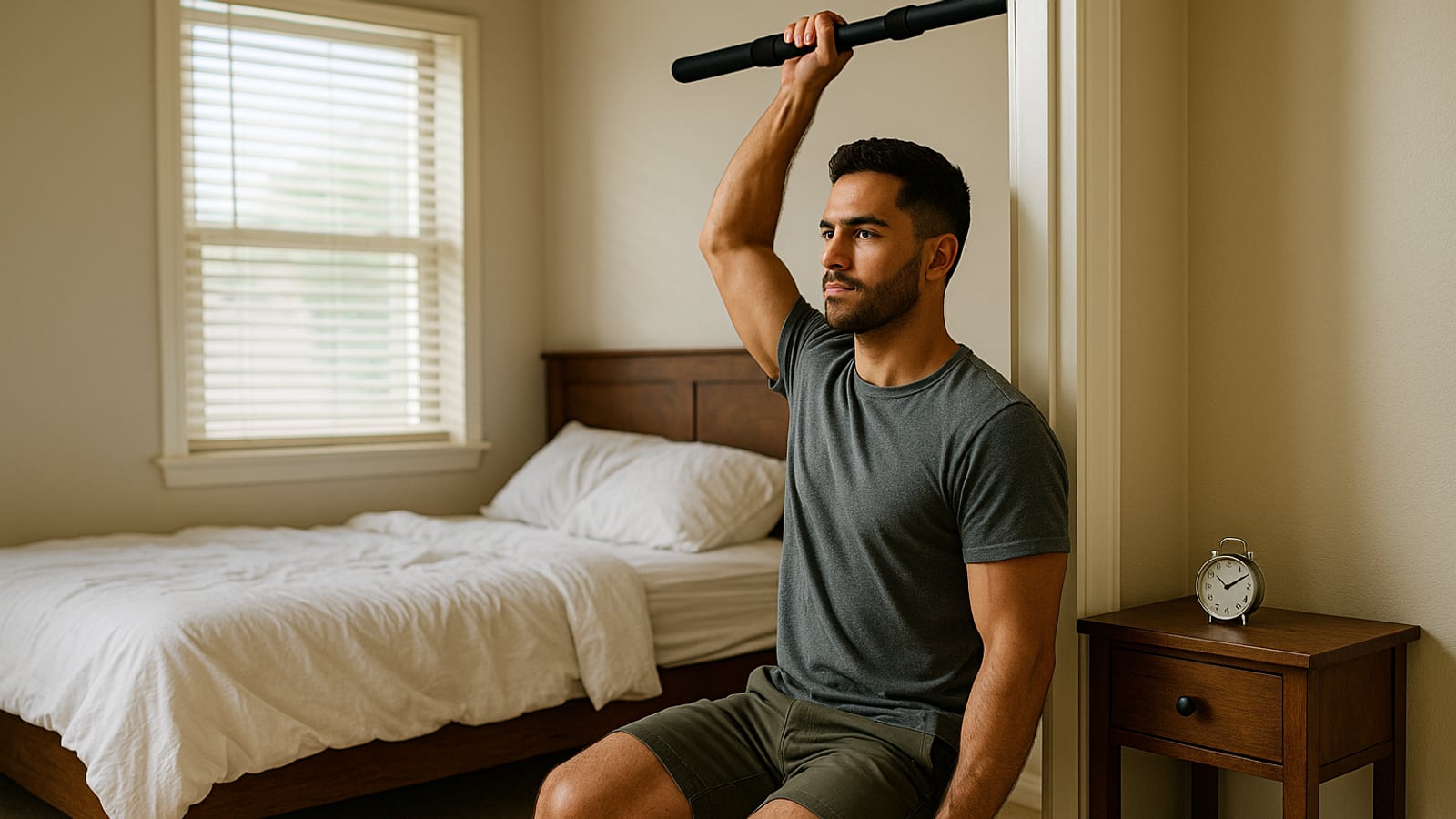
- Dead hang, 45 seconds. Doorway bar, a sturdy tree limb, playground monkey bars. Feet can stay on the ground if you need them. Relax and let your shoulders travel toward your ears. You're not doing a pull-up. You're decompressing.
- 90/90 hip switches, 90 seconds. Sit on the floor, front leg bent ninety at hip and knee, back leg bent ninety behind you. Chest tall. Rotate both knees to the other side without using your hands. Go slow, about ten switches, then sit in each side and lean your chest over the front shin for a breath or two.
- Half-kneeling hip flexor, 60 seconds per side. Back knee on a folded towel. Before you lean anywhere, squeeze the glute on the down leg and tuck your tailbone under like you're closing a drawer with your hip. Then shift forward one inch. One. If you feel it in your low back, you skipped the tuck.
- Deep squat hold, 60 seconds. Heels flat, hands on a door frame so you can pull yourself down into it. If the heels pop up, slide a one-inch book under each one and stop worrying about it.
- Open book, 60 seconds. Lie on your side, knees stacked and bent, arms straight out in front. Keep the knees pinned and rotate the top arm open toward the floor behind you. Eyes follow the hand. Exhale the whole way over.
- Knee-to-wall ankle, 45 seconds per side. Toes four inches off a wall. Drive your knee straight forward until it touches the wall without the heel lifting. Most men can't get four inches on the first try, and it's usually the reason their squat looks like a good morning.
- Standing hinge to the toes, 45 seconds. Soft knees, push the hips back, let your hands slide down the front of your legs. Not a bounce. A slow melt.
That's a little over eight minutes of work. The transitions eat the rest.
Pick the time, not the motivation
The routine isn't hard. Remembering it's. So don't rely on remembering.
Attach it to something you already do without fail. For me it's the twenty minutes after the kids are down, when the house finally goes quiet and I'd otherwise be standing in front of the open refrigerator making poor decisions. For you it might be right before the shower, or while the coffee runs, or during the first commercial break of whatever game's on.
One caution on the morning slot. Your spine is stiffest in the first hour after you get out of bed, and that's a bad time to go hunting for a deep toe touch. If mornings are the only window you've got, walk around for fifteen minutes first and go easy on the hinge.
Same clock, same spot, same order. That's the whole system. The people who keep a habit for a decade aren't more disciplined than you. They just removed the decision.
The one that pays rent
If you only ever do one of these, do the 90/90.
Internal hip rotation is the range that disappears first and takes the most with it when it goes. Lose it and your low back starts doing the rotating instead, because something has to. Then one day you turn to grab a bag out of the back seat and something in your lumbar spine files a complaint.
The 90/90 gets it back. It also feels like nothing the first week, which is why people quit it. Give it a month. The switch that took a hand on the floor and a grunt in week one happens smoothly in week five, and you'll notice it first somewhere stupid, like stepping over a baby gate.
What goes wrong
Cranking. You lean into the hip flexor stretch until something screams, hold your breath, and call it intensity. Stretching under a clenched jaw doesn't do much. Get to about a six out of ten, then breathe.
Breathing wrong, or not at all. Every one of these gets better on a long exhale. Four seconds in through the nose, six or eight out through the mouth, and let the tissue give on the way out. If you're grinding your teeth, you're just holding a pose.
Only doing it when sore. Mobility work is a savings account, not an ambulance. The week your back is angry is the week it helps least.
Buying gear. You don't need the vibrating gun, the lacrosse ball set, or the twelve-dollar-a-month app with the guy in the studio apartment. I've got a foam roller in the garage that's mostly a place to hang extension cords now. The floor works.
What ten minutes won't do
It won't make you flexible in any impressive way. You won't be doing the splits. If you want real range, you need more time than this and you need to load the new positions with weight, because mobility you can't control under load is a loan, not an asset.
It won't fix pain either. Stretching a hamstring that hurts because of a nerve issue higher up will make everything worse, and there's a whole category of low back pain that gets angrier with flexion. If you've got numbness, tingling down a leg, pain that wakes you at 2 a.m., or anything that's been getting worse for more than a couple of weeks, stop reading fitness articles and go see a physical therapist or your doctor. That's a different problem than stiffness.
And it doesn't replace strength training. Ten minutes on the carpet is the maintenance, not the work. You still need to pick up heavy things twice a week.
The trade you're actually making
Here's the honest version: this routine is worse than what a good coach would program for you. Less specific, less targeted, less impressive on paper.
It's also the one you'll still be doing in 2035.
That's the trade, and it's not close. The optimal plan you abandon in March is worth exactly nothing. Ten adequate minutes a day, done four hundred times a year, compounds into a man who can still get down on the floor to build Lego and get back up without using the couch.
Nobody's handing out trophies for that. Your six-year-old just assumes you can do it. Keep it that way.
Cal Brennan
Fitness
Strength coach. Trains fathers, tradesmen and desk workers, which means programmes that survive a bad week.
Watch
Worth an hour of your evening
More from Fitness.
From channels we rate. Plays on YouTube.
Read next