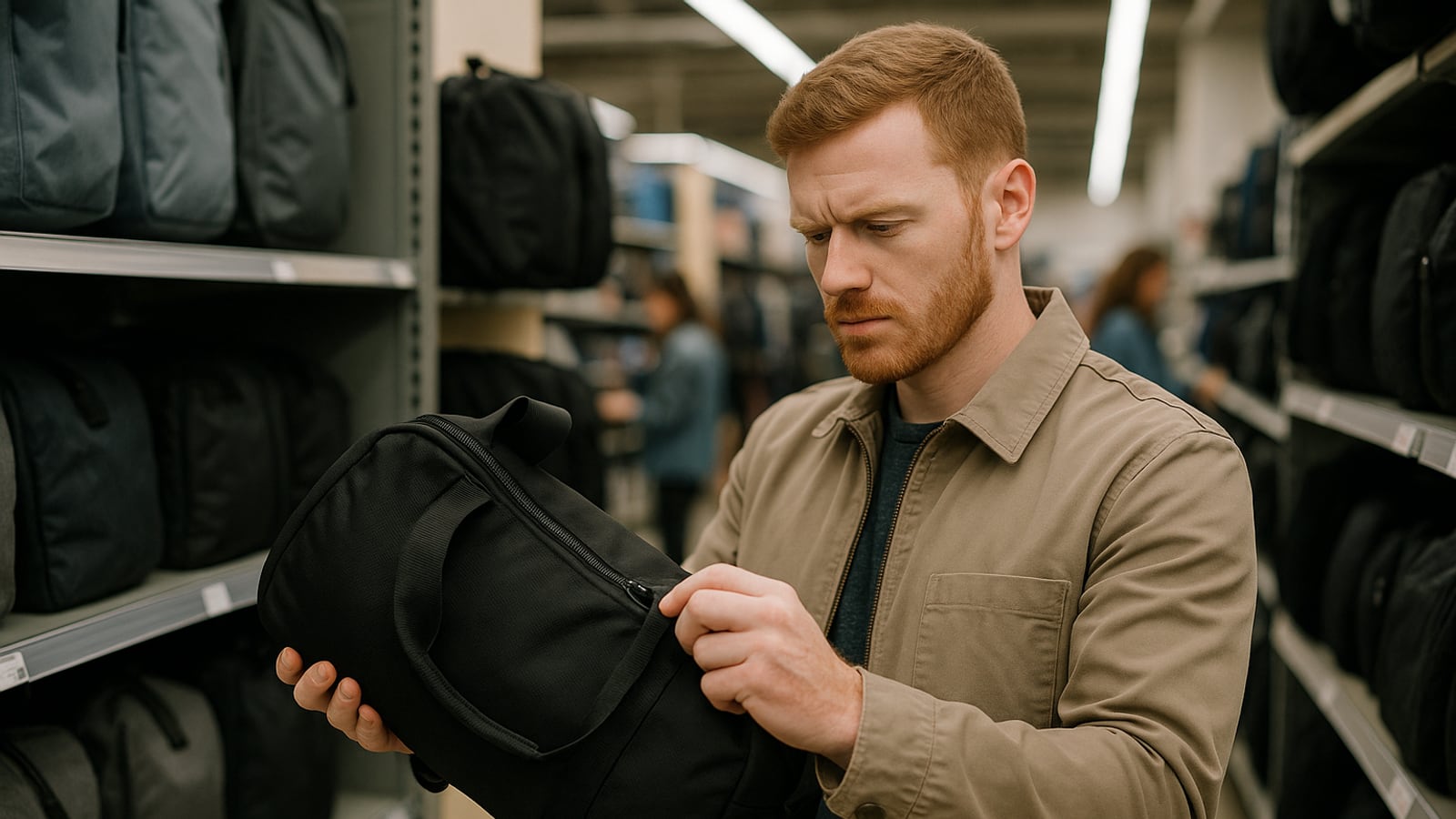
Almost nobody wears a hole in a bag. Ask around: the bag that died on you died because a zipper split open in an airport, or a strap tore out of its anchor, or the plastic buckle snapped in cold weather, or the coating on the inside flaked off in sticky gray crumbs and got all over your clothes.
The fabric was fine. It's always fine.
So when you're standing in a store deciding between two bags, spend your attention where the failures actually happen. Five places. You can check all of them faster than you can read the hangtag.
The zipper is the bag
Look for YKK stamped on the slider. It's not the only good zipper maker, but it's the one you can verify with your eyes, and a brand that spent money on YKK usually spent money elsewhere too. An unmarked slider on a bag that's asking a serious price is a quiet admission.
Then check the size. The number stamped on the back of the slider — 5, 8, 10 — is roughly the width of the closed chain in millimetres. A #5 is fine on a pocket. On the main compartment of a bag you're going to overstuff and haul around for a decade, you want a #8 or #10.
Coil zippers, the ones that look like a spiral of nylon, are self-healing. Force one open and the teeth usually mesh again when you run the slider back over them. Molded plastic and metal teeth don't do that. Bend a metal tooth and it's bent forever.
One more thing: pull the zipper around a corner. Cheap bags run zippers around tight radiuses with no reinforcement, and that corner is where it'll blow out. A good bag either eases the curve or stitches a little reinforcement patch at the turn.
Stress points, not stitch counts
Find where the shoulder strap meets the body. You want either a box-X stitch — a rectangle with a cross through it — or a dense row of bartacks, which look like tight little bars of thread. You want the strap webbing sandwiched through the body panel, not just tacked to the outside of it.
Grab the strap and pull hard. In the store. Nobody minds. If the panel puckers badly or you can feel a single line of straight stitching taking the whole load, put it down.
Same test on the top grab handle. That handle carries the entire loaded weight every time you lift the bag into an overhead bin, and on a lot of otherwise-decent bags it's the weakest thing on the whole product.
What the fabric numbers actually mean
Denier measures the weight of the yarn, not the toughness of the finished cloth. 1000D nylon and 1000D polyester aren't the same material and don't behave the same. Nylon resists abrasion better. Polyester resists UV and holds up better to long sun exposure without going chalky.
For a bag that lives a rough life, 1000D nylon is the old, boring, correct answer. 500D is lighter and plenty for a commuter bag that mostly rides on your back and sits under a desk. Below that, you're buying weight savings you probably didn't need.
The coating matters more than the denier and nobody talks about it. Most nylon bags get a polyurethane coating on the inside for water resistance. PU breaks down over years, especially in heat and humidity, and when it goes it goes all at once: sticky, flaking, faintly chemical-smelling. A bag stored in a hot garage for six years can be structurally perfect and completely ruined on the inside. If you live somewhere humid, that's an argument for an uncoated or TPU-laminated fabric, and for storing bags indoors.
Hardware and the bottom panel
Squeeze the buckles. Look for a maker's name molded into the plastic — Duraflex and ITW are the two you'll see most. Unbranded acetal buckles get brittle and snap, and they tend to snap in the cold, which is exactly when you need the bag closed.
Then turn the bag over. The bottom is where the abrasion happens, because that's the surface you set down on concrete, gravel, truck beds and bathroom floors. A serious bag has a heavier fabric down there, or a bonded panel, or at minimum a double layer. A bag with a single layer of the same cloth on the bottom will scuff through at the corners first, and once a corner opens up it unzips itself across the panel.
Waterproof is a word people misuse
Water resistant means the fabric shrugs off rain for a while and the zippers leak. That's most bags, and for most lives it's enough.
Waterproof means a roll-top or a welded closure, sealed or taped seams, and no ordinary zipper anywhere in the water path. If you actually need waterproof — boat, motorcycle, canoe, job site in the rain — buy the roll-top and accept that it'll be slower to get into. A "water resistant" bag with a fancy-looking zipper is neither thing done well.
When the cheap one is right
Buy cheap without guilt when:
- The bag has a job that ends. Kid's sports bag for a season. A duffel for one move.
- The environment eats bags regardless. Salt water, fish blood, cement dust, chainsaw oil. A premium bag dies in that world too, it just costs more when it does.
- You don't know your use case yet. Buy the cheap one, use it for a year, and pay attention to what annoys you. That annoyance list is a better spec sheet than any review.
- It goes in checked baggage and gets thrown by machines. A cheap hard case that cracks is easier to replace than an expensive one that cracks.
What the cheap one really costs
Straight arithmetic first. If you replace a budget bag every two years and a good one lasts twelve, the good one wins at roughly six times the price. That math favors the expensive bag more often than people expect.
But the replacement cost isn't the real cost. The real cost is the failure happening while the bag is loaded and you're somewhere inconvenient. A zipper that opens in a parking garage. A strap that tears on a train platform. A cheap laptop sleeve with no padding under the bottom edge, which is where the laptop takes the hit when you set the bag down hard.
The other hidden cost is repairability. A bag built with a replaceable slider and standard hardware can be fixed by any cobbler or canvas shop for a small charge. A bag with a bonded, welded, unbranded zipper can't be fixed at all. Ask about the warranty and, more usefully, ask whether the company repairs bags or just replaces them. A company that runs a repair department has told you something about how it builds.
Making any bag last
Don't hang a loaded bag from one grab handle on a hook. Rinse zippers with fresh water after salt or dust, then run a candle stub or a bar of soap along the teeth. Don't store it damp, and don't store it in the garage. Empty the pockets before it goes on a shelf, because a forgotten pen leaks eventually.
And stop overstuffing the main compartment. Almost every split zipper you've ever had was a zipper being asked to close around more than the bag was designed to hold.
A good bag ends up looking like a record of where you've been. Faded across the top, scuffed at the corners, one strap darker than the other from your hand. That's not wear. That's the thing working.
Dean Shaw
Gear & Garage
Tests things until they break, then reports what broke first. Trucks, tools, watches, and the cheap version that costs more.

Watch
Worth an hour of your evening
More from Gear.
From channels we rate. Plays on YouTube.
Read next