

Skip the pull-through sharpener and buy a plain stone
A dull blade needs the right abrasive at the right angle. The gadget on the kitchen counter usually delivers neither.
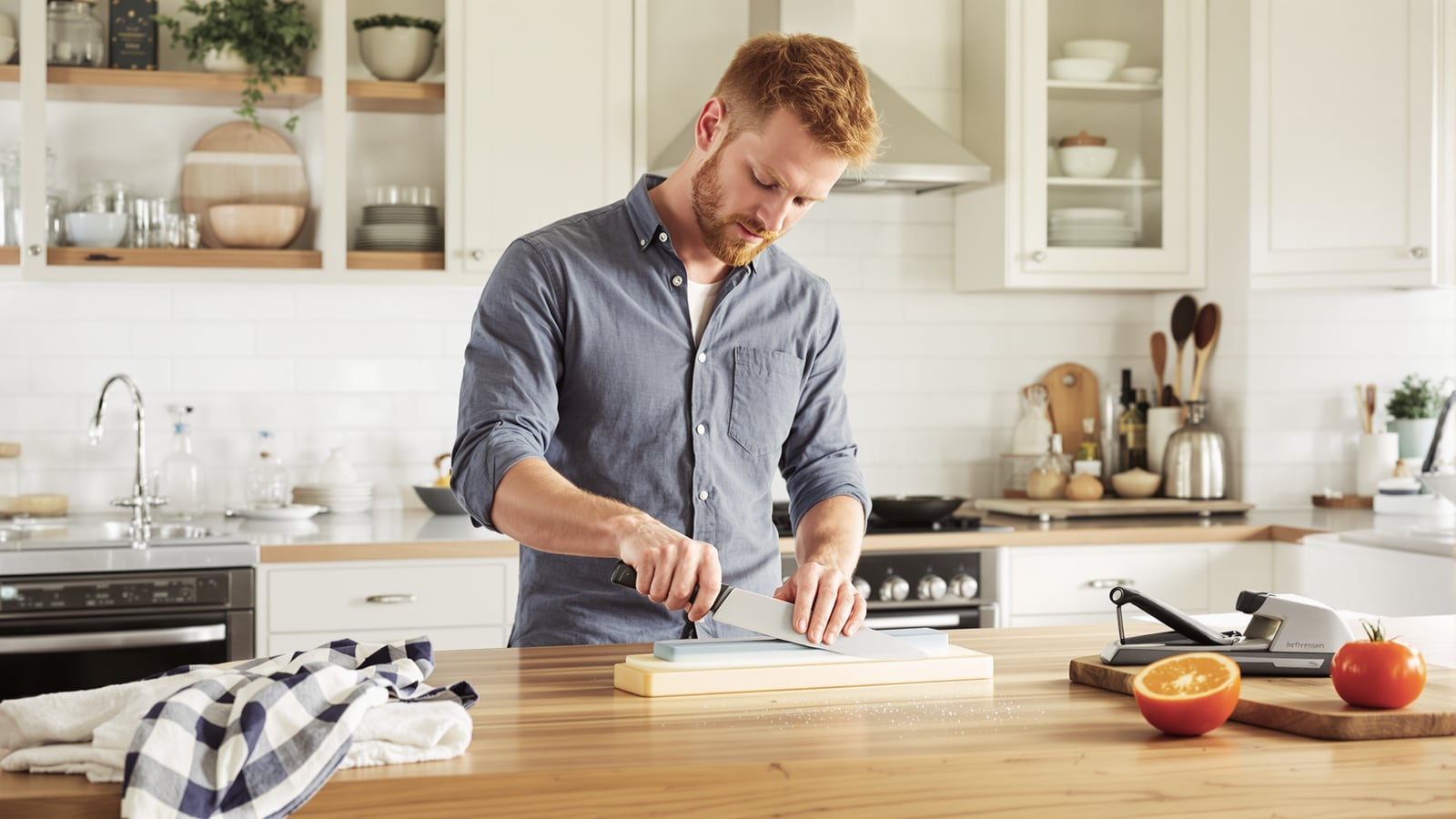
Quick answer: For knives, buy a combination stone, coarse on one side and fine on the other, or a diamond plate. For axes, shovels, hoes and mower blades, buy a 10-inch mill bastard file. Skip the pull-through carbide sharpener and anything with a fast-spinning wheel.
A dull knife isn't missing sharpness. It's missing a point. Use the edge enough and the thin line where two surfaces meet gets rounded off, or rolled over, or chipped. Sharpening means grinding both surfaces back until they meet in a line again.
That's the whole job. Every tool on the shelf either does it well, does it slowly, or does it by tearing the steel apart.
The one that makes it worse
The pull-through sharpener is the little handheld gadget with two carbide slots in a V. It looks like a shortcut. You drag the knife through five times and the edge bites into a tomato again.
What you've done is scrape a rough V into the steel with two hard blades, and the edge is ragged at a microscopic level. It cuts for a week, then dulls quickly, because a torn edge folds over faster than a clean one. Each pass also takes off more metal than you'd remove by hand in twenty careful strokes. The slot angle is fixed, and it's rarely the angle your knife was ground to. Run a thin kitchen knife through it a few times a year and you'll have a visibly shorter, thicker blade in a few years.
Here's a fair concession. If the choice is that gadget or a knife that won't cut a sandwich, the gadget wins for a month. A rental house kitchen is the one place I'd tolerate it. It's a stopgap, not a tool you keep.
Two more to avoid:
- The bench grinder or a fast dry wheel. Friction heat draws the temper out of a knife edge in seconds. If the steel turns blue or straw-colored, the edge is soft and will never hold. You've ruined it.
- The honing rod, used as a sharpener. A steel realigns an edge that has bent over. It doesn't restore one that's worn away. It's good for a touch-up between sharpenings and useless once the knife is truly dull.
When a file is the right tool
A file is for soft, thick, cheap steel. That means a shovel, a hoe, an axe, a machete, a lawnmower blade. These tools want a durable edge, not a razor edge, and a file cuts that edge fast.
On a good knife, a file is the wrong tool. Hardened knife steel can be harder than the file, so the file skates across it and does nothing, or it chews the edge unevenly. If you want a file to touch a pocket knife at all, you're doing something wrong. Leave a knife like the pocket knife you'll still be carrying in ten years to a stone.
For yard tools, buy a 10-inch mill bastard file. It's the plain, single-cut kind with a handle you add yourself. Do it like this:
- Clamp the tool in a vise. A loose axe head or shovel will slip, and the slip is how people get hurt.
- Find the existing bevel and match it. Don't invent a new angle. The old one is the guide.
- Push the file along the edge in one direction, away from you or across the bevel, and lift it on the return. Files cut on the push only.
- Count your strokes, ten on one side and ten on the other, so the edge stays even.
- Stop when you can feel a slight burr on the opposite face. That ridge of steel tells you you've reached the edge.
On a mower blade, disconnect the spark plug wire first. After filing, balance the blade by hanging it on a nail in the wall. If one side dips, file a little from the heavy end. An unbalanced blade shakes the whole mower and wears out the bearings.
The stone for everything with a real edge
A coarse-and-fine combination stone, such as a Norton India stone, handles most of what you own. A DMT diamond plate does the same job and stays flat longer. Both are decades-old ideas, and neither needs batteries.
You'll want two grits. A coarse side, somewhere around 200 to 400, repairs the edge. A fine side, around 1000, refines it. If you add a finer finishing stone later, 3000 or above, you're doing it for the pleasure of a polished edge, not because the knife demands it.
The routine is short:
- Hold the knife at roughly the angle it came with. For most pocket knives, lift the spine about the thickness of two stacked coins off the stone.
- Push the edge across the coarse stone as if you were slicing a thin layer off it. Do ten to fifteen strokes on one side.
- Run a fingertip across the opposite face, not along the edge. You're feeling for a thin burr. If you don't feel one along the whole length, keep going on that side.
- Flip the knife and do the other side until you raise a burr there.
- Move to the fine side with lighter pressure and alternate sides, fewer strokes each time.
- Finish by dragging the edge backward across a piece of leather or a bare cardboard strip to knock off the burr.
You'll botch the first one. Everyone does. The knife will still cut better than it did, and the second sharpening will be easy.
What the cheap one really costs
The combination stone is cheap and it's the right buy. A clamp, a vise and a file cost a little more, and they last a lifetime. That's the whole kit, and it matches the idea in buy-it-for-life should mean repairable, not expensive. Stones and files don't wear out in any way you'll live to see.
Where the cheap option costs you is the abrasive gadget that quietly eats the knife. You pay once, then pay again in replaced steel. A $15 sharpener that shortens a $150 knife isn't a bargain.
Spend more in two cases. If you can't hold an angle steady, a guided system such as a Lansky kit or a Spyderco Sharpmaker locks the angle for you. They're slower than a skilled hand, but they work, and they beat a ragged freehand edge. And if you process a lot of game each fall and have a drawer of blades to maintain, a belt system like the Work Sharp is worth a look. It takes off steel fast, so go gently and keep the knife cool.
Leave it sharper than you found it
The old code holds here. If you borrow a neighbor's axe, bring it back with a clean edge and a little oil on the head. If a friend lets you use a kitchen knife, hand it back sharper than it came.
Nobody will say a word about it. They'll just notice the next time they use it, and they'll lend you the next tool without being asked.
Wes Dunbar
Country & Skills
Grew up on an acreage and never quite left. Covers trucks, trades, land, and how to do the thing yourself.

Watch
Worth an hour of your evening
More from Gear.
From channels we rate. Plays on YouTube.
Read next