

Read a driveway crack by what it does, not how it looks
Most driveway cracks are harmless and a few are expensive. A pencil, a quarter and one season of patience will tell you which one you've got.
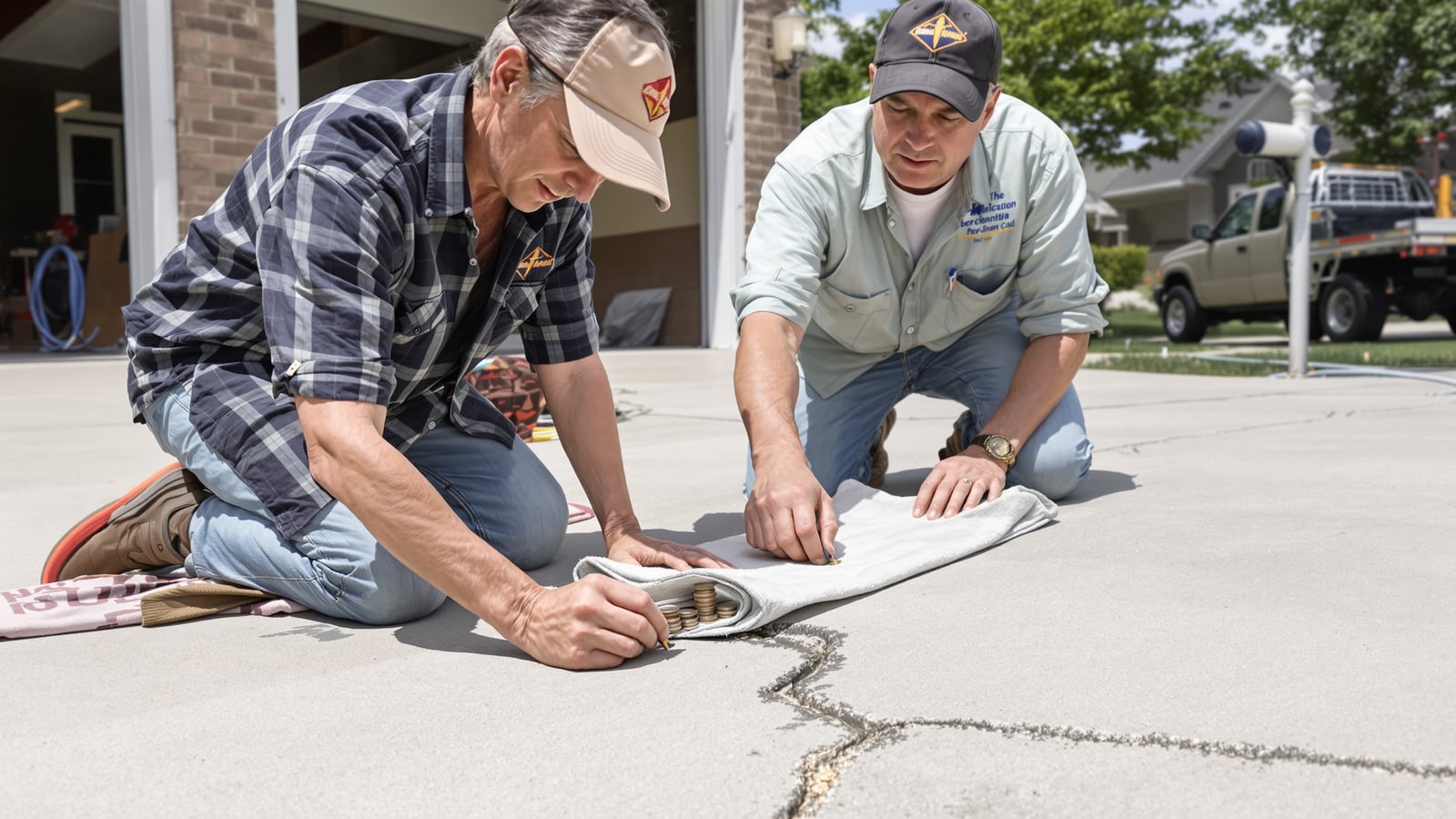
Quick answer: A crack that stays the same width and stays level is almost always cosmetic. Seal it and move on. A crack that widens, branches, or leaves one side higher than the other is telling you something is going on underneath. Mark it, measure it, and watch it for a season before you spend a dime.
Every slab cracks
Concrete shrinks as it cures. That's physics, not bad workmanship. The straight grooves cut across your driveway are there on purpose, to give the slab a weak line to crack along so it does it neatly.
So a hairline crack in a driveway that's a few years old doesn't mean the builder cheated you. It means the concrete did what concrete does. The cracks that deserve your attention are the ones that keep moving after the slab has been sitting for years.
Looks alone won't separate the two kinds. A scary-looking crack can be dead stable, and a thin one can be the start of a real problem. What separates them is behavior over time.
The pencil test
Do this on a dry day.
- Take a pencil and draw a short line straight across the crack at each end, and one in the middle on a longer crack.
- Write the date next to each line.
- Measure the width at each mark. A quarter is just over one sixteenth of an inch thick. Four stacked is a bit over a quarter inch. If you'd rather not play with coins, a cheap plastic crack gauge from the hardware store does the same job.
- Take a photo with a tape measure laid beside the crack.
- Check again after a hard freeze, after a stretch of heavy rain, and after a dry summer spell.
If the marks still line up and the width hasn't changed in a full year, you have a stable crack. If the pencil lines have drifted apart, or the crack has crept past one of the end marks, it's moving.
This costs nothing and it settles most of the arguments people have with contractors.
Three signs of a crack that's going somewhere
It's growing. Wider at the same spot, or longer at the ends. A rule of thumb many contractors use is that a crack wider than about a quarter inch deserves a closer look. Treat that as a prompt to investigate, not a diagnosis.
One side sits higher than the other. This one matters most. When the two edges are at different heights, the ground under one side has dropped or heaved. A lip of a quarter inch or more is also a trip hazard, and you'll find that out the hard way when somebody's carrying groceries.
It branches. One clean line is shrinkage. A web of cracks spreading in every direction, or a cluster that looks like dried mud, points to a weak base under the slab, often from poor compaction or water that's been washing soil out from beneath it.
Location counts too. Check these spots first:
- Cracks that run toward the house or the garage slab, especially if the driveway has pulled away from the apron.
- Cracks near a big tree. Roots lift slabs, and they don't stop.
- Any spot where water pools after rain. Water is the thing that turns a small problem into a large one, because it softens the ground below and then freezes and pries things apart in cold climates.
The fix for a crack that stays put
A stable crack is a ten-dollar job. The point of sealing it isn't to make it disappear. It's to keep water out.
Dig out loose debris with a screwdriver, scrub it with a wire brush, and blow it clean. Let it dry completely. For a crack wider than about a quarter inch, push foam backer rod into it first so the sealant has something to sit on and doesn't sink out of sight. Then fill it with a flexible, self-leveling concrete crack sealant. Check the label for the temperature range, because most products want mild, dry weather.
Skip the rigid cement patch on anything that might still be moving. It cracks and pops out within a season, and you end up with two problems instead of one. A flexible sealant can stretch a little when the slab does.
If the slab has seen a few winters, it's worth resealing every year or two. Put it on the same list as gutters and caulk. The home maintenance calendar that prevents the big repairs has a place for it.
When to stop and call someone
Some things aren't a weekend job, and pretending otherwise gets expensive.
- A section that has sunk or tilted. Concrete contractors can often lift a slab back into place with poured foam or a slurry pumped underneath, which usually costs far less than tearing out and replacing it. They can also tell you whether the soil is still shifting.
- A crack that has widened over your pencil marks even after you've fixed any drainage problems.
- A driveway that now slopes toward the house or garage, sending water where it shouldn't go.
- A crack that continues up the foundation wall or into the garage floor. That's no longer a driveway question. Ask a structural engineer, who has nothing to sell you but an opinion.
Get at least two quotes, and ask each contractor what's causing the movement before you ask what it costs. If nobody can tell you why the slab moved, that's a bad sign. I'd lean on knowing when to stop and how to get a quote you can trust before anyone signs anything.
If you're buying a house
Walk the driveway before you walk the kitchen. Photograph every crack with something for scale. Look for height differences between slabs and for any place the pavement meets the garage floor.
A hairline crack in a ten-year-old driveway shouldn't scare you off a house. A tilted slab with a pooling puddle by the garage should make you ask the seller what they know. It's also the kind of thing to raise with your inspector, and what your home inspector won't check, and what you should covers the gaps in a standard report. Their report may not cover the driveway in any detail.
The habit that saves you money
Most people look at a crack once, decide it looks bad, and either ignore it for five years or hire someone to fix it the first week. Both are guesses.
Do the third thing. Mark it, date it, and look again in the spring.
Wes Dunbar
Country & Skills
Grew up on an acreage and never quite left. Covers trucks, trades, land, and how to do the thing yourself.

Watch
Worth an hour of your evening
More from Home.
From channels we rate. Plays on YouTube.
Read next