

A dull ax is the one that cuts you
A sharp ax bites and sticks. A dull one skips toward your shin. Here's how to keep a sound edge at camp with a file, a stone and ten minutes.
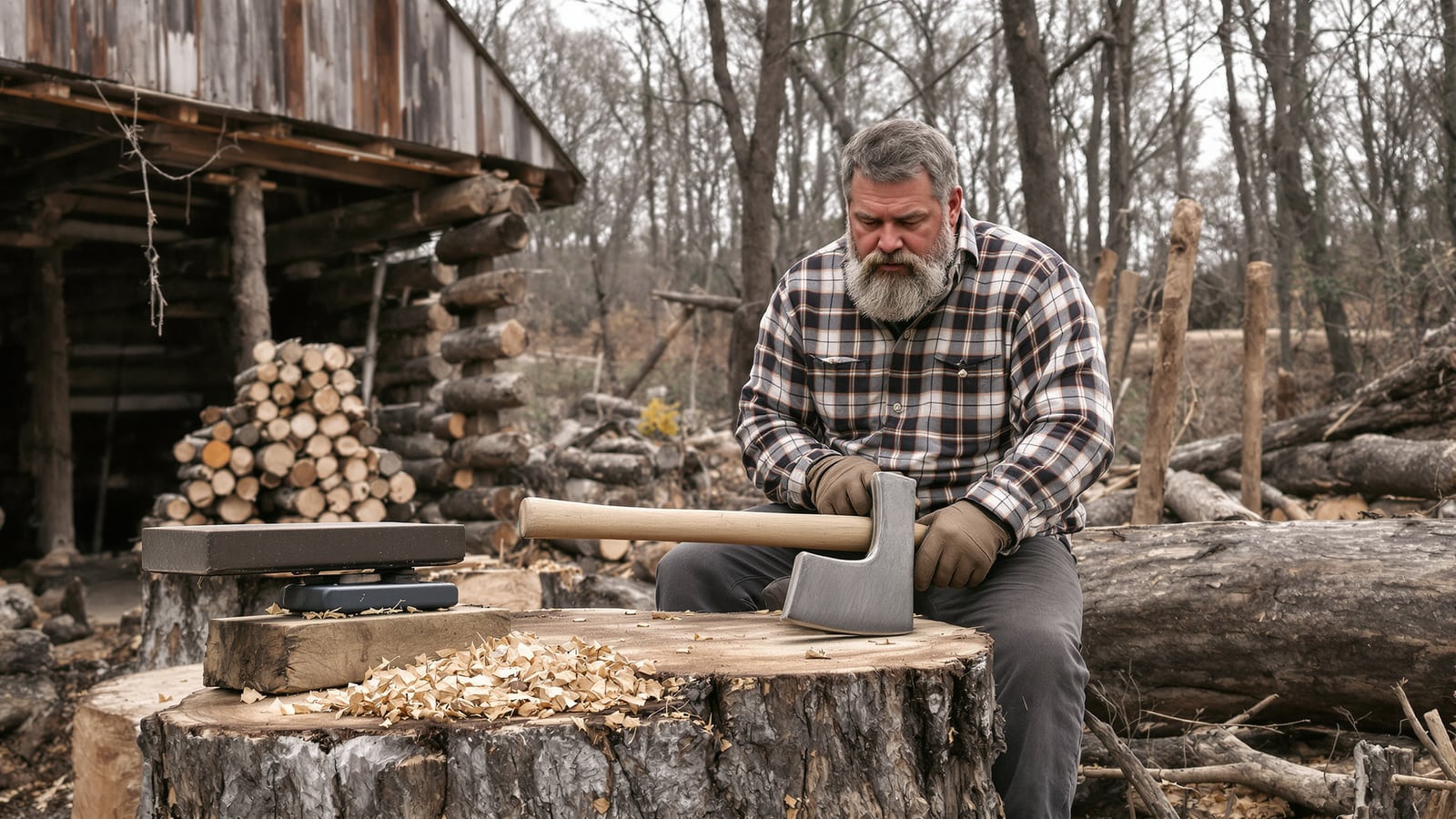
Quick answer: You don't need a razor. You need a clean, sturdy edge with no flat shine and no nicks, plus a head that doesn't wiggle. A 10-inch mill bastard file and a pocket stone will keep that for years.
A sharp ax bites into the wood and stays there. A dull one meets a frozen oak round, finds nothing to grab, and goes wherever the energy sends it. Usually that's sideways, and your leg is often sideways.
That's the whole case for sharpening. It isn't about looking like a lumberjack. It's about the ax doing what you told it to do.
Sharp doesn't mean thin
Most guys sharpen an ax like a pocketknife. They grind a long, skinny bevel until it shaves arm hair, then wonder why it chips on the first knotty split.
A splitting edge is a wedge. It forces the wood apart more than it slices it. A thin, knife-keen edge is fragile in hard, cold wood and tends to roll or chip. A slightly fuller edge holds up better and still bites.
Keep the factory shape. The bevel on a decent ax head is a curve, and it should stay a curve. If you start grinding flat facets with a bench grinder, you'll overheat the steel and lose the temper. Blue or straw-colored metal near the edge means it's already ruined. File by hand. It's slower, and slow is the point.
Check it before you swing
Do this at the trailhead or in the truck bed, not after you've started chopping.
- The edge. Hold the ax so light hits the edge head-on. A bright, shiny line means the edge is rolled or worn flat. A sharp edge reflects nothing. Look for nicks too. They show up as little bites of missing steel.
- The thumbnail test. Lay your thumbnail across the edge at a right angle, never along it, and press lightly. A sharp edge grabs the nail. A dull one skates. Go slowly and keep your fingers out of the way.
- The head. Grab the handle, brace the head against your hip and twist. Any rattle or movement is a problem. A loose head can fly off mid-swing, which is worse than any dull edge. A hardware store wedge and a little patience fix most of it. If the handle's cracked near the head, replace it.
- The handle. Check for splits and for finish that's gone slick. Leave the grip unvarnished. A light coat of boiled linseed oil keeps wood from drying out without making it slippery.
Sharpening at camp
You need three things: a 10-inch mill bastard file, a small sharpening stone (a diamond puck works fine), and something to hold the ax still. A vise is best. Out in the field, drive the head into a stump with the edge facing up, or have a buddy hold it. Wear leather gloves. Files slip.
- Remove nicks first. If there's a chip, work the file at the edge until the chip is gone and the line of the edge runs smooth. It takes more strokes than you'd think. Don't skip it.
- File with the bevel. Set the file flat against the existing bevel and push it from the back of the bevel toward the edge, following the curve. Use long, even strokes. Don't saw back and forth. Lift on the return.
- Count your strokes. Fifteen on one side, then flip and do fifteen on the other. Keeping the sides even keeps the ax tracking straight in the wood.
- Raise and remove the burr. Run a finger across the edge from the back side, carefully, and you'll feel a faint wire edge. That's the sign you've reached the edge. Take your stone and work it in small circles to knock the burr down on both sides.
- Stop. Don't chase perfection. A few minutes of work with a file will beat a half hour of fussing.
Back at home, a leather strop with a little compound will polish it further if you care to. A camp ax doesn't need it.
What dulls it faster than wood does
Dirt. Rocks. The ground.
The fastest way to take the edge off a good ax is to swing it into soil, gravel or a rock hidden under the surface of a stump. Always chop on a block, a big log set on end, never on bare ground. The last inch of a swing is where people get lazy and let the head touch the dirt.
Never use the ax as a hammer on tent stakes or a pry bar on a stuck log. Don't toss it in the truck bed loose with the wrenches either. A leather sheath or even a cut-up piece of garden hose keeps the edge from getting banged up and keeps everyone else safe from it.
Wipe the head clean at night and rub a thin film of oil on the steel. Damp air and wet wood will start rust in a single trip.
Swing like it's trying to get you
An ax doesn't have bad intentions. It just has no sense.
Clear a circle around you before you swing. You want a space at least two ax-lengths in every direction, free of kids, dogs, brush and guy lines. Look overhead for dead branches as well. Nobody else stands inside that circle while you work. That includes the kid who wants to watch.
Use a stable stance with your feet wider than your shoulders. When you're splitting, kneel on one knee if the wood is low. A glancing blow then has only the ground to hit, not your shin. Place your off hand well away from the strike zone and never hold a piece with your hand while somebody else swings.
For kindling, use a small hatchet and split sticks from a block. Don't hold a stick upright in one hand and chop at it. Set it down.
Don't swing when you're tired, cold to the point of clumsy, or after dark with only a headlamp. The ax will still be there in the morning.
If the worst happens, put firm pressure on the wound with a clean cloth, keep it raised, and get to medical help right away. A deep cut isn't something to wrap up and tough out. Pack a real first aid kit with trauma gauze in it, which is one more reason to carry the Ten Essentials every time.
Take what's already fallen
Leave no trace applies to firewood too. Use dead and down wood, and only what you need. Don't hack at standing trees, living or dead. Standing dead trees shelter birds and insects and can also drop on you.
Gather wood no thicker than your wrist from the ground around camp, not from the same patch the last party stripped bare. Check fire restrictions before you leave home, because many areas ban fires outright in dry months. And don't haul firewood across long distances. Buy it near where you'll burn it, since moving wood can carry pests into new forests.
If you're camping with family for the first time, a small sharp hatchet and a bundle of store-bought wood is plenty. One night out doesn't call for a full woodlot. And if you're choosing where to pitch, pick a spot you can leave quickly, with a clear, flat place to work.
A good ax outlasts the man who owns it. Treat it that way. File it, oil it, sheath it, and hand it down with a better edge than it had when you got it.
Wes Dunbar
Country & Skills
Grew up on an acreage and never quite left. Covers trucks, trades, land, and how to do the thing yourself.

Watch
Worth an hour of your evening
More from Outdoors.
From channels we rate. Plays on YouTube.
Read next