

Six knots you can tie blind, and the job each one does
Forget the poster of forty knots. Learn six until your hands know them in the dark, with cold fingers and a dead headlamp.
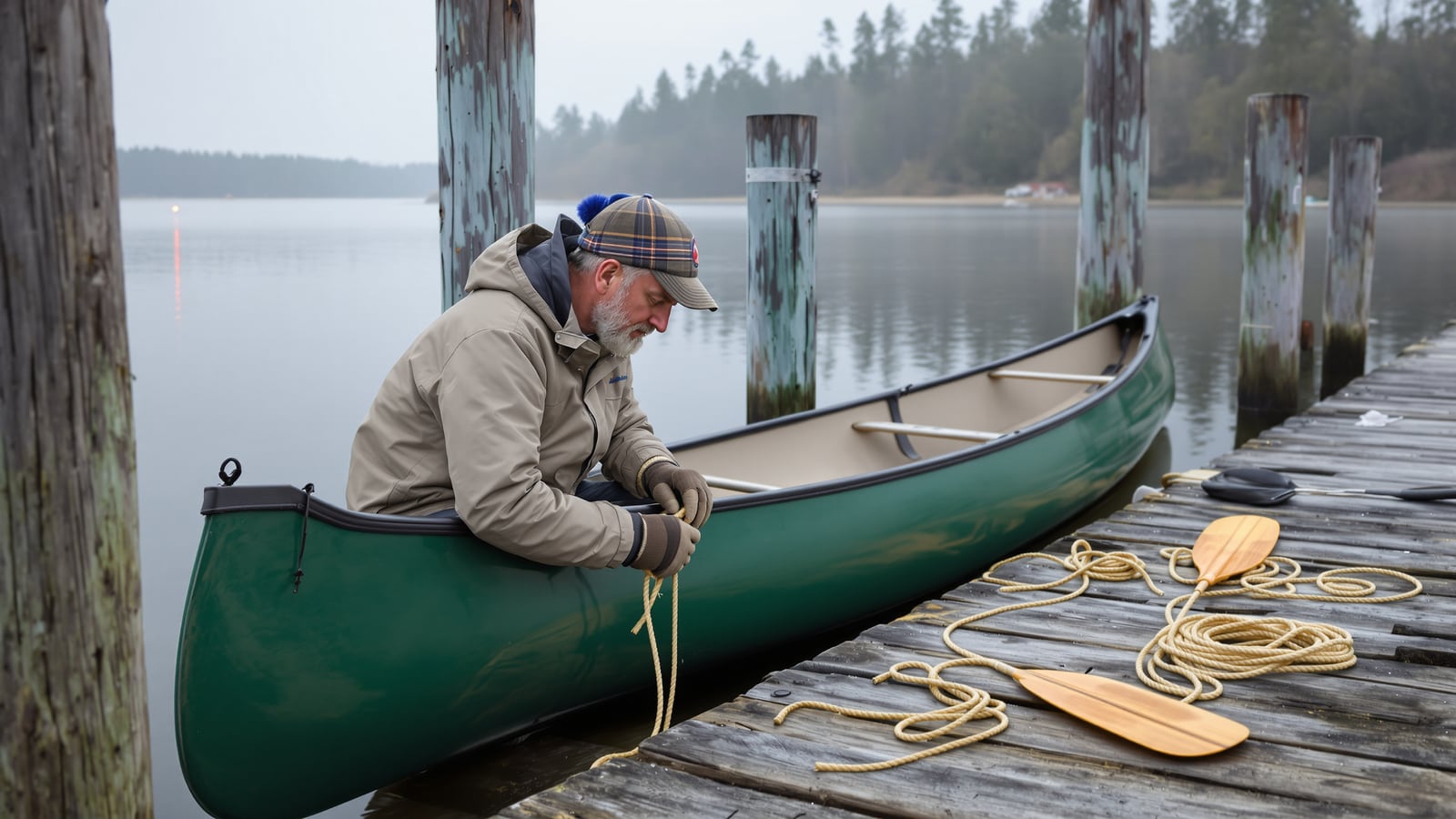
Quick answer: Bowline, taut-line hitch, trucker's hitch, clove hitch, round turn and two half hitches, sheet bend. Practice each one ten times with your eyes closed, then once more with gloves on. That covers a tarp, a canoe, a bear bag, a load in the truck bed and a broken line.
The test is 2 a.m. and rain
Nobody ties a good knot at noon with a coffee in hand and the cord laid out like a diagram. The knot that matters is the one you tie when the wind has found your tarp, the headlamp battery is gone, and your fingers feel like sausages.
Hands remember. Eyes mostly distract. So the whole method here is simple: get a six-foot piece of ordinary 3/16-inch cord, sit somewhere comfortable, and tie each knot until you can do it with your eyes shut. Make the second half of every practice session happen in the dark or in thick gloves. It's dull. It works.
One boundary first. Everything below is for camp work, hauling, tarps, boats and trucks. A knot that holds a life, whether climbing, rappelling or rescue, is a skill you learn from a qualified instructor in person. Don't improvise it from an article.
1. Bowline: the loop that won't slip
Use it for a fixed loop at the end of a line. Tie a boat's bow line to a ring, a haul loop on a pack, a loop to hang a food bag. Under load it holds. After a hard pull it still unties by hand, which is the whole reason people have trusted it for centuries.
By feel: twist a small loop into the line, a "hole" in the standing part. Bring the end up through the hole, behind the standing line, and back down through the hole. Snug it.
The annoying part is that a bowline can work loose when it goes slack and gets shaken, like a boat line in a chop. Leave a tail at least as long as your hand and finish with a loose overhand knot around the loop as insurance.
2. Taut-line hitch: the guy line that adjusts
Every tarp and tent guy line wants to be tightened after the first hour, once the fabric has stretched and the stakes have settled. A taut-line hitch slides when you push it and grips when you pull.
Wrap the end around your anchor and back along the standing line. Take two turns around the standing line inside the loop, working toward the anchor. Then one more turn outside the loop, on the side away from the anchor. Snug it, and it slides.
It likes textured cord. On slick line it creeps, so add a third turn. And remember the Leave No Trace part: if you're tying around a living tree, use a wide strap or a loose wrap, never a cinched cord that cuts into the bark.
3. Trucker's hitch: the one that does the heavy lifting
This is a pulley made out of the rope itself. In theory it multiplies your pull about three to one, less once friction takes its share. In practice it's what gets a ridgeline drum-tight, a canoe snugged to a rack, or a load held down in a bed. I covered how the rest of that setup comes together in Your Truck Is Already an Overland Rig.
Twist a loop into the standing line. Run the end around your anchor and back through the loop. Pull down hard, then lock it off with two half hitches.
The warning that the cheap tutorials skip is that you can pull too hard. A canoe hull can dent or crack under a cranked-down line, and a tarp can rip at a grommet. Tight is the goal. Crushed isn't.
4. Clove hitch: fast on, fast off
The clove hitch is how you attach a line to a pole, a post, a paddle or a branch in about three seconds. It's also the starting knot for most lashings.
Two turns around the post, crossing in the middle, with the end tucked under the second turn. Pull both ends and it grips.
Know its weakness. If the pole can roll, or the load goes on and off, a clove hitch can slip. Back it up with two half hitches when you can't watch it. It's a great starter knot and a poor finishing one.
5. Round turn and two half hitches: the dock and tree knot
Take two full wraps around a post or rail, then two half hitches on the standing line. The wraps carry the friction, so the hitches only have to keep things tidy. That's why the knot holds a steady pull, like a canoe on a dock or a tarp line on a stout anchor, and still comes undone when you want it to.
Tie it first at a fence post. It's the easiest to learn, and you'll use it more than you expect.
6. Sheet bend: joining two ropes honestly
Two lines too short? A square knot looks like the answer. It isn't, because under uneven load it can capsize and spill. The sheet bend is the real way to join two ropes, and it works even when one is thicker than the other.
Make a bight in the thicker line. Pass the thinner line up through it, around the back of both parts of the bight, and tuck it under itself. Pull the standing lines apart. Every knot loses some strength in the rope, and joining two lines is one of the places that matters, so check it by hand after the first strain.
Make it stick
Learn them in this order: bowline, round turn and two half hitches, clove hitch, taut-line, trucker's, sheet bend. That's roughly easiest to hardest, and the early ones show up in the later ones.
Then put the practice cord somewhere it can't be ignored. Keep it in your pack's lid pocket with the spare headlamp batteries and the rest of the kit from The Ten Essentials and Why Veterans Still Carry Them. Tie one knot while the kettle heats up. Tie another when you're stuck waiting for someone else to finish their dinner.
Know when weather turns. A tarp that has to go up fast in a storm is a bad time to remember how a hitch goes. The Weather That Kills Hikers and How to Read It in Time is the reason to have this done before the sky changes.
Leave it better than you found it. When you break camp, untie every line, coil it, and pick up the scraps of cord that always seem to end up under the tarp. A clean site is part of the skill.
The man who can tie a bowline blind doesn't think much about it. He thinks about the next job. That's the entire point.
Wes Dunbar
Country & Skills
Grew up on an acreage and never quite left. Covers trucks, trades, land, and how to do the thing yourself.

Watch
Worth an hour of your evening
More from Outdoors.
From channels we rate. Plays on YouTube.
Read next