

Set your turnaround by the sun, not the mileage
Most hikers who get caught in the dark weren't slow or lost. They kept walking toward a summit after the clock said to quit.
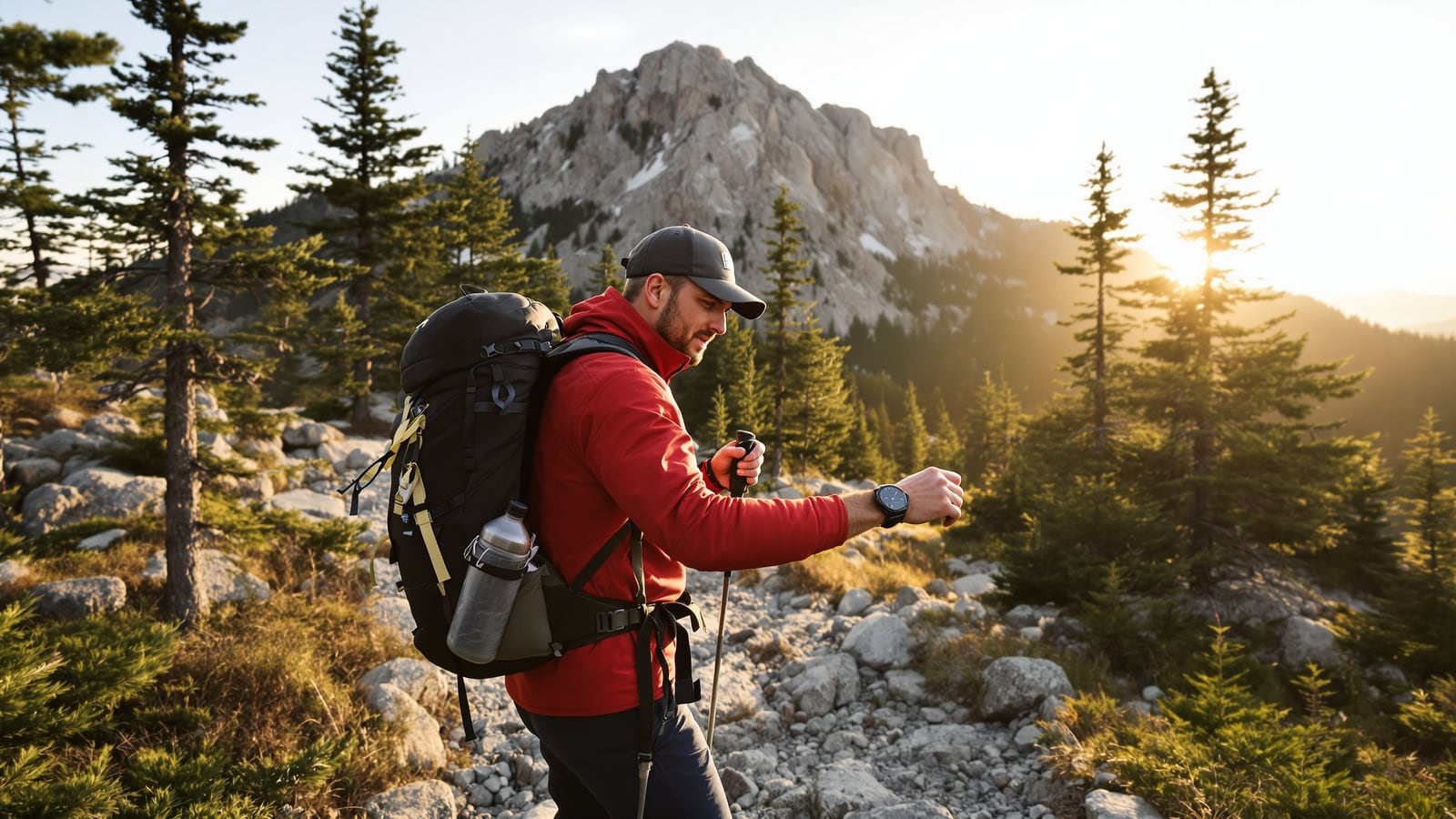
Quick answer: Find sunset for your trail's date. Subtract the time the hike back will take, plus a 30-minute cushion. That's your turnaround time. When the clock hits it, you turn around, even if the summit is in sight.
The mistake is measuring the wrong thing
Ask a hiker how far they're going and they'll say a number of miles. Ask when they have to turn around and you'll often get a blank look.
Distance is a lousy way to plan a day. Six flat miles on a gravel path and six miles gaining 2,400 feet over roots and loose rock are different afternoons. Sunset is the one number that doesn't care about your fitness, your boots or how good you felt at the trailhead. It shows up on schedule.
So build the plan backward. Start with the time you want to be standing at your truck, then work out how late you can be at the far end of the hike.
Do the math at the kitchen table
Take a real example. Sunset is 7:40 p.m. You want to be back at the trailhead by 7:10, with a little light left for the drive out and the boots and the gear in the bed.
The route is six miles one way with 2,400 feet of climbing. A rough planning number is Naismith's rule: an hour for every three miles, plus an hour for every 2,000 feet you climb. That's two hours for the distance and about 1.2 for the climb, call it 3.2 hours up.
Now the part people skip. Going down feels faster, and on smooth ground it can be. But your legs are tired, the trail is steep, and your knees are doing the braking. On rough terrain, budget the way back at roughly what the way up took. It's a planning number, not a law. If you've hiked the route before, use your own times.
So you need about 3.2 hours to get down. Add a 30-minute cushion for a blister, a wrong turn, or the stop where you finally eat something. That's 3.7 hours before 7:10, which puts your turnaround at about 3:30 p.m.
If you're still twenty minutes below the summit at 3:30, you turn around. The mountain will be there next month.
The sun quits earlier than the almanac says
The sunset time on your phone is for flat ground at the horizon. You're not hiking on flat ground.
In a canyon or on the east side of a ridge, the sun drops behind rock well before the listed time. Under thick evergreens, the forest floor goes gloomy long before that. You can lose an hour of usable light on a north-facing trail and never see a sunset at all.
Two other things work against you:
- Seasons. Around the spring and fall equinoxes, daylight changes by a couple of minutes every day at mid-latitudes. A hike you did comfortably in early September can run you into the dark in October on the same schedule.
- Temperature. When the light goes, the cold comes down fast, especially at elevation. A hiker in a T-shirt at 3 p.m. can be miserable by 6.
Check the sunset time for the date you're actually hiking, not the one you remember from last trip.
Summer storms are a second clock
In many mountain ranges, afternoon thunderstorms build on a predictable schedule, and sunset isn't the only deadline. If your route puts you on an exposed ridge or summit at 2 p.m. in storm season, your turnaround may be set by the sky long before the sun matters. The weather that kills hikers, and how to read it in time covers what to watch for. Use whichever deadline comes first.
Write it down and say it out loud
A turnaround time that lives in your head will get renegotiated at the worst moment. You'll be tired, the view will be close, and you'll hear yourself say "we're almost there." Everyone says it. It's usually wrong.
Do three things before you leave the lot:
- Write the time down. Put it in your phone notes, or stick a strip of tape on your watch band. A number on paper is harder to argue with.
- Tell your group. Say it once, early, when everyone's fresh and thinking clearly. "We turn at 3:30, no matter where we are." Then nobody has to be the bad guy at 3:30, because the decision was made hours ago.
- Tell someone at home. Give them the trailhead, the route, your turnaround, and the time you'll be back. Tell them that if they haven't heard from you an hour after that, they should call the local sheriff's office. That plan costs nothing and has found people.
If you're the one leading, own it. Serve the group by being the person who calls it, and don't give ground when somebody pushes. The one who says "we're turning around" on a good-weather day gets a bit of ribbing. The one who didn't gets a search party.
Carry the dark with you anyway
Plan to be out by sunset. Pack as if you won't be.
A headlamp with fresh batteries and a spare set is the minimum. The flashlight on your phone is not a plan. It drains the battery you may need to call for help, and it leaves one hand holding a phone on terrain where you want both free. Add a warm layer and a little extra food. It's all on the Ten Essentials list veterans still carry for exactly this reason.
If you're heading out overnight, the same logic applies at the other end of the day. Get to camp with enough light to set up, cook and find the bathroom spot without a scramble. Pick a campsite you can bail from in forty minutes is the companion to this one.
If the light goes anyway
It happens to careful people. Here's the sequence:
- Stop and eat. Put on your layer and your headlamp before you do anything else. Panic is mostly low blood sugar and cold.
- Stay on the trail you know. If it's well marked and you're sure of the route, slow down and keep walking. Short steps, trekking poles if you've got them, and a hand on the downhill side.
- Don't take a shortcut. Bushwhacking down a drainage in the dark is how people end up above a waterfall or a cliff band.
- If you've lost the trail, stay put. Backtrack only to the last place you were sure of. If you can't find it, stay where you are. Three whistle blasts, repeated, is the standard distress signal. Searchers look for people who stayed put.
The only thing the trail asks
Every trail has a point where the smart move and the exciting move split apart. You'll feel it, usually with a view just ahead and the clock saying go home.
Take the smart one. A man who turns around at 3:30 gets to come back in better shape, with a better plan, and brings his kids next time.
Pack out what you packed in, and leave the trail cleaner than you found it. Then be at the truck while there's still light to see it.
Wes Dunbar
Country & Skills
Grew up on an acreage and never quite left. Covers trucks, trades, land, and how to do the thing yourself.

Watch
Worth an hour of your evening
More from Outdoors.
From channels we rate. Plays on YouTube.
Read next