

Your sleeping pad matters more than your sleeping bag
Most cold nights outdoors are lost through the ground, not the air. Check the R-value, match it to the night, and stop blaming your bag.
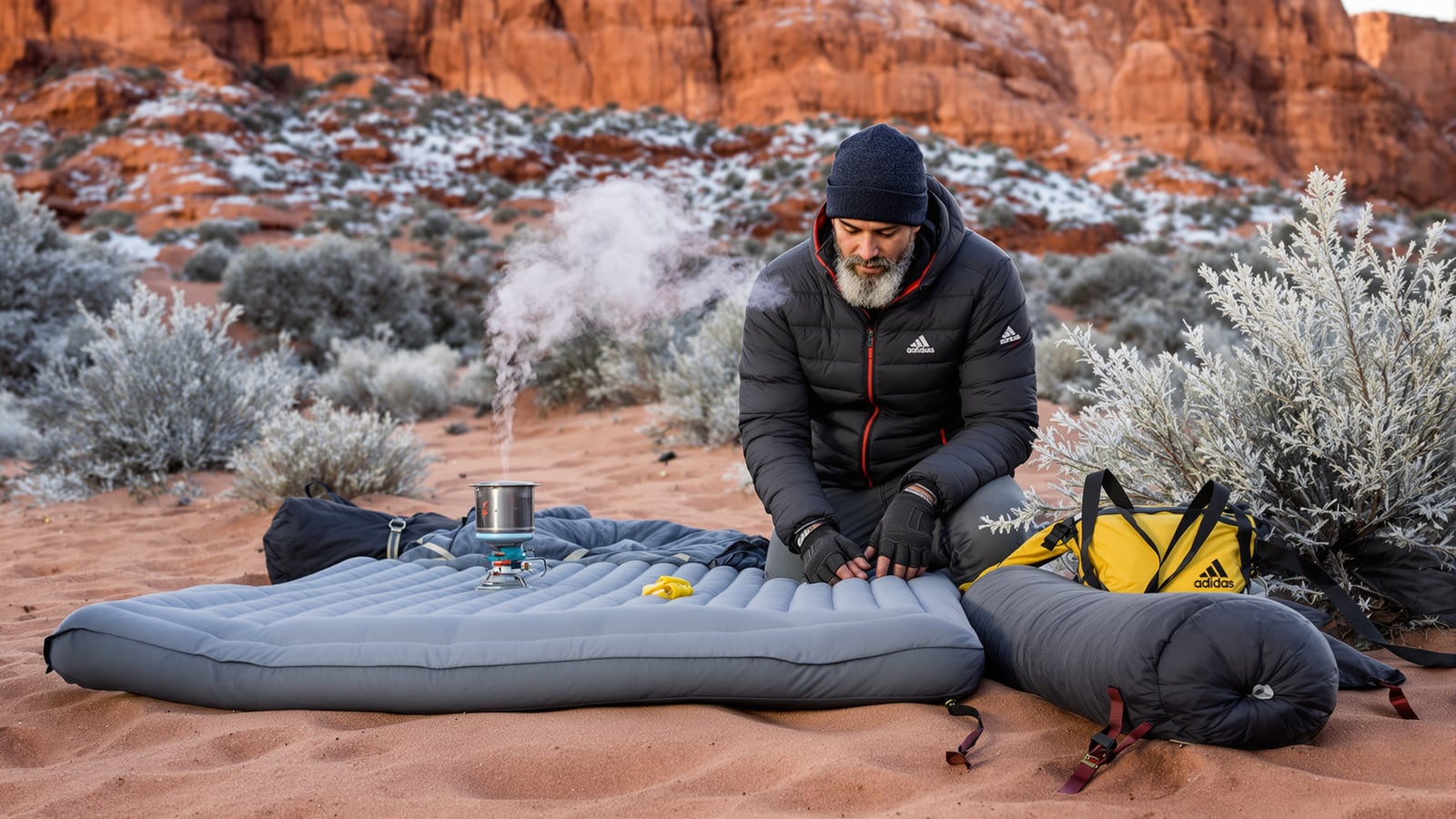
Quick answer: Ignore thickness and read the R-value, which measures how well a pad resists heat loss into the ground. Roughly, R 2 works for warm summer nights, R 3 to 4 covers most three-season camping, and R 4 to 5 or more is where freezing nights start. A foam pad under an air pad adds warmth and covers you if the air pad fails.
The 2 a.m. problem
It's 38 degrees. Your bag is rated to 20, so you figured you were covered. You zipped in at ten, and by two you're curled into a ball with your back cold and your top half fine.
That's not the bag. It's what's under you.
Insulation works by trapping air. Lie on a sleeping bag and your body weight crushes the fill beneath you flat. The loft that keeps your top half warm barely exists under your back and hips. The ground, meanwhile, is a bottomless heat sink. It never warms up and it never stops taking. (The related piece on how the ground steals your heat before the air ever does covers the physics.) The pad is the only thing between you and it.
So a fifty-dollar bag on a good pad will often beat a four-hundred-dollar bag on a bad one. Spend in that order.
The number on the box
R-value is the only spec that tells you how warm a pad is. Higher is warmer. Thick doesn't mean warm. A three-inch air mattress with no insulation inside can have a lower R-value than a thin foam pad, because the air in it circulates and carries your heat away.
A few real examples:
- Therm-a-Rest Z Lite Sol, the folding foam pad with the egg-carton surface: about R 2.0.
- Therm-a-Rest NeoAir XLite NXT, an air pad that packs to the size of a water bottle: about R 4.5.
- Klymit Static V, the original, a popular budget air pad: about R 1.3. Fine in July. Miserable in October.
- Therm-a-Rest NeoAir XTherm NXT, built for winter: around R 7.
Since about 2020, most major brands test to the same industry standard, so a number on one box means roughly the same thing as the same number on another. Older pads and off-brand listings may not follow it, so be wary of a bare "R 5" on a no-name pad with no mention of how it was tested.
Match the pad to the ground, not the forecast
Air temperature gets all the attention. The ground temperature matters more for your pad choice, and it lags behind the air. Early summer ground can still be cold. Late summer ground holds warmth into September.
Rough guidance, and it's only rough:
- Warm nights, above about 50 degrees: R 2 is plenty.
- Three-season, down to about freezing: R 3 to 4.
- Below freezing: R 4 to 5 at the very least.
- Snow camping: R 5 or more. Many winter campers go higher.
Cold sleepers should round up. Warm sleepers can round down. And if you're buying one pad for everything, buy for the coldest night you'll realistically camp, because it's easy to sleep warm on a warm night and impossible to fix the reverse.
R-values also add together. A closed-cell foam pad under an air pad stacks the numbers. A 2.0 foam pad under a 4.5 air pad gets you somewhere near 6.5. That's a cheap winter system, and the foam doubles as insurance if the air pad springs a leak at midnight.
Width, length and how you sleep
Warmth isn't the only thing that decides whether you wake up wrecked.
Side sleepers need thickness. A hip pressing through a one-inch pad hits the ground by 1 a.m. and you'll spend the night rolling over. If you sleep on your side, look at pads around three inches thick.
Width matters if you shift. A standard pad is 20 inches wide. Roll off the edge at 3 a.m. and your arm lands on the dirt. Regular-wide pads at 25 inches cost a few ounces more and are worth it for most big guys and restless sleepers.
Length: if your feet hang off, the ground takes them. Short pads save weight, but you can put your pack or boots under your feet to cover the gap.
What I'd buy and what I'd skip
For most people, buy: an insulated air pad in the R 3.5 to 4.5 range, plus a cheap folding foam pad you can lay under it. The Therm-a-Rest NeoAir XLite NXT is the benchmark for backpacking. The Z Lite Sol is the foam pad that's lasted a generation of campers.
For car camping, weight doesn't matter, so buy a thick self-inflating pad and enjoy it. Your truck bed or tent floor doesn't care that it weighs three pounds. If you're setting up out of a truck, the piece on why your truck is already an overland rig makes the case for packing comfort you'd never carry on foot.
Skip: any uninsulated air mattress for anything colder than a summer night. Skip the "it feels so thick in the store" test too. Thickness feels great in a store and does nothing at 30 degrees.
The honest trade-off: foam is bulky, strapped to the outside of a pack, and not as comfortable. Air pads are comfortable, light and compact, but they can puncture, and a leak is a bad night. That's why the two together beat either one.
Test it before it counts
Blow it up at home. Leave it overnight and see whether it's still firm in the morning. A slow leak found in the living room is an annoyance. A slow leak found at a trailhead is a ruined weekend.
Then sleep on it in the backyard. If you're planning your first trip, your first overnight backpacking trip and what to leave home will tell you what's worth carrying, and a backyard night will tell you whether your pad belongs on the list. If you're taking the family out, your first family camping trip should be one night is still right. One cold, bad night is a long one when kids are on the pad.
Pack a patch kit and use the pump
Carry the repair kit that came with the pad. Know where it is. Find a leak by listening for it or running a wet fingertip over the surface, then patch it dry.
Don't blow it up with your mouth in cold weather. Your breath puts moisture inside, which lowers insulation and can grow mold. Use the pump sack or built-in pump.
Store it unrolled or loosely rolled, valve open, in a closet. Not compressed in its stuff sack for the winter.
Leave the boughs alone
Old-timers cut fir boughs for bedding. Don't. Stripping live trees for a mattress scars a campsite for years, and it's against the rules in most places. The pad is the leave-no-trace answer, and it's lighter than the boughs ever were.
Pack it out clean. Shake off the dirt, wipe it down, and leave the site looking like nobody slept there.
Buy the pad for the night you're dreading. You'll never regret the extra warmth, but you will remember the night you skimped.
Wes Dunbar
Country & Skills
Grew up on an acreage and never quite left. Covers trucks, trades, land, and how to do the thing yourself.

Watch
Watch how it's done
Picked for this article.
From channels we rate. Plays on YouTube.
Valley and Peak
R-Value Ratings Explained: How to Choose the Right Sleeping Pad.
Justin Outdoors
Sleeping Pad R-VALUE Explained
Read next