

The battery space heater math nobody prints on the box
A 1,500-watt heater will drain a 1,000 watt-hour battery in under an hour. Here's what keeps a house warm when the grid goes down.
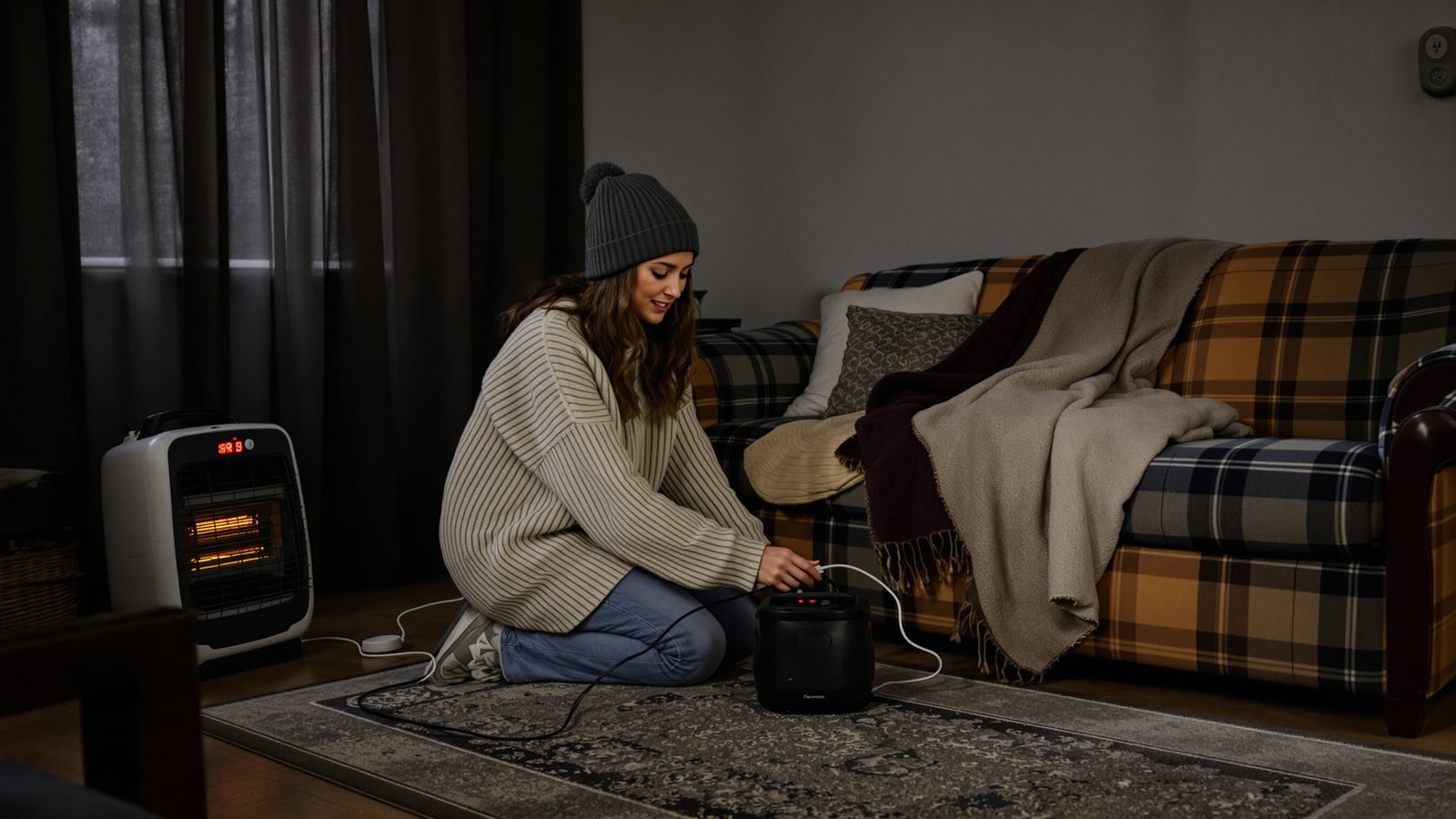
Quick answer: A battery can't run a full-size electric space heater for a night. Heat is the hungriest thing you can ask a battery to make. Plan on a heater that burns fuel and is rated for indoor use, a working carbon monoxide alarm, and warm gear that draws almost no power.
Do the arithmetic before you buy
A standard plug-in space heater tops out at 1,500 watts. That's what a normal household circuit can safely feed it. Run it for an hour and it uses 1,500 watt-hours.
Now look at the box on the portable power station you're eyeing. Say it's a 1,000 watt-hour model. Divide. You get about 40 minutes, and less once you account for the energy lost converting battery power to household current.
That's the whole story. A big battery is a fine thing to own. It just isn't a furnace.
Some products advertise heaters with built-in batteries and "all-night" run times. Find the watt-hour number. If the listing doesn't print one, walk away. If it does, divide it by the heater's watts and see whether the claim survives. Small heaters that really do run for hours achieve it by putting out very little heat. That's a personal warmer, not a room heater.
What a battery can do well
Batteries are good at small loads. Use them for those.
- Electric blankets and heated throws. They draw a small fraction of what a space heater does, and they warm the person rather than the air. Check the label wattage, but they're in a different league from 1,500.
- Heated vests, jackets and gloves. These run on their own small rechargeable packs. Charge them before the storm.
- Phones, radios and lights. The things you actually need the battery for. A power station that spends itself on a heater has nothing left for the radio that still works when the internet doesn't.
The honest trade-off: heated gear keeps you comfortable, not the house. Pipes still freeze in a cold house. If the outage will last, you need real heat in at least one room.
The heater that actually works
For a true room heater with no grid, the answer is a propane heater built and labeled for indoor use. The Mr. Heater Portable Buddy is the familiar example. It runs on one-pound propane cylinders, offers settings from roughly 4,000 to 9,000 BTU, and carries a low-oxygen shutoff and a tip-over shutoff. Compare that to the 1,500-watt electric heater, which is about 5,100 BTU, and you see why fuel wins at this job.
Read the manual and follow it. Specifically:
- Use it only if it's labeled for indoor use. Camp stoves, charcoal and gas grills, and propane patio heaters aren't. They kill people every winter.
- Crack a window. Manufacturers call for fresh-air ventilation. Do it even though it feels like you're letting the warmth out.
- Keep it at least three feet from anything that burns. Curtains, bedding, couches, the dog's blanket.
- Never leave it running while you sleep unless the manufacturer's instructions allow it. Most don't, and fire and carbon monoxide agencies say the same.
- Put it on a flat, solid surface where kids and pets can't knock it over.
Check that your local rules and your lease or insurance allow fuel-burning heaters indoors. Some places restrict them. A call to your local fire department's non-emergency office settles it.
Don't buy an unvented kerosene heater just because it's cheap. Many jurisdictions restrict them, and the fuel and fumes demand more care than most households give.
The alarm that's non-negotiable
Any fuel-burning heater means a carbon monoxide alarm in the house, with battery backup, tested before the storm and not during it. Press the button. Replace the batteries on a schedule you'll remember. Put one near the sleeping areas.
Carbon monoxide has no smell and no color. The early signs feel like the flu: headache, dizziness, nausea, confusion. If the alarm sounds or anyone has those symptoms, get everyone outside into fresh air and get medical help right away. Don't go back in to open windows or shut the heater off first.
The same warning covers generators. Never run one in a garage, a basement or near a window. Our piece on generator placement and the twenty-foot rule covers where it goes and what cord to use.
If you do have a generator, you can run an electric space heater from it, but size the load honestly. A 1,500-watt heater eats most of a small portable unit. Plug the heater into a heavy-duty cord rated for the load, not a thin household extension cord, and keep the generator outside and well away from the house.
Shrink the space, keep the heat
Whatever heater you own, it will do more in a small room.
Pick one room, ideally an interior one with few windows. Shut the doors. Hang blankets over the windows. Shove a towel against the gap under the door. Put the family there at night.
Layer clothes, wool and synthetics over cotton, and add a hat. Cold feet make the whole body feel cold, so get dry socks on and keep a sleeping bag rated for low temperatures for each person. Sleeping bags are the cheapest heat you'll ever buy, and they need no power or fuel.
Stay hydrated and keep eating. Your body makes heat from food.
What I'd buy and what I'd skip
Buy:
- A carbon monoxide alarm with battery backup, tested.
- An indoor-rated propane heater with low-oxygen and tip-over shutoffs, plus enough cylinders for the days you're planning for.
- Sleeping bags rated for the lowest temperature you're likely to see.
- A heated blanket or heated gear, if you own a power station.
Skip:
- Any "battery heater" listing with no watt-hour figure.
- Any grill, camp stove or outdoor heater brought inside. Ever.
- Spending your whole power station on one hour of warmth.
If you've never planned for a week of this, what a week without power actually takes walks through the rest. And the seventy-two hour kit is where the sleeping bags and spare cylinders belong.
Run the math on the box before you pay for the battery. It takes ten seconds, and it's the cheapest research you'll do all winter.
- power outage heating
- portable power stations
- winter storm preparedness
- carbon monoxide safety
- emergency heat
Wes Dunbar
Country & Skills
Grew up on an acreage and never quite left. Covers trucks, trades, land, and how to do the thing yourself.

Watch
Worth an hour of your evening
More from Preparedness.
From channels we rate. Plays on YouTube.
Read next