

Stop choking your wood stove to make the wood last
Closing the damper too far doesn't save fuel. It turns your firewood into smoke and your chimney into a fire hazard. Do it in this order.
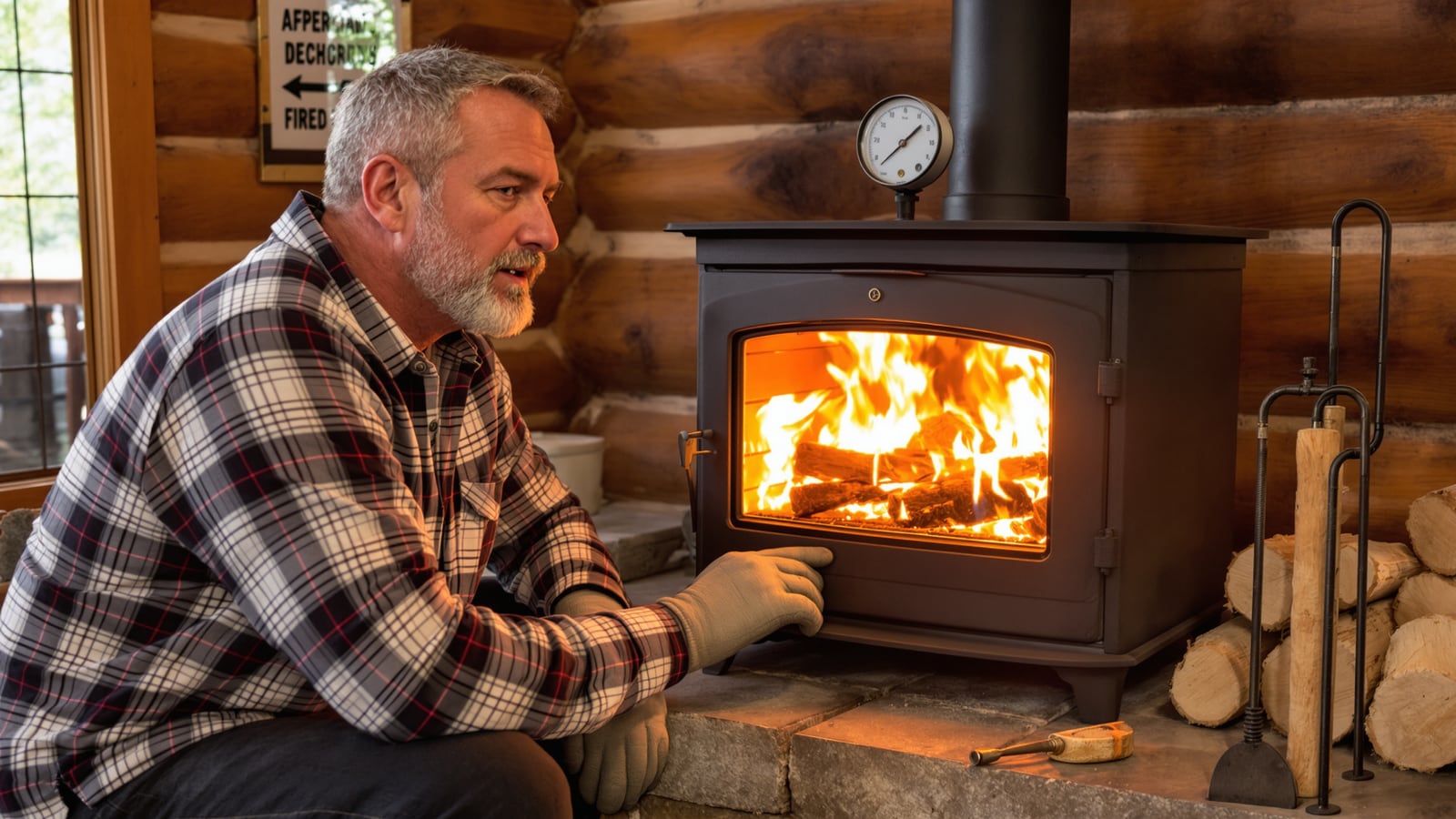
Quick answer: Open the damper and air control all the way to light the fire and to reload. Run it hot for 15 to 20 minutes, until the wood is charred and burning with real flames. Then close things down in small steps. Stop when the flames are lazy but still alive and the pipe thermometer reads roughly 300 to 500 degrees. Never close it far enough that the fire smolders.
The mistake most people make
A fire that burns hot and fast feels like money going up the chimney, so people throttle it down hard. It feels frugal. It isn't.
A starved fire doesn't burn less wood. It burns the same wood badly. The gases that should burn in the firebox leave as smoke, cool off in the pipe and stick to the inside as creosote. You get less heat and a dirtier chimney, and creosote is what fuels a chimney fire.
Heat comes from a fire that's getting enough air. The damper's job is to tune that air, not to strangle the fire.
Know which control you have
Two different things get called "the damper."
A flue damper is a round plate on a rod inside the stovepipe, with a handle outside. Handle in line with the pipe usually means open, and crosswise means closed. Don't trust that. Handles get installed every which way. Look inside the pipe if you can, or watch what the fire does when you move it.
An air control is a lever or slide on the stove itself that meters air into the firebox. Most newer stoves have only this, and many have no flue damper at all. If that's you, everything below still applies. Your air control is the thing you're adjusting.
Some older stoves have both. Open the flue damper first, then work the air.
Before you touch anything
- Carbon monoxide alarm within earshot of where people sleep, with fresh batteries. A plug-in or battery unit is fine. If you'd rather hardwire alarms, read the wiring jobs worth doing yourself and the ones that aren't first.
- Chimney cleaned and looked over in the last year by a certified sweep, or by you if you know what you're looking at.
- A magnetic stovepipe thermometer. It's cheap, and it's the only way to stop guessing. Stick it on single-wall pipe about 18 inches above the stove. Double-wall pipe reads cooler, so go by the stove manual if yours is double-wall.
- Dry wood. Split pieces stacked off the ground and covered on top for a year or two, longer for oak. Wet wood wastes heat boiling off water, and no damper setting fixes that. A cheap moisture meter will tell you if it's under 20 percent.
- Your manual. If it gives operating temperatures that differ from the ones here, the manual wins.
If anyone gets a headache, nausea or dizziness while the stove is running, treat it as carbon monoxide until proven otherwise. Get everyone outside into fresh air and get medical help right away. What to do in the ten minutes before the ambulance arrives is worth reading before you ever need it.
Light it wide open
Open the flue damper all the way. Open the air control all the way. If the stove has a bypass or a start-up setting, use it.
If the chimney is cold, the air inside it is heavier than you'd like and may not rise. Prime it first. Roll up a sheet of newspaper, light it and hold it near the base of the flue for a minute, or crack a window near the stove. You want to feel air moving toward the fire, not smoke leaning out at you.
Build the fire the way you always do. Then leave the door latched, or cracked only if your stove's manual says to. Let it go. This is the part people cut short, and it's the part that matters.
Close it in steps
Wait until the kindling has caught the logs and the logs are charred on every side, with flames rolling across the top. That's usually 15 to 20 minutes. Check the thermometer. If it's climbing past 300, you're ready.
- Close the flue damper about a quarter of the way. Wait five minutes. Watch the flames and the thermometer.
- Then bring the air control down a bit. Another five minutes.
- Repeat in small moves until the flames are steady and unhurried, not roaring and not licking weakly at the wood.
Stop when the pipe sits in the 300 to 500 range and the fire is still clean. Every stove is different, so you're learning yours. Mark the setting that works with a dab of paint or a scratch next to the lever. Next week you'll thank yourself.
Don't do it all in one move. Slamming it shut can snuff the flame and fill the room with smoke.
Read the fire
The fire tells you if you got it right.
Too closed:
- Dark, sooty glass.
- Dull, orange, lazy flames, or no flames at all.
- Smoke smell in the room.
- Pipe temperature dropping below about 250 and staying there.
Open it up a notch and give it ten minutes.
Too open:
- Roaring sound.
- Pipe temperature well past 500, climbing toward the manual's limit.
- Stove glowing, or paint blistering.
- Logs gone to ash in an hour.
Close it a notch. If you see the stove or pipe glowing red, shut the air control right away and keep people back.
If you ever hear a deep roar from the chimney, or see flames or sparks shooting out the top, that's a chimney fire. Shut the air control, get everybody out of the house and get the fire department on the way from outside.
Reload without smoking out the room
Most smoke in the living room comes from reloading wrong.
- Open the flue damper and air control all the way first.
- Crack the stove door an inch for a few seconds, then open it slowly. That lets the stove equalize and pull instead of puff.
- Rake the coals forward, put the new wood on and shut the door.
- Run it wide open for a few minutes until the new wood is burning, then close down in steps again.
Reload while there's still a good bed of coals, not when the fire is almost dead. A hot bed lights the new wood fast, so you spend less time wide open and the stove stays clean.
Overnight
Load it full with big, dense splits, burn it hot for 20 minutes, then close down in steps, stopping a little more closed than usual. Keep the thermometer in the lower half of its range. It won't last until breakfast every time, and that's fine. A stove that's still warm at 6 a.m. with a few coals in it is a win. One that's black glass and a smoky house isn't.
Leave it better than you found it
If you're borrowing a cabin or a friend's stove, take the ashes out into the metal bucket, wipe the glass, restack the wood box and bring in a load for the next person. Leave the stove with a clean grate and a full box.
And write down your setting. The guy who lights it next will want to know what works.
Wes Dunbar
Country & Skills
Grew up on an acreage and never quite left. Covers trucks, trades, land, and how to do the thing yourself.

Watch
Worth an hour of your evening
More from Skills.
From channels we rate. Plays on YouTube.
Read next