

Tune a chainsaw carburetor until it idles, cuts and stays alive
Most bogging saws don't need a carburetor adjustment at all. Rule out the cheap culprits first, then set the screws in the right order.
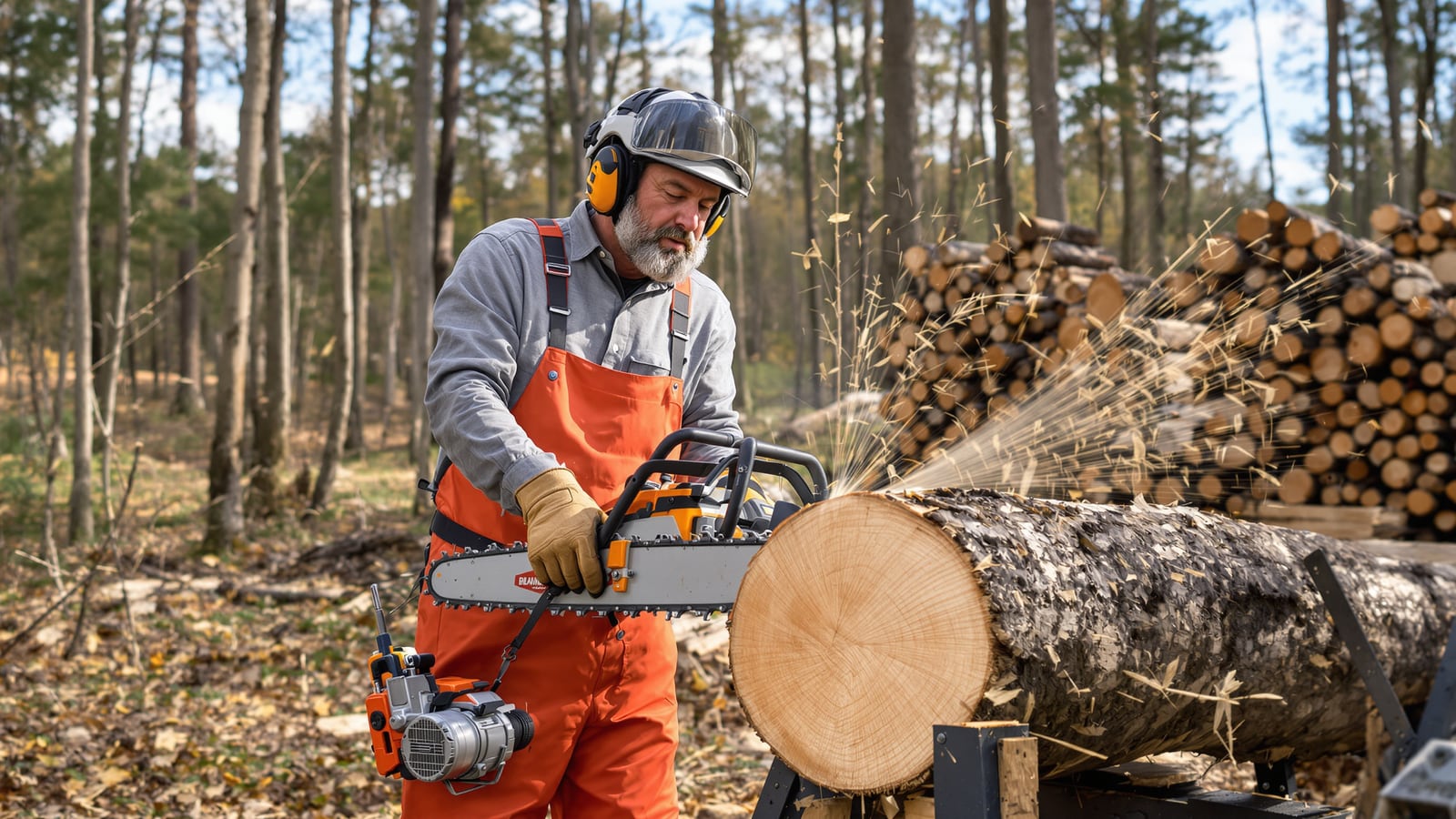
Quick answer: Fix the fuel, air filter, spark plug and chain first, because those cause most "carburetor" problems. If the saw still misbehaves, warm it up, set the idle, set the low screw, then set the high screw a hair rich. Adjust in eighth-turns.
Rule out the impostors first
A man hauls a saw to the shop saying it bogs in the cut. The mechanic sharpens the chain and hands it back. Happens constantly.
Before you touch a screw, check four things:
- Fuel. Mixed gas goes stale in a matter of weeks, and ethanol blends make it worse. If the can has been in the garage since last winter, dump it and mix fresh at the ratio printed on your saw or in the manual. Many saws call for 50:1. Check yours.
- Air filter. Pull it, knock it out, look at it. A clogged filter starves the engine and mimics a lean or rich problem.
- Spark plug. Dry, tan and clean is fine. Black and wet or crusty means replace it. It's a few dollars.
- Chain. A dull chain makes a healthy saw feel weak. If it throws fine dust instead of chips, sharpen it before you blame anything else.
If the saw still won't behave, now you can look at the carburetor.
Safety before you start
You'll be running the saw and putting a screwdriver near a spinning engine, so set it up right.
- Work outside on flat ground. Exhaust is carbon monoxide, and a closed garage is no place for it.
- Wear eye protection, hearing protection and gloves. Chaps are cheap insurance if you own them.
- Set the saw on the ground with the chain brake on and the bar pointing at nothing. Never adjust a saw you're holding in the air.
- Keep the chain clear of dirt and your boots. If your idle screw is set too high, the chain will creep, and you need to find that out with the bar well away from you.
- Let the engine cool before refueling, and fuel away from any spark.
A saw is a tool you respect every time. If something ever goes wrong, what to do in the ten minutes before the ambulance arrives is worth reading before you need it.
Find the screws and get a baseline
Most saw carburetors have three adjustments, usually marked near the screws:
- H is the high-speed screw. It controls fuel at full throttle under load.
- L is the low-speed screw. It controls fuel at idle and off idle, the moment you squeeze the trigger.
- T or LA is the idle speed screw. It sets how fast the engine turns when you're off the trigger.
Your manual lists the factory starting position for H and L, typically somewhere between one and one and a half turns out from lightly seated. It differs by model, so look it up. If your saw has plastic limiter caps on the screws, you'll only get a quarter to half turn of adjustment either way. That's an emissions feature, and it's why the steps below move in tiny increments.
You may need a special tool. Many saws use a splined or D-shaped driver, not a flathead. Match the tool to the screw. Forcing the wrong one chews it up.
If the settings are way off, reset them. Turn each screw in gently until it just seats, and stop there. Cranking it down bends the needle tip, and that ruins the carburetor. Then back it out to the manual's setting.
Set the idle, then the low screw
Start the saw and let it warm up for two or three minutes. Tuning a cold engine gets you a bad tune.
Idle first. With the saw idling, the chain should sit perfectly still. If it creeps, turn the T screw counterclockwise a little. If the engine dies at idle, turn it clockwise. You want the lowest idle that keeps the saw running without the chain moving.
Now the low screw. Here's the method that works:
- With the saw idling, turn L slowly clockwise (leaner) until the engine stumbles or wants to die. Note that spot.
- Turn it counterclockwise (richer) until the engine runs rough and smoky. Note that spot too.
- Set the screw halfway between the two.
Now snap the trigger. The saw should jump up to speed cleanly. If it hesitates or sputters before catching, open L an eighth of a turn richer and try again. Retune the idle afterward, because the two interact.
A saw that falls on its face when you squeeze the trigger is almost always too lean on the low side.
Set the high screw, and err rich
This is the one that can hurt the engine. A lean high-speed setting runs hot and can score the piston in a matter of minutes. A slightly rich one costs you a little power and some smoke. Take the rich side.
The best tool is a tachometer. Your manual gives a maximum no-load RPM, and a small-engine tach clipped on the plug wire tells you where you are. If you don't have one, use your ears.
Give the saw full throttle with the bar in the air for only a second or two, no longer. Listen:
- Rich: it burbles and "four-strokes," a rhythmic brrr-ap-ap-ap, with blue smoke. That's fine, and it's the direction you want to lean toward from.
- Lean: it screams high and flat, with no burble at all. Back off the trigger immediately.
The target is a saw that burbles slightly at full throttle in open air, then smooths out and holds a strong, even pitch once the bar is buried in wood. Turn H in eighth-turns, clockwise to lean it, counterclockwise to richen it, and make a real cut in a log between each adjustment. The cut is the true test.
If it bogs in the cut, the high screw is probably too rich, or the chain is dull again. If it screams and loses power, or you smell hot metal, richen it right away.
When to stop and take it in
Adjustment fixes a saw whose settings drifted. It doesn't fix a carburetor with a hardened diaphragm, a clogged jet, or a cracked fuel line. If you've set it right, used fresh fuel, and it still dies, stops idling, or floods, you're past a screwdriver. A new carb kit or a shop visit is cheaper than a seized engine. Knowing where your own job ends is the same discipline as in the wiring jobs worth doing yourself and the ones that aren't.
Finish like a pro
Shut it down, let it cool, and wipe off the sawdust and oil. Stored with fuel in it for months, the carburetor gums up and you're right back where you started. Either run it dry or use fresh mix next season.
And if the saw is a neighbor's, bring it back sharpened, cleaned and with a full tank of mixed fuel, even if it came to you near empty. That's how you get asked again.
Wes Dunbar
Country & Skills
Grew up on an acreage and never quite left. Covers trucks, trades, land, and how to do the thing yourself.

Watch
Watch how it's done
Picked for this article.
From channels we rate. Plays on YouTube.
Steve's Small Engine Saloon
CORRECT WAY To Adjust Or Tune The Carburetor On A Chainsaw (Step-by-Step)
Chickanic
HOW TO ADJUST your 2 Cycle Carburetor on a Chainsaw or Trimmer and when you probably shouldn't VLOG
Read next