

Bleed your radiators so every room actually gets warm
A cold radiator with a hot pipe feeding it usually means trapped air. The fix takes a four-dollar key, a rag, and about twenty minutes.
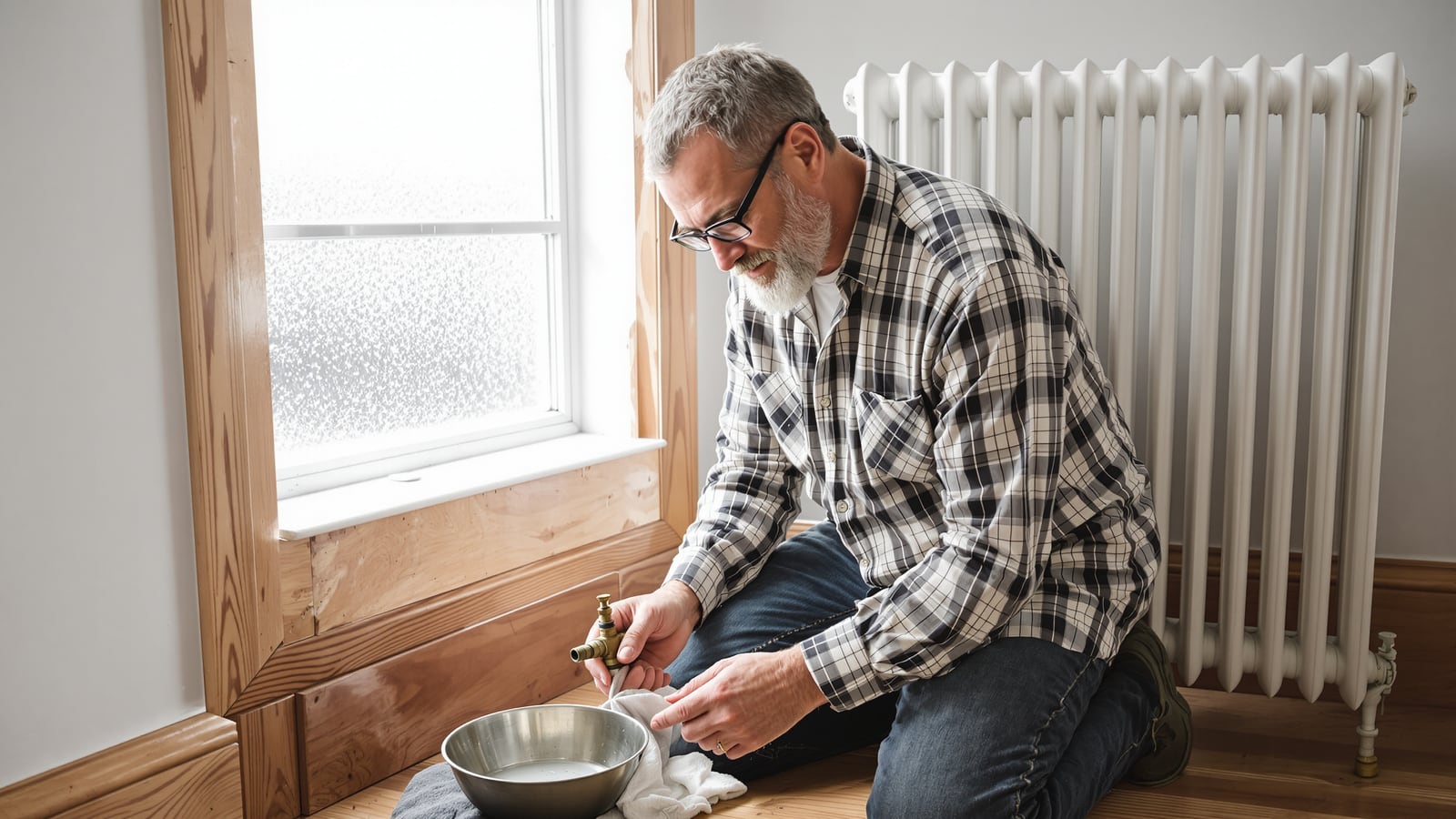
Quick answer: If a radiator is cool at the top and hot at the bottom, air is trapped inside. Shut off the heat, let the system cool, open the small valve a quarter turn until water spits, close it, then check the boiler pressure.
This job is for hot-water systems: radiators or baseboard units fed by a boiler. Steam systems are different. They've got air vents built in, and opening a valve on a steam radiator is a good way to make a mess. If you aren't sure which you have, look for a boiler with a pressure gauge and a small tank nearby. Steam radiators usually have a vent on one end that hisses on its own. Check the boiler's manual or the label on it.
Find the cold ones first
Run the heat for an hour. Then walk the house and put your hand on each radiator, top and bottom.
The pattern tells you what's wrong.
- Hot at the bottom, cool at the top: air. That's the one you can fix today.
- Hot at the top, cool at the bottom: sludge settled in the bottom. That's a flush, and it's a job for a heating pro.
- Cold everywhere: a valve, a pump, or a boiler problem. Bleeding won't touch it.
Make a list of the radiators with air. Upstairs ones are the usual offenders, since air rises and collects at the highest points.
Gather what you need
A radiator key costs a few dollars at any hardware store. It's a small brass or steel thing that fits a square nub on the bleed valve. Some newer radiators take a flathead screwdriver instead. Look at yours before you shop.
You also want:
- Two or three old towels
- A small cup or jar, a yogurt cup works
- A flashlight
- Something to write on, for the pressure reading
Put a towel under the valve before you open anything. The water that comes out is rarely clean, and it will find your carpet.
Safety before you touch a valve
Turn the heat off and wait. Set the thermostat down, shut off the boiler at its switch, and give it an hour or two. Water in a running system can be hot enough to scald you badly, and it comes out under pressure.
Shutting the system down also stops the circulator pump. A running pump can pull more air in while you're working, and you'd be undoing your own job.
If somebody does get scalded, run cool water over the burn and read what to do in the ten minutes before the ambulance arrives. Better still, don't skip the cooldown.
Keep kids and pets out of the room while you work. And if your boiler switch is hard-wired in a way that makes you nervous, stop there. Some electrical work is worth paying for, and the wiring jobs worth doing yourself and the ones that aren't will help you tell which is which.
Write down the pressure
Before you open a single valve, read the boiler's pressure gauge and write the number down. Most home systems sit somewhere around 12 to 15 psi when cold, but your manual has the real number for your unit.
Bleeding lets water out, and the pressure will drop. If it falls too far, the system won't heat right, and you'll have fixed one problem by causing another.
Start low and work up
Begin with the radiator closest to the boiler on the lowest floor. Then go to the next closest. Work away from the boiler and up through the house. The top floor is last.
At each one:
- Lay a towel on the floor under the valve and hold the cup against it.
- Fit the key onto the valve. It's usually near the top on one end.
- Turn it counterclockwise, a quarter turn. That's all. A half turn at most.
- Listen. A hiss means air is escaping. Let it go.
- When the hiss turns into a sputter and water starts to show, close the valve. Clockwise, snug, not cranked.
- Wipe the valve dry.
Don't walk away mid-bleed. Water follows air in a second or two.
And don't unscrew the valve any further than a quarter turn. On older radiators the valve pin can come out entirely, and then you've got a small fountain and a very long afternoon. If it does happen, push it back in with your thumb on the towel and tighten. It's rare. It's also the reason you go slow.
Read what comes out
Clear or slightly cloudy water is normal.
Black or rust-brown water means sludge is circulating, which is a bigger problem than a little air. Bleed a bit more to see if it clears. If it stays dark, stop and call a heating contractor. That's a flush, and the job needs equipment you don't own.
If a radiator won't stop hissing, or water comes out without any air at all, close the valve and move on. That radiator's air isn't the problem.
Check the pressure and top it up
When every radiator on your list is done, go back to the gauge.
If it's within a pound or two of where it started, you're fine. If it dropped well below, you'll need to add water through the boiler's fill valve. Most boilers have one, usually a lever or small wheel on a pipe near the gauge. Open it slowly until the pressure comes back to the number you wrote down, then shut it.
Some boilers have an automatic fill and will do this for you. Check the manual if you aren't sure which kind you've got. Don't overshoot, and don't leave a manual fill open and walk off.
Turn it back on and test
Switch the boiler on, set the thermostat, and give the system an hour. Walk the house again with your hand.
Most radiators will be warm from top to bottom. A few may take a second round, because air can hide in the loop. If the same one is cold again a week later, you've got something else going on: a leak, a failing air eliminator, or a pump issue. Keep topping off the pressure and you're hiding the evidence. Have a pro look.
Leave it better than you found it
Hang the radiator key on a nail by the boiler where you'll find it next October. Wipe the floor dry. Put the towels in the wash instead of back in the closet.
Do this before the first cold snap each year, and you'll rarely have to do it at six in the morning with a freezing house and a bad attitude. A warm home is one of those quiet things a man provides without anyone noticing, until the day he doesn't.
Wes Dunbar
Country & Skills
Grew up on an acreage and never quite left. Covers trucks, trades, land, and how to do the thing yourself.

Watch
Worth an hour of your evening
More from Skills.
From channels we rate. Plays on YouTube.
Read next