

Make a belt sander track straight in five minutes
A belt that crawls off the roller chews your housing and your workpiece. One knob fixes it, if you turn it the right way.
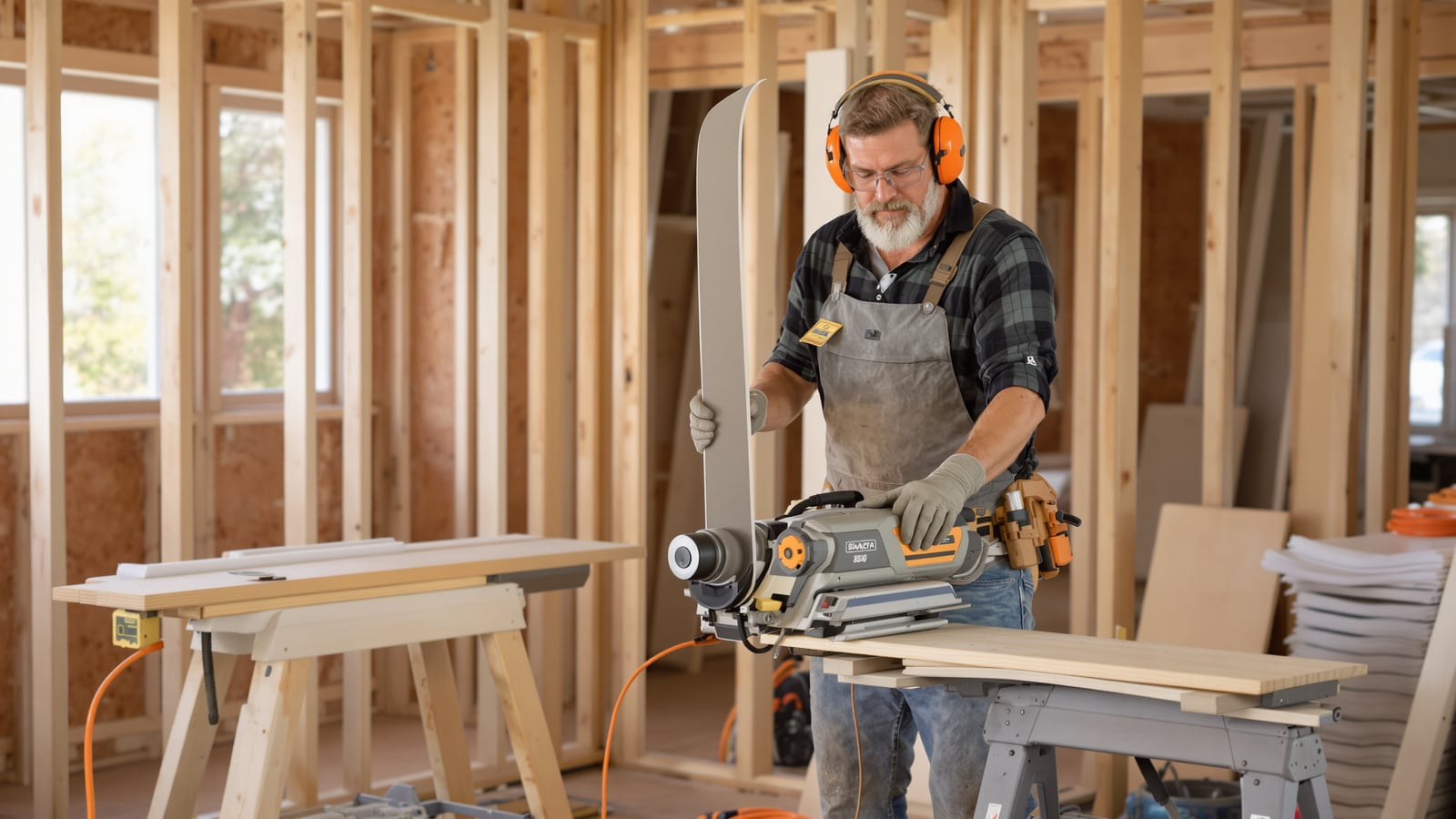
Quick answer: Unplug it, seat the belt with the arrow pointing the way the belt turns, then run it in the air and nudge the tracking knob a quarter turn at a time until the belt rides still. Test it again with light pressure on scrap wood.
A belt sander that walks sideways does three things to you. It scars your project with a crooked edge. It grinds the belt's edge against the housing until the belt frays or snaps. And it makes you fight the tool with your wrists, which is how a sander gets away from you.
The fix takes five minutes. It's mostly patience.
Unplug it first
Pull the plug from the wall. Don't rely on the switch or the lock-on button. You're about to put your fingers near a roller, a spring and a belt, and a tool that starts while your hand is in there will take skin.
Put on safety glasses. Add a dust mask and hearing protection for the test run, because you'll be running the sander in the open and it throws grit.
Look at the cord while you're at it. If the insulation is cracked or the plug is loose, stop and read the wiring jobs worth doing yourself and the ones that aren't before you plug anything in.
Check the belt before you touch the knob
Half the sanders that "won't track" have a bad belt. Run your fingers along the seam. It should be flat and even. A lumpy or overlapped seam makes the belt wobble and no knob will cure that. Look for torn edges and a belt that's stretched out of shape. Throw those away. A new belt costs a couple of dollars. Your afternoon is worth more.
Also check the size. A 3x21 sander wants a 3x21 belt. A 3x24 belt on a 3x21 machine will fit just badly enough to waste your time.
Seat the belt correctly
Inside every sanding belt is a printed arrow. It shows the direction the belt travels. Point it the same way the belt turns on your tool, which on most sanders means the arrow points toward the front, the same direction the tool pulls itself across the wood. If the belt runs backwards, the seam can catch and split.
To fit it, flip the tension lever to release the front roller. Slide the belt over both rollers and around the platen, the flat plate in the middle. Then snap the lever shut. The belt should be snug but not drum tight.
Now spin each roller by hand. They should turn freely. If one is gummed with sawdust, wipe it with a dry rag or a stiff brush. A dirty roller makes the belt drift and costs nothing to clean.
Find the tracking knob
Look at the side of the sander, near the front roller. You'll find a knob or small screw. On most handheld models it tilts the front roller a few degrees. Tilt it one way and the belt creeps toward the housing. Tilt it the other way and it creeps outward.
Your manual will say which direction does what. If you've lost it, there's no mystery. Turn it a little and watch which way the belt goes.
Run it in the air
Hold the sander firmly in both hands, belt facing away from your body, away from the bench and everything breakable. Or clamp the body in a vise by its housing, never by the belt. Keep your fingers and hair clear of the roller.
Plug it in and run it at the lowest speed, if yours has a dial. Watch the belt for five seconds.
It will do one of three things. It might ride dead center, in which case you're done. It might creep toward the housing. Or it might drift away and hang off the outer edge of the roller.
Unplug it each time before you reach for the knob. Yes, every time. It feels fussy for about a minute and then it's habit.
Adjust in small moves
This is where people go wrong. They crank the knob a full turn, the belt slams the other way, and they chase it back and forth for ten minutes.
Turn it a quarter turn. Plug in, run, watch for a few seconds. The belt needs a moment to settle into its new path, so don't judge it in the first second.
Repeat until the belt sits steady. The edge should sit flush with the edge of the roller, or just a hair proud of it on the open side. If the belt sticks out far beyond the roller, it's out of true even if it isn't moving. Pull it back.
Test it under load
A belt that tracks perfectly in the air can still wander once you press it on wood. Take a piece of scrap pine and clamp it down. Don't hold it with your free hand, because a sander that kicks will take that hand with it.
Set the sander on the wood with the belt already running, and let the weight of the tool do the work. Lean on it too hard and you'll deform the belt and throw off the tracking.
Watch the belt's edge. If it still creeps under pressure, make a tiny correction, an eighth of a turn this time. Tracking changes slightly under load, so the winning setting is the one that holds on scrap, not the one that looked perfect in your hands.
If it still walks
Work down the list.
- Worn or stretched belt. Replace it. This is the usual culprit.
- Packed dust in the rollers or the platen. Clean it out.
- Bent platen or damaged roller. If a roller wobbles or the platen is warped, the sander needs repair or retirement.
- Wrong belt for the tool. Check the size stamped on your sander's housing.
- A knob that's reached its limit. If it won't hold or won't go far enough, something is worn inside.
Bench and stationary belt sanders work the same way, only the tracking knob usually sits on the back idler roller. Same method. Unplug, move a little, test, repeat.
Leave it better than you found it
Before you put the sander away, blow or brush the dust out of the housing and off the rollers. Pop the belt off if you're not going to use it for a while, because a belt left under tension for months stretches and loses its shape.
If you borrowed the tool, hand it back with a fresh belt on it. Nobody ever complained about getting a sander back cleaner than it left.
And next time it starts to walk, you'll know it's a quarter-turn problem. Treat it like one.
If you do catch a finger on a belt, or a spinning roller cuts you, stop work and read what to do in the ten minutes before the ambulance arrives. Get proper medical help for anything deep. Better yet, never be the guy who needs it. Unplug first.
Wes Dunbar
Country & Skills
Grew up on an acreage and never quite left. Covers trucks, trades, land, and how to do the thing yourself.

Watch
Worth an hour of your evening
More from Skills.
From channels we rate. Plays on YouTube.
Read next