

The Beaver Trappers Who Drew the Map of the West Without Meaning To
They went west for fur and a payday. What they left behind was the road map for a nation, and a bill that was paid in blood.
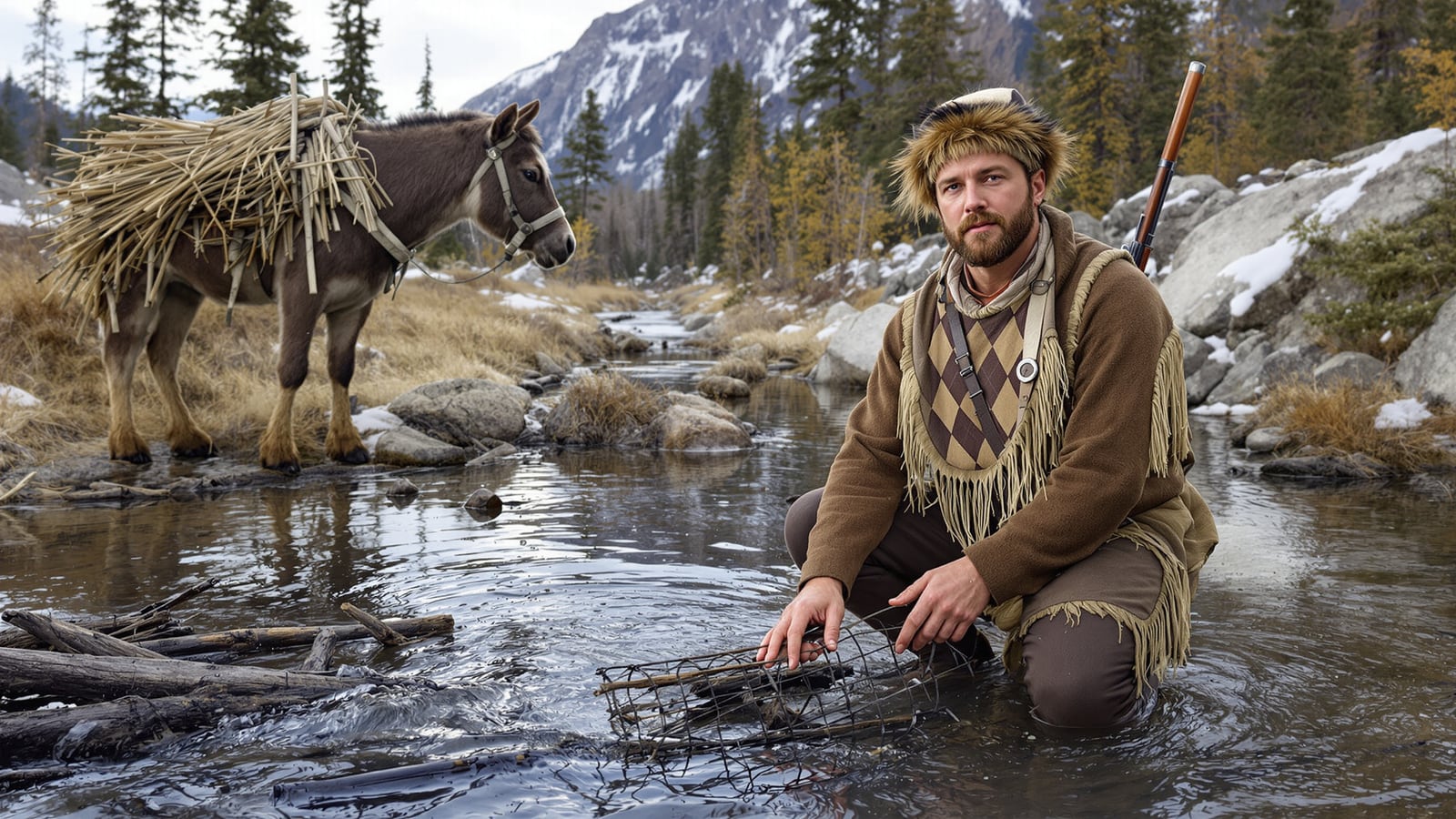
In February 1822, William Ashley ran an ad in a St. Louis newspaper asking for one hundred men to go up the Missouri River to its source and stay one, two or three years. He didn't mention the Blackfeet, the grizzlies or the winters. He didn't have to. Young men signed up anyway.
Among the ones who answered over the next few seasons were Jedediah Smith, Jim Bridger, Thomas Fitzpatrick and William Sublette. Bridger was eighteen. A few years later, a sixteen-year-old saddler's apprentice named Kit Carson slipped out of Missouri, and his master ran an ad of his own offering a reward of one cent for his return. Nobody collected.
None of them were setting out to explore. They were chasing beaver.
Why a rodent drew the map
Beaver fur made the felt for the hats that men in Eastern cities and European capitals wore, and a good pelt, called a plew, was money you could carry on a horse. The beaver lived in cold mountain streams, so the money lived in the Rockies. That's the whole logic behind the most remarkable geography lesson in American history.
A trapper didn't follow a trail. He followed water. He worked a creek, trapped it out, crossed the divide to the next one and did it again. Each season pushed him into country no American had written down. Nobody was making a map. They were making a living, and the map came along as a byproduct.
The system had a rhythm. Trappers scattered in small brigades through fall and spring hunts, then gathered each summer at a rendezvous on the Green River or nearby, where supply caravans from St. Louis met them. They sold their furs, bought powder, lead, coffee and whiskey, and headed back out. It was a business with a calendar, and it ran from 1825 to 1840.
The man who couldn't stay put
Jedediah Smith is the one to know. In 1824 he was with a party that crossed South Pass in what's now Wyoming. Americans had used it once, in 1812, and then lost track of it. Smith's crowd brought it back, and it became the gateway for the Oregon Trail. In 1830 Sublette took wagons through it to the rendezvous. Within a few years the wagon trains had a road.
In 1826 Smith led a party southwest from the Great Salt Lake, through the Mojave Desert and into California. He was the first American to reach it overland that way. The next spring he took two men and crossed the Sierra Nevada eastbound, then the Great Basin desert, in a march that killed most of their animals. They walked into the summer rendezvous at Bear Lake anyway.
He was also a man of discipline. He kept journals, studied the maps he could get and gave what he learned to William Clark in St. Louis, who was still the best map-maker in the country. Most of Smith's own papers were later lost. His routes weren't.
The hard parts
Here's the cost, and it's on the record.
On the Colorado River in 1827, Mojave warriors attacked Smith's party and killed ten of his men. In July 1828, on the Oregon coast, Umpqua people attacked his camp and killed fifteen of nineteen. Smith was off scouting and came back to a ruin. The causes are tangled. Earlier clashes with trappers sat behind both fights, and the trade wasn't gentle with the people who lived on the land. Say that plainly. It's still true that the men who died were not villains. They were hired hands a long way from home.
Smith himself died in 1831 on the Santa Fe Trail. He was thirty-two. A Comanche war party caught him alone at a dry crossing where he'd gone looking for water.
John Colter has a story that sounds like a tall tale and mostly checks out. He'd traveled with Lewis and Clark, then stayed in the mountains. By the account that survives, the Blackfeet captured him in 1808, stripped him, gave him a head start and ran him down. He outran the pack for about six miles, hid under a pile of driftwood in a river, and walked roughly two hundred miles to a trading post. His reports on what's now Yellowstone were so odd that people called the place "Colter's Hell." Clark put his routes on a map in 1814.
Hugh Glass got mauled by a grizzly in 1823. His companions, Bridger reportedly among them, left him for dead. He crawled and limped toward Fort Kiowa on the Missouri, roughly two hundred miles by tradition, and got there. The details have been polished by a century of retelling. The core is solid, and so is the lesson. Don't walk off from a man who isn't dead yet.
What they got right, and what they ruined
Jim Bridger couldn't read, but he could draw the country on the ground with a stick, and the Army hired him as a guide for exactly that reason. He's credited with being among the first Anglo-Americans to see the Great Salt Lake in 1824. Later he built a fort on the trail that still carries his name. Jim Beckwourth, born enslaved in Virginia, became a trapper in this world, lived among the Crow, and in 1850 found the Sierra pass that bears his name. Edward Rose, of mixed heritage and a Crow adoptee, guided and interpreted for Ashley's men. This was a rougher, more mixed fraternity than the Hollywood version.
Many trappers also married Native women, and the trade ran on Native partners as much as it did on rifles. Bridger's wives were Flathead and Shoshone. Those relationships were practical, and often lasting.
But the trade carried harm too. Whiskey was a standard trade item. In 1837, smallpox came up the Missouri aboard a steamboat of the American Fur Company and devastated the Mandan and neighboring nations. And the beaver themselves were nearly trapped out of many streams. When fashion moved to silk hats around 1840, the market collapsed almost overnight. The last rendezvous was held that year.
The road they left
When the wagon trains started rolling in the 1840s, they didn't blaze anything. They followed the trappers' routes, and often hired trappers as guides. Bridger, Fitzpatrick and Carson guided military expeditions and emigrant parties because the only reliable map of the West was inside their heads. The families who made that drive, and the women who wrote down what it cost them, are in The Pioneer Women Who Wrote It All Down. The route they traveled came first from men like these.
It's the same pattern behind a lot of what we take for granted. Somebody hard-headed and underpaid did the unglamorous work, and the rest of us drove on it. The Men Who Built Your Ordinary Tuesday covers more of that kind of debt.
You don't have to make them saints. They were hired for a job, they were paid badly, and they trapped a species nearly bare. But they walked into the unknown with a rifle, a few traps and nothing else, and they came back with the information a nation needed.
Next time you cross a mountain pass on a paved road, check the map. Odds are a man looking for beaver got there first, on foot, with no reason to think anyone would ever follow.
Marcus Vale
Editor-in-Chief
Twenty years in magazines, most of it deciding what to cut. Writes about work, discipline and the decisions that compound.

Watch
Worth an hour of your evening
More from History.
From channels we rate. Plays on YouTube.
Read next