

Find the first post, not the loudest one
Outrage travels faster than facts. Ten minutes of tracing a claim back to its source tells you which one you're holding.
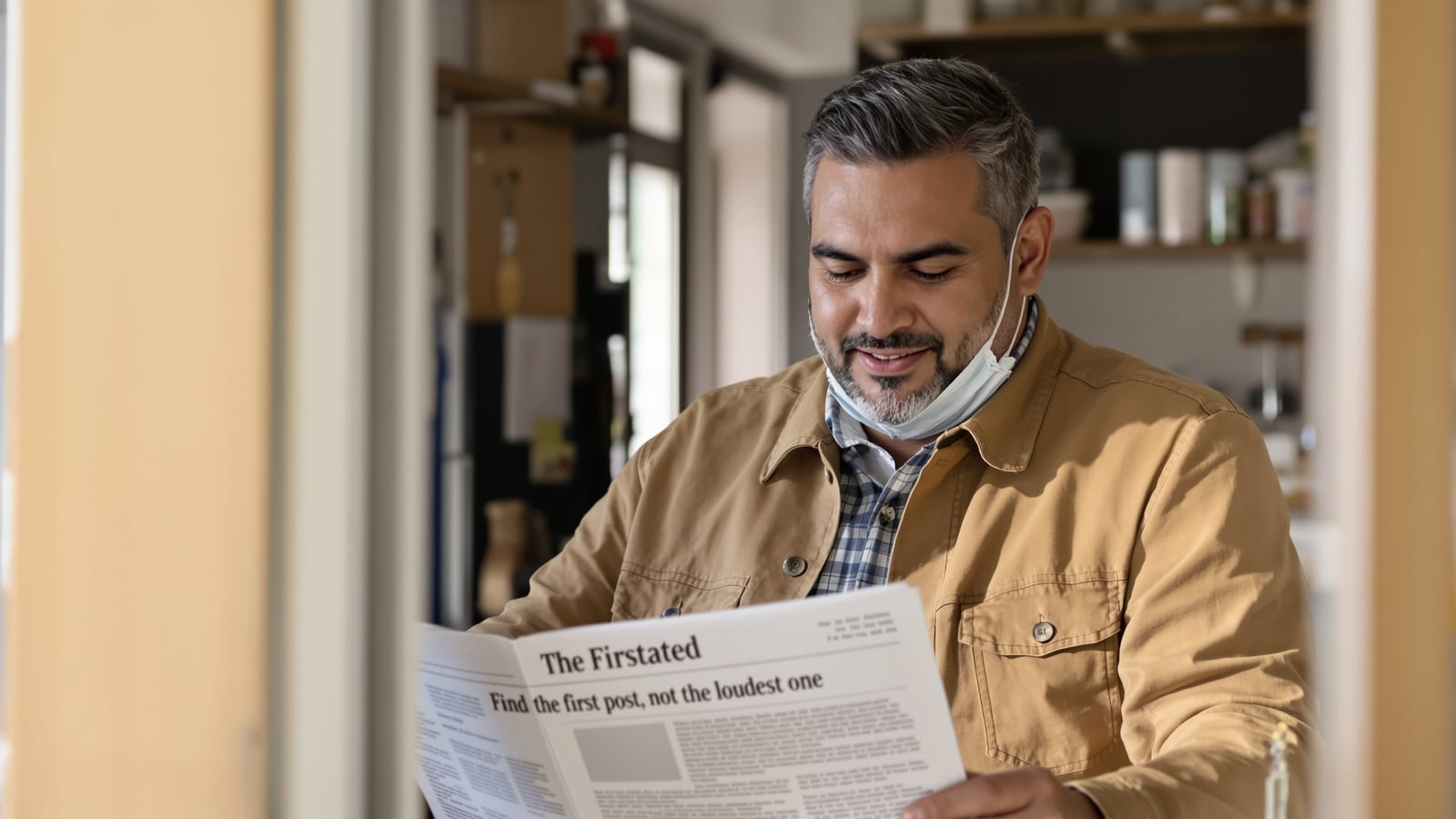
Quick answer: Don't ask whether a claim is true. Ask where it started. Find the earliest version, the primary record behind it (video, document, named witness), and whatever got cut out of the frame. If you can't find those in ten minutes, don't share it.
Why the origin matters more than the verdict
Most people check a viral claim by asking whether it sounds right. That tests your instincts, not the claim. And outrage is built to sound right to the people it was built for.
Tracing the origin works on every claim, whichever way it leans. Some claims start with something that happened and get stretched. Some start with a feeling and go looking for an event to attach to. The two look identical in your feed. They look very different at the source.
Three kinds of viral claim
Invented from nothing. No event behind it. Someone made it up, or a joke lost its label somewhere along the way.
A real event, warped. Something happened. The clip is cropped, the caption is wrong, or the date is off by years.
A real event, accurately described, wrongly sized. One incident gets passed around as proof of a trend. Everything in the post is true, and the conclusion still doesn't follow.
The third kind is the hardest to catch, because every fact-check of the individual facts comes back clean. You have to ask a different question: how many cases does this one stand for?
The ten-minute trace
1. Find the earliest appearance. Put a distinctive phrase from the post in quotation marks and search it. Use the date tools to push results back to the first day it shows up. For a photo or a still from a video, run a reverse image search. You're looking for the oldest copy, not the most shared one.
2. Follow the links until they stop. A post cites an article. The article cites "reports." The reports cite a post. That's a circle, and it happens constantly. Real stories end at something you can point to: a court filing, a police report, a transcript, raw footage, a named person who'll stand behind the quote.
3. Look for the boring details. Real events come with a town, an agency, a date and sometimes a case number. Outrage-first claims run on "a school somewhere," "a major company," "they're now saying." Vagueness isn't proof of falsehood. But a claim built to make you furious that can't tell you where or when should make you slow down.
4. Get the whole clip. Short video is the easiest thing in the world to mislead with, because the missing ten seconds feel like they don't exist. Search for the longer version, the other camera angle, the footage from before the part that went viral.
5. Separate the event from the meaning. Write down only what a camera would have recorded. "A man shoved a woman." Now look at what the post added: why he did it, what he believes, what it says about people like him. The event may be solid and the interpretation may be pure invention.
Case one: a clip that went viral in a day
In January 2019, a short video from Washington, D.C. spread fast. It showed a teenager in a MAGA hat standing face to face with a Native American elder beating a drum. The students were in town for the March for Life. Within hours, the clip was being treated as a settled story about the teenager.
Then longer footage surfaced, close to two hours of it, including a separate group that had been shouting at the students beforehand. It didn't make the encounter pretty. It did make the first story incomplete. The teenager, Nick Sandmann, later sued several news organizations, and some of those suits ended in settlements.
The lesson isn't that the first take was a lie. A real moment was real. The failure was building a verdict on 60 seconds when more footage existed. Plenty of people with a platform skipped step four.
Case two: when the debunking was the claim
In October 2020, the New York Post reported on emails said to come from a laptop belonging to Hunter Biden. Twitter blocked links to the story. A letter signed by 51 former intelligence officials said it had the "classic earmarks of a Russian information operation," while acknowledging they had no evidence of that. The story was widely treated as disinformation. Twitter's own CEO later said blocking it was a mistake.
By spring 2022, the New York Times and the Washington Post had both reported that they could authenticate some of the emails.
Notice what this does to the method. "This is disinformation" is itself a claim, and it needs the same trace: who said it, on what evidence, and did they say what the headlines said they said? Running the check only on the posts you dislike isn't checking. It's picking.
Case three: a false story that fit a mood
After the October 2022 attack on Paul Pelosi in his home, a fabricated account from a fringe website was passed along by accounts with large followings. It fit what some people already wanted to believe about the people involved. The criminal complaint and, later, the federal trial told a different story. The attacker, David DePape, was convicted in November 2023.
That one started with a real event too. The invention arrived afterward and attached itself to it. Same pattern, opposite side of the aisle from the Covington clip.
Warning signs in the shape of the post
None of these prove anything. Stack two or three and slow down.
- A villain who's easy to hate and no named person to ask.
- A demand to share, or a line like "the media won't show you this."
- A date missing, or a date that doesn't match the event.
- A screenshot instead of a link.
- A strong emotional reaction in you in under three seconds.
That last one is the real tell. Ask yourself how good it felt to read. If the answer is "satisfying," that's the moment to trace it hardest. How your feed rewards that feeling is a whole subject of its own, covered in How Your Feed Decides What You See, and How to Take It Back.
What a real newsroom does, and you can too
Editors who do this for a living ask a short set of questions before anything runs. They're laid out in The four questions an editor asks before a story runs. You don't need a newsroom to ask them. You need a few minutes and the willingness to look worse in your own group chat for saying, "I don't know yet."
When the story you shared turns out wrong, say so plainly and quickly. Outlets get judged on how they handle that too, as How to Tell Which Outlets Actually Own Their Mistakes explains. The same standard applies to you.
The rule to take with you
Wait a day on anything that makes you angry fast. Real news will still be real tomorrow, with more of the record filled in. Outrage that was built to spread usually can't survive that long.
Be kind to the person who shared it. Most of them weren't lying. They were moved, and they hit the button. Be hard on the claim, easy on the person, and keep your own finger off the share button until you can name where it started.
Marcus Vale
Editor-in-Chief
Twenty years in magazines, most of it deciding what to cut. Writes about work, discipline and the decisions that compound.

Watch
Worth an hour of your evening
More from Media Literacy.
From channels we rate. Plays on YouTube.
Read next