

Ninety seconds inside the garment before you pay
Most clothes fail at the buttons and the seams, and you can spot it in the fitting room. Here's what to check and how to fix what you can't skip.
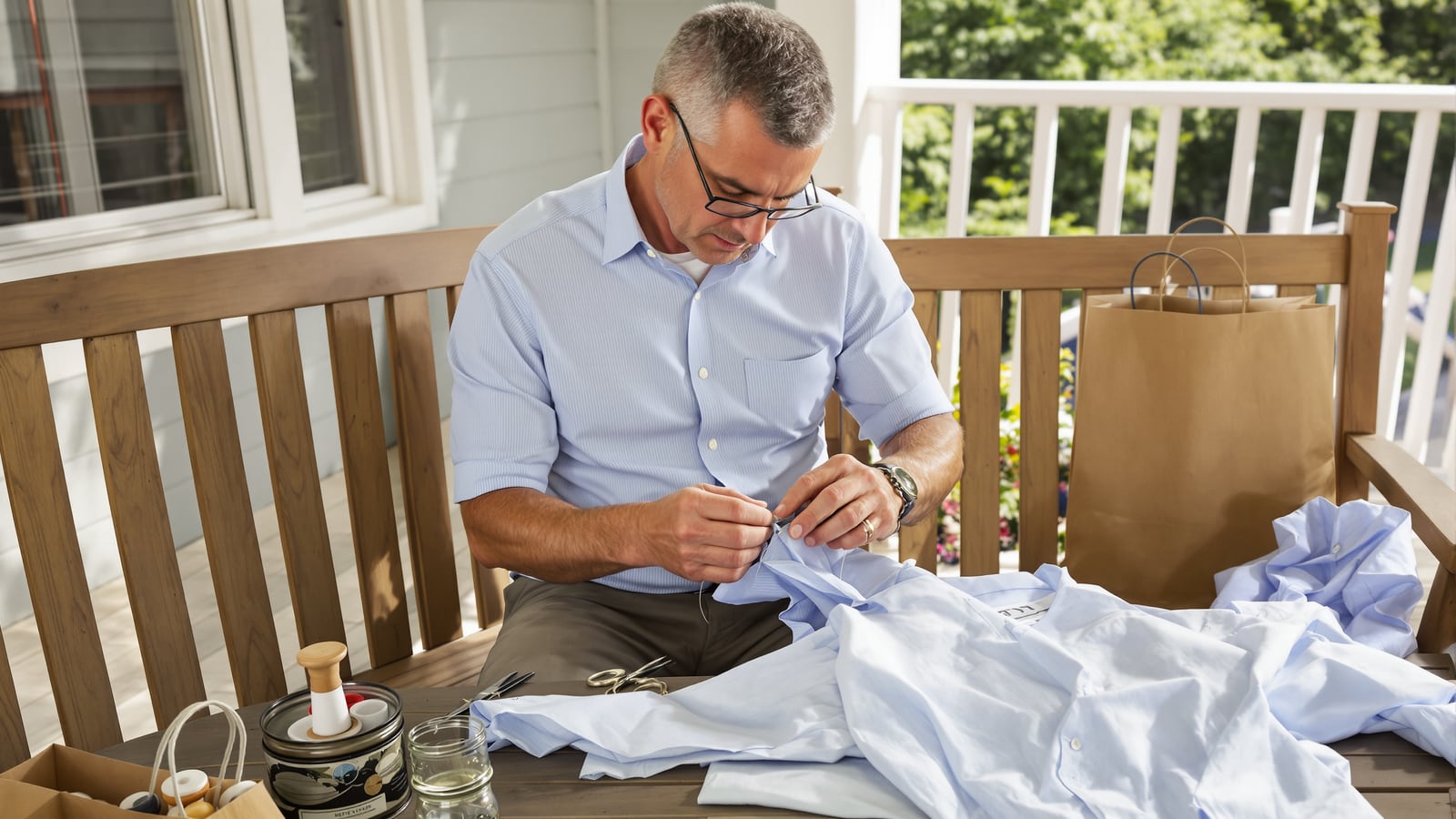
Quick answer: Turn it inside out. Tug one button and one seam, then hold the fabric up to the light. That's ninety seconds, and it'll tell you more than the tag will. If you buy it anyway, re-sew the buttons before you wear it.
Fit comes first, and nothing here changes that. A shirt that pulls across the chest is wrong no matter how well it's sewn. Run the checks that tell you a garment actually fits first. Then, once it's a keeper, turn it inside out.
Tug the button
Pinch the second button from the top of a dress shirt, the one that takes the most strain, and give it a firm pull. Not a yank. The kind of pull a collar gets when you're running late.
It shouldn't wobble. Look at the thread. You want it to run through each hole several times, and you want to see a little neck of thread between the button and the fabric. That neck is called a shank. It lets the button sit on top of the placket instead of crushed flat against it. No shank, and the button works loose first.
Look for thread that's been tied off with a visible knot, or one lazy X across two holes. That's the cheap way, and you'll lose the button in a month.
Check the spare, too. A shirt with a spare button sewn inside the tail or on the side seam is telling you someone thought about the owner. Its absence doesn't prove anything. But when it's there, the buttons usually deserve more trust.
Count the stitches
Find a side seam and look at the stitching. Count how many stitches fit in one inch. As a rule of thumb, eight to ten or more is a seam made to last. Five or six is a seam made to ship.
Long, loose stitches gape when the fabric stretches, and you'll see little gaps of thread when you pull the seam gently apart. Tight, even stitches stay closed. Skipped stitches, where the line suddenly jumps, are a bad sign. So is a seam that puckers, with the fabric bunched along the sewing line instead of lying flat.
A loose thread tail isn't a verdict. Every garment has a few. Clip them, don't pull them. But a seam you can see daylight through is another matter.
Turn it inside out
This is the move that separates people who've been burned from people who haven't.
Look at how the raw edges inside are finished. On a good shirt, the side seams are folded over and stitched flat, or wrapped in a clean, narrow seam. On a cheap one, the edges are left as raw fabric, or serged with a thin overlock stitch that frays and unravels at the first hard wash.
Serging isn't evil. Plenty of decent clothes use it. But on a shirt where the sleeve seam is serged with a fuzzy, thin thread, and the hem is a single skimpy fold, you're looking at a garment with a short life.
On jeans, look at the inseam and the outseam. The good ones are flat-felled: two rows of stitching with the fabric folded under, which makes a ridge. They're nearly impossible to split. A single row of stitching with a serged edge will open up in the crotch long before the denim gives out.
Find the stress points
Clothes don't wear out evenly. They fail in the same few places:
- The bottom of a shirt placket, where the buttons end
- The corners of jeans pockets and the base of the fly
- Belt loops
- The underarm seam
- The back of the collar where it joins the body
Look for small, dense blocks of tight zigzag stitching at pocket corners and belt loops. Those are bar tacks, and they exist because someone knew that spot would be pulled on all day. A pocket corner with plain stitching and nothing else will tear.
Pull a belt loop. Yank a pocket opening. If it flexes and the stitching stretches visibly, put it back.
Hold it to the light
Cheap fabric hides behind a crisp fold on the rack. Hold a sleeve up to a store light and look at the weave. Thin, uneven patches or gaps mean it'll go see-through at the elbows and seat.
Check the pattern at the seams. Stripes and plaids on a decent shirt line up across the front placket and at the pocket. When they don't, the maker cut fabric as fast as possible. That says something about every other decision in the shirt.
For sweaters, turn the shoulder seam inside out too. Knit pieces that are properly linked together have a neat, small line of loops. A seam that's just serged in a hurry can run, and a run in a sweater is a one-way trip.
Fix it the day you buy it
You'll sometimes buy a shirt with weak buttons anyway. Maybe it fits perfectly and it's the only one in your size. Fine. This is a ten-minute job, and it's the best habit in this whole piece.
Get a spool of polyester thread that matches, a needle, and a toothpick or a matchstick. Cut off the button. Double the thread and knot the end. Put the toothpick on top of the button and sew through the holes over it, six or eight passes. Pull the thread tight, then slide the toothpick out. The slack that's left becomes the shank.
Wrap the thread around the neck a few times and push the needle through to the back. Tie it off with two small knots. That's a button that outlasts the shirt.
A tailor will do the same thing, and it's cheap. Ask for a reinforced shank. They'll know what you mean.
For a seam that's starting to open, sew it back up with small, tight stitches before it spreads, and don't wait for it to go in public.
When the test fools you
Be fair to the garment. A higher price doesn't guarantee good sewing, and some inexpensive shirts have beautifully done buttons. Some expensive ones are sewn badly and stamped with a famous name. Check the same way every time and let the stitching do the talking.
Also, plenty of clothes are built to be worn a season. A cheap tee for the lake or the job site that you'll throw away? Don't inspect it like a wedding suit. Spend your scrutiny where the garment has to work for years: the work shirt, the jeans, the blazer, the winter coat. The ten garments that get you through almost any week is a decent list of where that effort pays off.
And once you've bought well, don't undo it at home. The dryer is why your clothes wear out early, and heat does the same damage to thread that it does to fabric.
Next time you're in a fitting room, keep the shirt on the hanger for one more minute. Turn it inside out. If the inside looks like somebody cared, buy it. If it looks like somebody was in a hurry, so was the person who made it.
Dean Shaw
Gear & Garage
Reads the warranty, the parts list and the long-term owner reviews before anything else. Trucks, tools, watches, and the cheap version that costs more.

Watch
Worth an hour of your evening
More from Style.
From channels we rate. Plays on YouTube.
Read next