

The shirt pocket should hold one flat thing, if anything
Where it sits, how deep it should be, and why the phone, the wallet and the fistful of receipts all belong somewhere else.
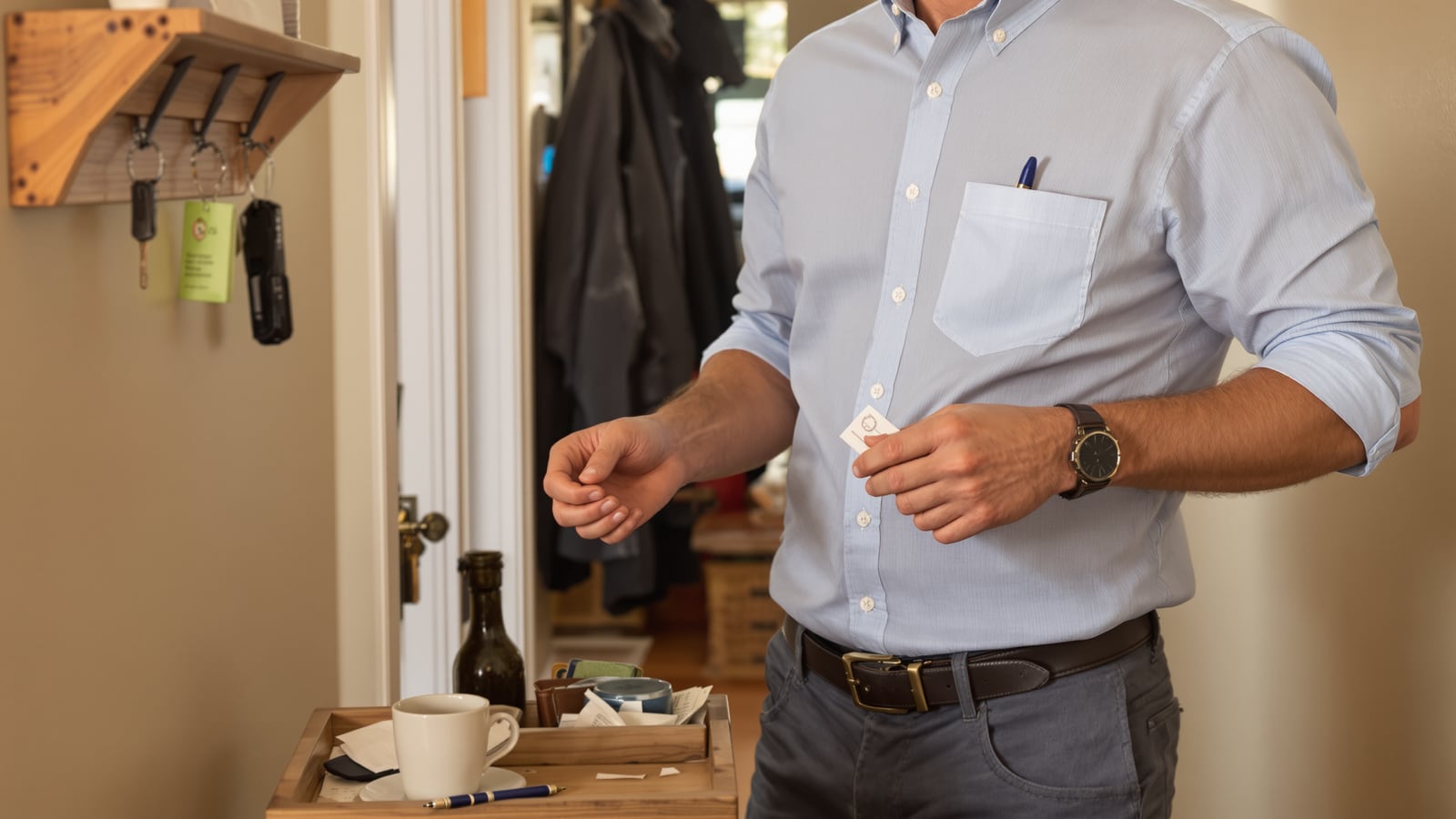
Quick answer: A good chest pocket sits high, about a palm's width off the placket, and runs roughly as deep as a pen is long. Put one flat thing in it, or nothing. Anything thicker pulls the shirt out of shape.
Picture a man leaning over an engine bay to check the oil. The pen in his pocket slides out, bounces off the fender and disappears behind the battery. He's lucky it wasn't his phone. The pocket was too shallow for the job he gave it, and no belt, tuck or brand name was going to change that.
Where the pocket should sit
Button the shirt and stand up straight. The top edge of the pocket should land on your chest, a few inches below the base of the collar. The inside edge should sit about a palm's width from the line of buttons.
Two mistakes show up constantly.
Too low. The pocket drifts toward your stomach and the whole shirt looks like it's hanging off a hook. This happens on cheaper shirts cut for a generic torso, and on tall guys wearing a shirt built for someone shorter. If the pocket sits below your ribs, the shirt is too short in the body for you, and that's a fit problem no pocket fix will cure. The checks that tell you a garment actually fits will tell you whether to keep the shirt or return it.
Too wide for the chest. A broad pocket on a narrow frame reads like a patch. A narrow pocket on a big chest looks like an afterthought. Look for a pocket that's roughly the width of your palm plus a thumb. Wider than that and it starts to dominate the shirt.
Crooked is the other one. Hold the shirt up by the shoulders and look at the pocket against the yoke seam and the placket. If the top edge tilts, the pocket was sewn on badly. Some people never notice. Everyone who does will notice it every time.
How deep, and why it matters
Depth decides whether the pocket works or just decorates.
Most dress and casual shirts have a pocket five to six inches deep. That's enough for a pen with the clip showing, a folded card, or a pair of reading glasses laid flat. It isn't enough for a modern phone. A phone is longer and thicker than the pocket was designed for, so it sags the fabric forward, swings when you bend and eventually escapes. Don't test this over a toilet, a lake or a workbench.
A few real depth notes:
- Pen. A standard pen fits a five-inch pocket if the clip catches the top edge. If it doesn't clip, it'll tumble out the first time you bend.
- Glasses. Reading glasses fit if they're folded and lying flat, with the arms tucked in. Wearing them hooked in the placket is a different habit and it stretches the buttonhole.
- Notebook. A small pocket notebook, the kind a contractor or a hunter carries, fits and rides well. It's one of the few things a pocket does better than any other place on you.
- Phone. No. Use a pants pocket, a jacket, a belt holster if you work with your hands. A phone in a chest pocket also pulls the whole front of the shirt forward, and the placket starts to gap.
If a pocket has a button or a flap, it can hold a bit more securely. Field shirts and chore shirts are built this way. That's the pocket to use for a notebook or a small flashlight.
Does it need to hold anything?
No. That's the part most guys never hear.
A pocket is a design element first. It breaks up the chest, adds a line and, on a casual shirt, makes it look like something you'd actually work in. It was never a promise that you'd fill it.
An empty pocket on a well-fitted shirt looks right. A full one on a shirt that doesn't fit looks like a man who's lost track of his stuff.
The old rule stands up well: one flat item, and only if you reach for it often. A pen for the guy who signs things. A tally pencil for the guy who measures. Nothing for everyone else. Wallets, keys, receipts, sunglasses with the arms sticking out, a pack of anything: all of that belongs elsewhere, and it'll leave a visible bulge that never quite settles.
When to skip the pocket altogether
The more formal the shirt, the less it needs one. A dress shirt worn under a suit looks cleaner with no pocket, because a pocket under a jacket creates a bump, and you can't get at it anyway. If you buy one dress shirt for weddings, funerals and interviews, buy it pocketless.
Casual shirts are the opposite. Oxford shirts, flannels, chambray, and work shirts look slightly wrong without one. A pocket gives a flat chest some structure, and it signals that the shirt is meant to be worn untucked or rolled up. For the in-between zone, smart casual gives you room to go either way. A single plain pocket on a solid oxford is hard to beat there.
Fixing a pocket that bothers you
Most pocket problems are cheap to fix. A few aren't, and you should know which is which.
It puckers or ripples. The pocket is sewn to the shirt with stitching that shrinks or tightens at a different rate than the fabric. Often that's the dryer talking. Air-dry the shirt or use low heat, and read why the dryer wears clothes out early. Press the pocket flat from the inside with steam. If it still ripples after a wash or two, a tailor can resew it.
It sags or pulls away at the corner. That's a stitching failure. Have a tailor or a seamstress reinforce the corners with a bar tack, a small block of tight stitches. It runs a few dollars and takes minutes. You can also do it yourself with a needle and matching thread if you're patient.
It's crooked or too low. A tailor can move it, but the shirt keeps the ghost of the old position, a faint line of needle holes and sometimes a slightly different shade. On a dark or textured shirt you may never see it. On a pale one, you will. That's often a reason to return the shirt rather than fix it.
You want it gone. Removing a pocket from a dress shirt is possible, but it leaves the same ghost marks. Don't do this to a shirt you love. Buy the pocketless version next time.
The pocket's too shallow for what you carry. Don't alter the shirt. Change what you carry, or buy a work shirt with a deeper, flapped pocket. A tailor can deepen a pocket in some cases, but you'll almost always spend more than the shirt cost.
What to look for when you buy
Before you pay for a shirt, run through a quick check in the mirror:
- Is the pocket straight against the placket and the yoke?
- Does the top edge sit on your chest, not your stomach?
- Is it about a palm and a thumb wide?
- Is it deep enough for a pen to stay put?
- Does the fabric lie flat when you slip a hand in and out?
If four of five check out, buy it. If the pocket's the only thing wrong, it's a cheap fix.
The pocket is a small detail, and it's one the best-dressed men rarely think about, because it's already right. Pick a shirt where it is, and put one flat thing in it, on days you actually need it.
Dean Shaw
Gear & Garage
Reads the warranty, the parts list and the long-term owner reviews before anything else. Trucks, tools, watches, and the cheap version that costs more.

Watch
Worth an hour of your evening
More from Style.
From channels we rate. Plays on YouTube.
Read next