

Work pants fail at the seams, not the fabric
The fabric outlasts the stitching every time. Here's where a pair of work pants actually gives out, in order, and what to check before you buy.
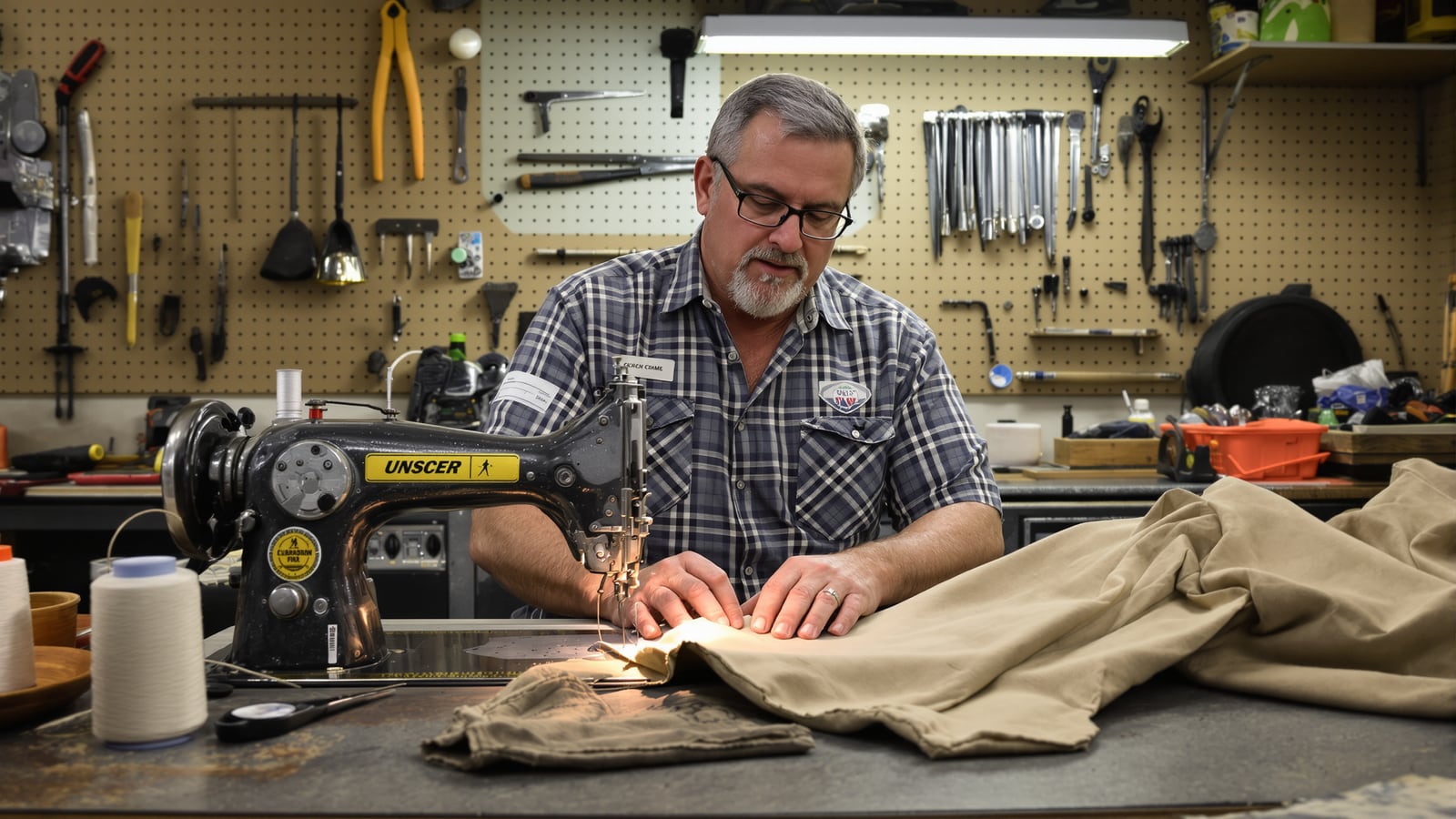
Quick answer: Work pants almost never wear through the middle of the fabric first. They fail at a handful of seams that take the most strain: the crotch, the pocket corners, the belt loops, the knees and the hem. Buy for how those spots are built, and fix them early when they start to go.
You squat to grab a dropped socket, and you hear it. A soft rip, low and personal. The fabric on that pair was a heavy twelve-ounce duck that could have lasted another five years. The thread holding it together couldn't.
That's the whole story of work pants, and it's why reinforced stress points matter more than the weight printed on the tag.
Where they tear first, in order
Pants fail in a pattern. Learn it and you'll know what to inspect on any pair.
1. The crotch seam. It takes the worst of everything: squatting, climbing, stepping up onto a tailgate, friction from both thighs, sweat that breaks down thread. Four seams meet in one spot, so it's already the bulkiest, most stressed point on the garment. Cheap pants run a single line of stitching there. When one stitch pops, the rest follow.
2. Pocket corners. Every time you jam a hand in, tug out a tape measure or hang a phone on the edge, you load the top corner of the pocket opening. That's where the fabric starts to split. The back pockets get it from a wallet and a sitting-down habit.
3. Belt loops. They look decorative. They aren't. Tuck a thumb in one and hitch your pants up all day, or hang a tool pouch or holster off your belt, and you're pulling on a small strip of cloth held by two tiny stitched ends.
4. Knees. Here the fabric itself wears, but the seam below the knee often goes first because of the extra bend and kneeling.
5. The hem. You step on it with your own boot heel. It frays, then drags, then tears up the back of the leg.
What a reinforced stress point looks like
Reinforcement means somebody did extra work at a place that was going to fail anyway. You can see it.
- Bar tacks. A short, dense block of tight zigzag stitching, usually a half-inch long. Look for them at the top of the fly, at the bottom of belt loops and at pocket corners. A good pair has them stacked at each end of every belt loop.
- Rivets. Metal rivets at the pocket corners are old technology. Jacob Davis and Levi Strauss patented the idea in 1873 for exactly this reason: miners were ripping pockets open. It still works.
- A gusseted crotch. A diamond-shaped piece of fabric sewn into the crotch so four seams don't all converge at one point. It also lets you squat and climb without the whole leg pulling. If you've ever blown out a pair while stepping over a fence, this is the feature you were missing.
- Triple-needle or flat-felled seams. Down the inseam and outseam, look for two or three parallel rows of stitching, or a seam where the fabric edges are folded under and locked flat. Compare that to a single seam with loose threads along the inside edge. That edge is called a serged or overlocked finish, and it's fine on a dress pant. It's a risk on something you kneel in.
- Double knees. A second layer of fabric over the knee, ideally with an open top so you can slide in a pad.
The thread matters more than anybody tells you
The cheapest pair and the best pair can use the same cloth. What separates them is the thread.
Cotton thread is soft and comfortable, and it also rots from sweat, sun and repeated washing. Polyester or poly-wrapped thread holds up against all of that, which is why a lot of better work pants use it even though the fabric is cotton. Ask yourself why a thirty-dollar pair splits at the seam while the cloth next to it's still fine. That's why.
Stitch type is the other half. A chain stitch can unravel along the whole seam once one loop breaks. A lockstitch holds when a single stitch fails. You can usually tell by turning the seam inside out and looking: a lockstitch looks like the same stitch on both sides, while a chain stitch has a looped, braided look on the underside. You won't always find that information on a tag, so look at the seam.
How to check a pair in the store
Don't read the label first. Turn them inside out. This takes ninety seconds and tells you more than any marketing copy.
- Crotch: Is there a gusset? If not, how many rows of stitching, and are they even?
- Pocket corners: Rivets or bar tacks? Or just a single backstitch that you can pick apart with a fingernail?
- Pocket bags: Thin, see-through lining is a warning. Your keys and knife will cut through it long before the outside wears. Look for sturdy cotton or a doubled bag.
- Belt loops: Bar tacked at both ends, or tacked once at the bottom and folded over at the top?
- Hem: Wide and doubled, or a quick single fold?
- Fit: Sit in a full squat right there in the aisle. If the pants bind or pull across the seat, the seam is already under stress before you've worked a minute in them. Buying jeans you can actually work in covers fit in more detail.
Be honest about the trade-off. Every added layer and extra row of stitching makes a pair stiffer and a bit hotter, and it adds to the price. A gusset and triple stitching can feel like overkill if you work at a desk and wear pants for weekend yard work. For you, a plain pair is fine. If you kneel, climb, haul and squat for a living, you'll pay for the plain pair twice.
Fix it before it's a hole
Most pants don't die in one dramatic rip. They give a warning: a few loose threads at the crotch, a pocket corner starting to pucker, a belt loop hanging by one end.
Fix it that day. A spool of heavy polyester thread, a needle and ten minutes will save a pair that would otherwise go in the rag bin. Sew a few tight, overlapping passes over the weak spot, the way a bar tack does. Patch the inside of a worn knee before it opens. Resew a belt loop before it comes off in your hand and takes the waistband stitching with it.
It's the same code that applies to a good tool or a good truck: take care of the thing before it fails, and it'll quit costing you. And if you're hanging a heavy belt off those loops, buy the belt right so the load sits where it should. Buy the strap right and the buckle takes care of itself has the details.
The same logic runs up top. A jacket lives or dies by the same stitching at the same kind of stress points, which is why buying the work jacket once comes down to the same inspection.
Next time you pick up a pair of work pants, skip the tag. Flip them inside out, find the crotch, and look at what's holding it together.
Tobias Reed
Style & Grooming
Spent a decade in menswear retail watching men buy the wrong size. Believes fit is ninety per cent of it and says so weekly.

Watch
Worth an hour of your evening
More from Country Style.
From channels we rate. Plays on YouTube.
Read next