

Your collar's choking you because of your shoulders, not your neck
A work shirt that fits standing at the mirror can strangle you under a hood or over a fence. Test it bent over, and look at the back first.
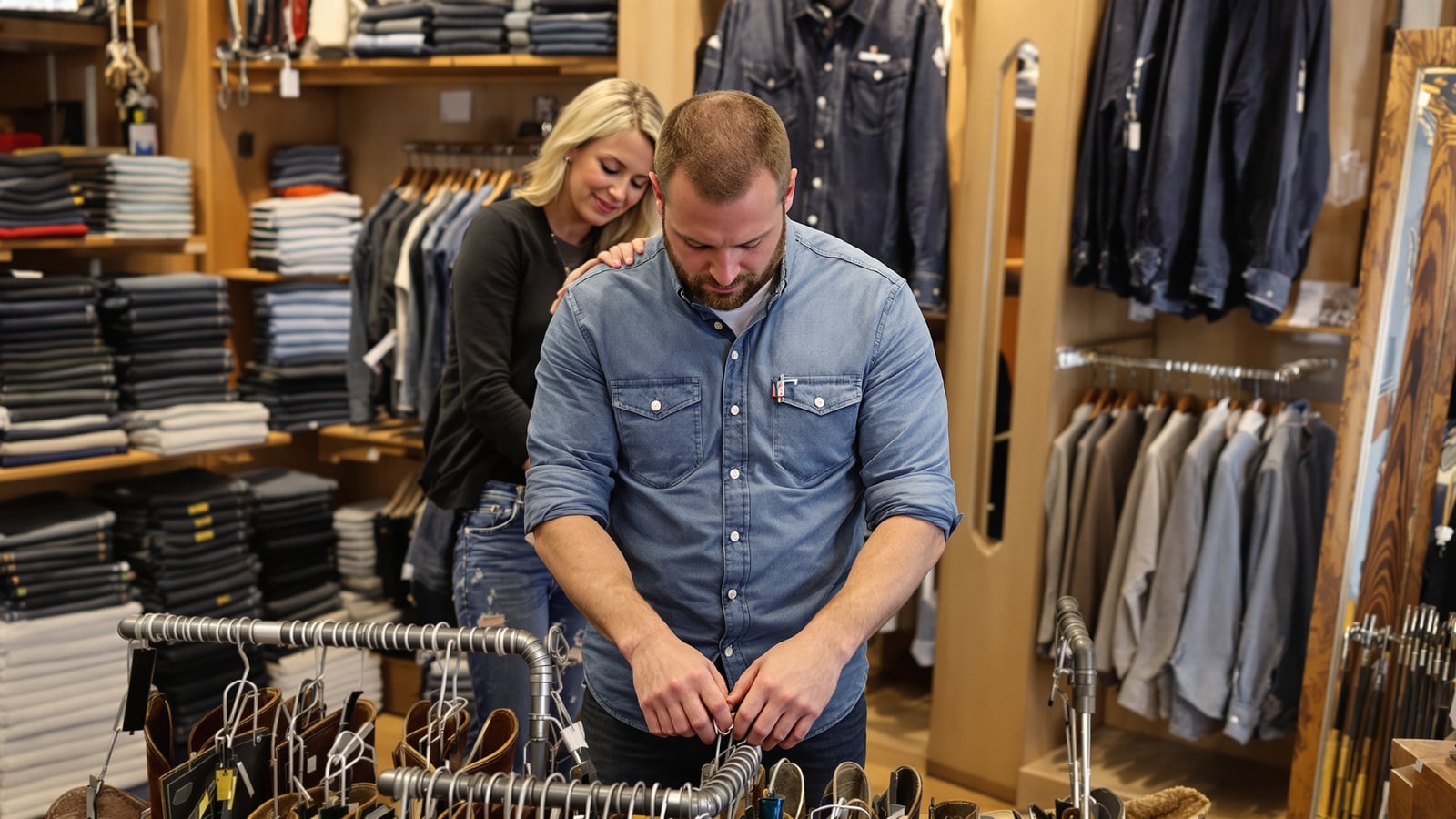
Quick answer: Button the top button, then bend forward like you're reaching into an engine bay. If the collar bites your throat, the neck probably isn't the problem. The back of the shirt is too tight across your shoulders and it's dragging the collar down behind you. Size for the bend, not the mirror.
The mirror lies
You try on a shirt. You stand up straight, chin level, arms down. It fits. You pay, wear it Monday, and by ten in the morning you're tugging at your throat like a man in a tie at a funeral.
Nothing changed about your neck. What changed is your posture. You've been bent over a tailgate, a fence line, a workbench or a transmission for three hours, and the shirt was only ever tested standing at attention.
When you lean forward, your shoulders round and your shoulder blades spread. The back of the shirt has to stretch across that wider, curved surface. If it's cut too narrow, it pulls forward and down. The collar is attached to the back, so it goes with it. The back of the collar drops, the front rides up and clamps your windpipe.
That's the mechanism. It's why men keep buying the next size up in the neck and still choke. The neck was never the issue.
Measure your neck anyway
You still need the number, because a collar that's genuinely too small will choke you standing still.
Wrap a soft tape around the base of your neck, where a collar sits, just below the Adam's apple. Keep it snug enough to stay put and loose enough to slip one finger under. Read it to the nearest half inch.
Dress shirts are sold by that number, in half-inch steps. Most work shirts aren't. They come in small, medium, large and extra large, and the neck opening for a "large" varies from maker to maker. So use your number as a filter. If a shirt lists a neck size, buy within about half an inch of your measurement, rounding up. If it doesn't, you're back to trying it on.
Two things move that number over time. Lift for a few years and your neck thickens. Put on weight and it does too. The shirt that fit at twenty-five may not at forty, and you'll blame the dryer.
The bent-over test
Do this in the fitting room, or in your garage the day it arrives, before you cut the tags.
- Button the top button, even if you never plan to wear it that way. It's your worst-case test.
- Stand up straight. You should be able to slide two fingers between collar and neck without fighting. One is snug. Three means it'll gap and flop open.
- Drop your chin to your chest and hold it for a few seconds. The collar shouldn't ride up under your jaw.
- Reach both arms straight out in front of you, then cross them like you're hugging a barrel. If you feel the shirt grab across your upper back, put it back on the rack.
- Squat, or bend at the waist with your hands near your knees. Check the collar and the tail. The shirt should stay tucked or at least cover your belt.
The arm-cross is the one most men skip, and it's the one that tells you the truth. A shirt that passes it won't pull your collar backward when you work.
What to look for in the cut
Look at the back before you look at the front. Pull the shirt inside out if you have to.
A back yoke with a pleat or gusset. Some work shirts have a fold of fabric in the center back, or side pleats under the arms. That's extra material built in for movement. It's old design and it works. A flat, narrow back is a shirt for standing.
Sleeves that don't fight the shoulder. If the sleeve seam sits out past the edge of your shoulder bone, the arm will hang oddly. If it sits too far in, you'll feel it pinch when you reach. The seam should land right at the edge of the shoulder.
A collar with some stand to it. The stand is the band the collar folds over. A taller, stiffer one holds its shape when you move. A flimsy collar collapses, and then you keep adjusting it all day.
Fabric with a little give. Cotton twill and chambray are the standards for a reason. Some shirts blend in a small amount of stretch, which helps across the back. Stretch isn't a substitute for a correct cut, though. It just forgives a small mistake.
Account for the shrink
Cotton shrinks. Mostly in length and in the collar. Check the tag for "sanforized," which means the fabric was pre-shrunk at the mill. That cuts the surprise but doesn't kill it. A shirt that isn't pre-shrunk can come out of the first hot wash a full size smaller.
So wash before you judge. Wash it the way you'll actually wash it, cold if you can stand it, and dry it low or hang it. If you're buying raw or unwashed cotton, buy a touch large in the neck and plan on it settling.
And buy for the shirt you'll wear in February, not July. If you layer a thermal under it, try it on with the thermal. Anything under a collar eats room. For more on how layers behave, see why your flannel shirt isn't keeping you warm.
What a tailor can and can't fix
A good tailor can shorten sleeves, take in the sides and fix the length. Moving a collar is another story. It means taking apart the neck of the shirt, and for a work shirt that costs more than the shirt did. Don't buy a shirt with the plan to have the neck altered. Buy the neck right and let the tailor handle everything else.
The same applies to the back. If the shirt is tight across the shoulders, there isn't much to let out. You'd be paying to fix a cut that was wrong in the first place.
Don't button it, but buy it like you will
Most men wear a work shirt with the top button open, and plenty with two. That's fine. It's a working shirt, not a courtroom. But you want the option. A collar that closes comfortably means the shirt is actually your size, and it means you can button up when the wind comes across a field in November or when the boss from the home office shows up. If you want to know how the same shirt carries off the job, workwear that still looks right after you clock off covers it.
The jacket you wear over the shirt matters too. A heavy coat with a stiff collar can make a perfectly good shirt feel tight. If you're shopping for both, look at buying the work jacket once and wearing it for ten years and try them together.
The one-minute check before you buy
Neck measured. Top button closed. Chin to chest, arms crossed in front, a deep squat. If it passes, it's a work shirt. If it doesn't, it's a good-looking shirt you'll be wearing unbuttoned and annoyed.
Spend the extra minute in the fitting room. You'll spend eight hours a day in it.
Tobias Reed
Style & Grooming
Spent a decade in menswear retail watching men buy the wrong size. Believes fit is ninety per cent of it and says so weekly.

Watch
Worth an hour of your evening
More from Country Style.
From channels we rate. Plays on YouTube.
Read next