

Roast the chicken upside down and the breast stays juicy
Flip a four-pound bird onto its breast and the oven does half the work. Here's the setup, the timing, and the one real cost.
Quick answer: Salt the bird the night before, roast it breast side down at 425°F on a bed of sliced onions, and flip it for the last 15 minutes to crisp the skin. Pull it when the breast reads 160°F and the thigh reads 175°F.
You've carved this bird before. The breast slices come off pale and stringy, you bury them in gravy, and the thigh near the bone is still faintly pink. Somebody says "it's fine" in the tone people use when it isn't.
That's a timing problem, and turning the chicken over fixes more of it than you'd expect.
Why the breast goes first
A chicken is two different meats on one frame. The breast is lean and finishes at about 165°F. The thighs and legs have more fat and connective tissue, and they eat better at 175°F or higher. They need more heat than the breast can survive.
Set the bird breast side up and the breast sits at the top of the oven, in the hottest moving air, with nothing between it and the heating element. It reaches 165°F while the legs are still working. By the time the thighs are done, the breast is well past it.
Flip the bird and the order changes. The breast is shielded by the rest of the carcass, so it heats more slowly. The legs and thighs, now facing up, take the direct heat they need. Fat renders off the back and thighs and runs down toward the breast instead of dripping into the pan. You aren't doing anything exotic. You're pointing the heat where it's needed.
The night before
Pat a 4-pound bird dry with paper towels, inside and out. Wet skin steams instead of browning, and no oven trick fixes that later.
Salt it with about a tablespoon of Diamond Crystal kosher salt, which is roughly 3/4 teaspoon per pound. If you only own Morton, use about half as much, because the crystals are denser. Rub it over the skin and into the cavity. Put the bird on a plate or sheet pan, uncovered, in the refrigerator, breast side up for the night. Twelve hours is good. Twenty-four is better.
The salt pulls moisture out, dissolves into it, and gets drawn back into the meat. The meat is seasoned through, and the open-air chill dries the skin so it'll crisp. It costs you nothing but fridge space and a little forethought.
Skip the pepper for now. It scorches at this temperature and turns bitter.
Set it up so the skin doesn't stick
Breast-down roasting has one practical headache. The skin lies against the pan and can tear off when you flip it.
Fix that with a bed. Slice two onions into thick rounds, add a couple of carrots cut in half lengthwise, and lay them in a cast iron skillet or a roasting pan. The bird rides on the vegetables, and the juices cook into them. You get a side dish and a base for gravy, and nothing glues itself to the metal.
If you'd rather use a rack, rub a little oil on the breast skin first and use a V-rack so the bird doesn't slide.
Preheat the oven to 425°F, with the rack in the lower third. Take the chicken out of the fridge 30 minutes ahead. Rub a tablespoon of butter or oil over the skin, and tie the legs together with kitchen twine if you want a tidy bird. It doesn't change the cooking much.
The roast
Lay the bird breast side down on the vegetables. Roast it for about 45 minutes, then check.
Check the thigh first. Slide an instant-read thermometer into the thickest part without touching the bone. You're looking for 175°F, and you won't be there yet at 45 minutes. A 4-pound bird usually takes about an hour and 10 minutes in total, but ovens lie, and chickens vary. Trust the thermometer, not the clock.
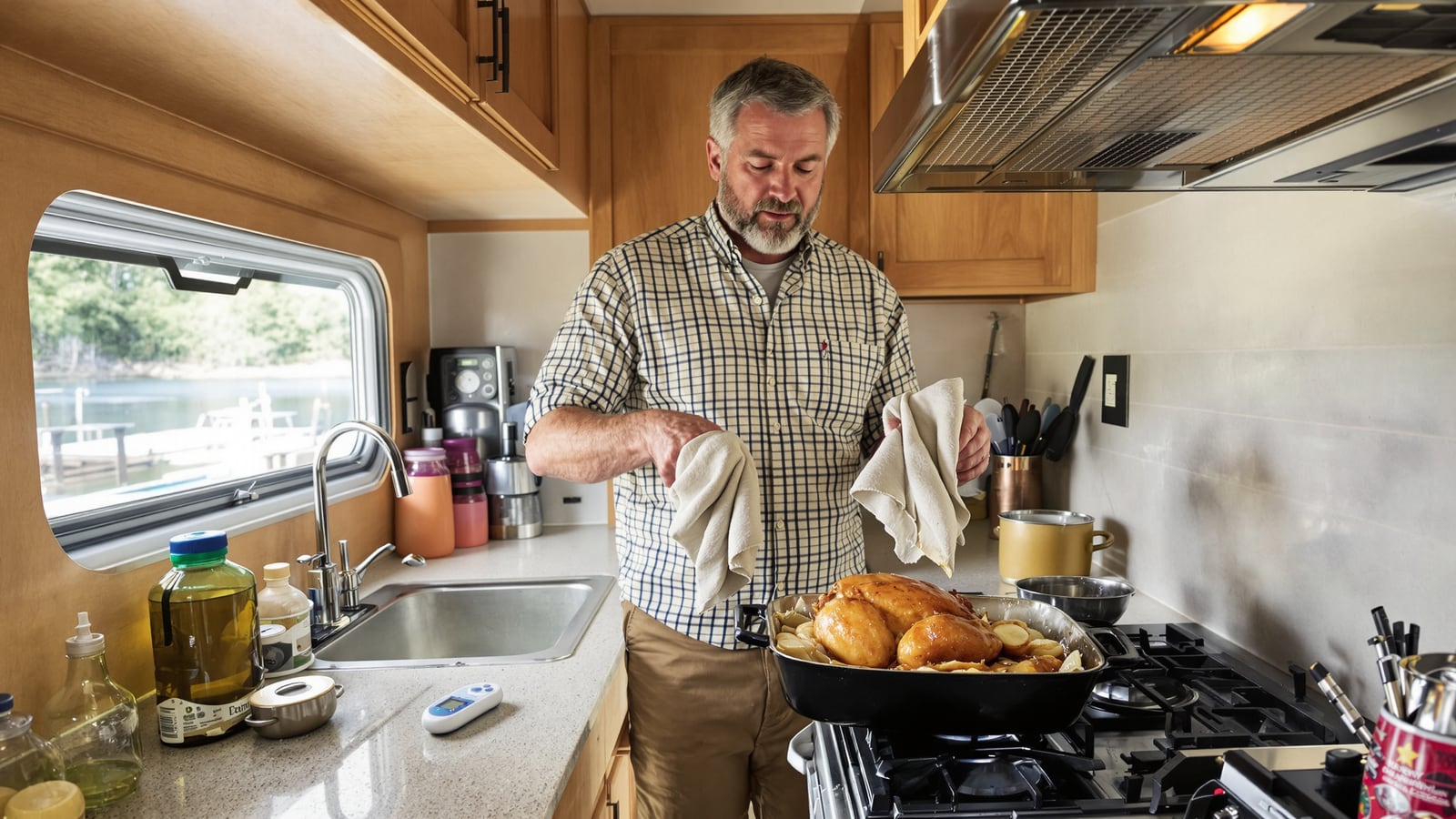
At around 50 minutes, take the pan out and flip the bird. This is the awkward part. Use a thick folded towel in each hand or a pair of sturdy tongs, and turn it over in the pan. The bird will be hot and a little slippery. Do it over the pan, not over your kitchen floor.
Then give it 15 to 20 minutes, breast side up, to brown. The skin on the breast will have stayed pale and soft while it was down. Now it gets the heat it needs, and it crisps up fast.
Pull the chicken when the breast hits 160°F and the thigh hits 175°F. The breast will climb to 165°F as it rests.
The honest trade-off
Breast-down skin is never quite as good as a bird that spent the whole time up. You're getting a juicier breast at the cost of a slightly less glassy finish. For most tables, that's a fair deal.
If you're serving this to a guest who cares about crackling skin, finish the last 10 minutes at 450°F, or set the bird under the broiler for a couple of minutes while you watch it. Don't walk away. Skin goes from gold to charcoal quicker than you'd like.
And a concession worth making: the flip is the smaller part of this. The dry brine and the thermometer do more. A well-salted bird pulled at the right temperature, roasted breast side up, will beat an unsalted bird roasted upside down and left in until it looks done. Orientation helps. It doesn't rescue bad habits.
Rest it, then carve it right
Move the bird to a cutting board and leave it alone for 15 minutes. Don't tent it tightly with foil, which steams the skin you just crisped. A loose piece sitting on top is fine.
While it rests, the juices that were pushed toward the center spread back out. Cut it too soon and they end up on the board instead of in the meat. If you cut into it and see a pool, that's what happened.
To carve, remove each leg at the joint, then slice the breast off the bone in one piece per side. Cut it across the grain into slabs about half an inch thick. Cutting is easier with a sharp knife, and a dull one tears the meat you just worked to protect.
What goes wrong
- Pale, rubbery skin: The bird wasn't dry going in, or you didn't flip it. Fix both next time.
- Torn skin on the pan: You skipped the vegetable bed or the oil. Use one or the other.
- Dry breast anyway: You cooked by the clock. Buy a thermometer for about the price of a pizza and use it every time.
- Salty meat: You used table salt by the same measure as kosher. Table salt is much denser. Cut the amount by more than half.
Keep the carcass. Boil it with the leftover vegetables and you have stock for the week, and the meat you pick off the bones feeds a couple of lunches. If that's the kind of Sunday you're after, the Sunday roast that leaves your afternoon alone pairs well with this, and cooking components instead of meals is how the leftovers earn their keep.
Next Sunday, flip the bird. Carve it at the table. Let somebody else notice that the breast is the best part.
Wes Dunbar
Country & Skills
Grew up on an acreage and never quite left. Covers trucks, trades, land, and how to do the thing yourself.

Watch
Worth an hour of your evening
More from Food.
From channels we rate. Plays on YouTube.
Read next