

Leave the cast iron home and cook on seasoned steel
A 12-inch cast iron skillet weighs close to eight pounds. A seasoned carbon steel pan does the same work for about half that, and takes the fire better.
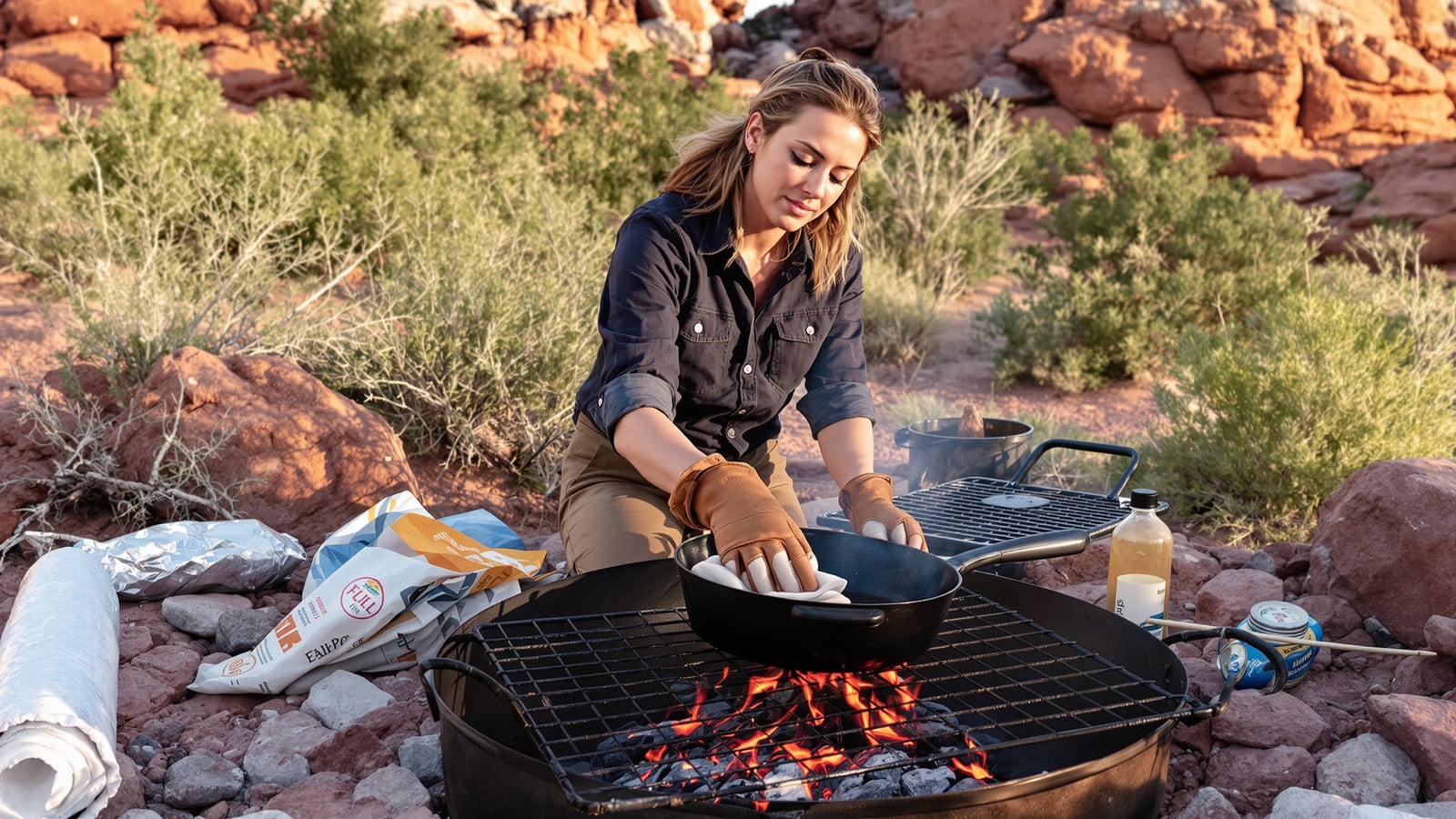
Quick answer: Cook on coals, not flames. Bring one 12-inch seasoned carbon steel skillet, a folding grate, foil, and a pair of welding gloves. Leave the nonstick pan and the thin aluminum one at home.
The pan that dies at the fire ring
Watch a family cook breakfast at a drive-up campsite and you'll see the same thing. Flames licking up the sides of a nonstick skillet. Handle too hot to touch. Eggs welded to a surface that was supposed to prevent exactly that.
Nonstick coatings are built for a kitchen burner. Manufacturers warn against high heat for a reason, and a fire doesn't hold still at a polite temperature. Overheat the coating and it's finished. Thin aluminum has its own problem: it warps. One hot spot over a coal bed and the pan rocks like a bad table. Everything slides to one side and burns there.
Thin stainless scorches. Enamelware chips, and chipped enamel is just rust waiting for a wet night. The grill-basket gadgets sold in the camping aisle are mostly clutter.
None of that is a knock on the people who bought them. It's a knock on pans designed for a different heat.
Why steel, and why seasoned
Carbon steel is nearly pure iron with a little carbon. It's what restaurant line cooks use for a reason: it takes brutal heat, it's tough, and it doesn't care if you bang it on a grate.
Seasoning is what makes it work. Oil baked onto the metal turns into a hard, slick layer that bonds to the pan. That layer is your nonstick surface, and unlike a coating it gets better with use. Every fry, every wipe, every bit of bacon grease adds to it.
The weight is the other half of it. A 12-inch cast iron skillet runs close to eight pounds. A carbon steel pan the same size is roughly half that. If you're hauling gear from the truck to a walk-in site, or building a kit for a first overnight backpacking trip, that difference matters. Even if you're carrying everything in a rig like the one in Your Truck Is Already an Overland Rig, lighter pans mean less to dig out and less to drop on your foot.
Now the trade-off, because there is one. Cast iron holds heat longer. It's better for a slow braise or a thick steak that needs to stay hot after it leaves the coals. Steel heats fast and cools fast. You'll tend it more.
For most camp meals, eggs, sausage, fish, hash, pancakes, burgers and seared vegetables, fast and responsive is what you want.
Season it at home, not at camp
Don't show up with a pan out of the box. Most new carbon steel ships with a wax or oil coating, and it needs scrubbing off before you start.
- Wash it with hot water and a scrubber. Dry it right away on a burner.
- Wipe on a thin coat of neutral oil, such as canola or grapeseed. Thin is the whole trick. Then wipe it off as if you made a mistake.
- Heat until it smokes, then let it cool.
- Repeat several times. The pan will go from silver to bronze to near black.
Then cook something fatty in it. Bacon is the old answer and it's still the right one.
Thick, sticky oil layers turn tacky and flake. A thin layer bakes hard. That's the difference between a pan that lasts forty years and one you strip and redo every spring.
Cook on coals, not flames
This is where most people go wrong, and no pan fixes it.
Build the fire early. Let it burn down for thirty to forty-five minutes until the big pieces are gray-edged coals. Flames are for looking at. Coals are for cooking.
Set a grate over the coals, or use the one in the ring. Put the pan on the grate, not directly on the embers. Hold your hand at cooking height. If you can't keep it there for two seconds, it's screaming hot, which is right for searing and wrong for eggs. Five or six seconds is where most breakfast lives.
Bank the coals so one side runs hot and the other runs cool. Now you've got a stove. Sear on one side, slide the pan over to finish.
Two things to keep in the kit:
- Welding gloves. Oven mitts burn. Leather gloves don't.
- A folding grate. Many fire rings have a rusted grate, or none at all. A cheap folding one fits flat against a cooler.
What else works
Foil packets work, and you don't need a pan. Potatoes, onions and sausage in a double layer of heavy-duty foil, set in the coals for about thirty minutes, turning once. It's a meal that's hard to ruin, which makes it a good first dinner on a one-night family trip.
A stainless pot with a lid handles the water jobs: coffee, oatmeal, pasta. Set it on the grate and keep the lid on.
A sturdy stick still does hot dogs better than anything with a brand name.
What doesn't work: anything with a plastic handle, anything with a nonstick surface, and anything thin enough to bend in your hand.
What we'd buy and what we'd skip
Buy: One 12-inch carbon steel skillet with a steel handle. De Buyer, Matfer Bourgeat and Lodge all make one. Handles get hot, so you'll want the gloves, but a steel handle won't melt.
Skip: The pre-assembled "camp cookware set" with a dozen thin nested pieces. You'll use two of them, and both will warp.
Skip: Tomato sauce, wine and vinegar-heavy dishes in your steel pan, at least until the seasoning is deep. Acid strips it. Cook those in the stainless pot.
Clean it like you plan to keep it
While the pan's still warm, scrape it with a flat wooden spatula or a pan scraper. Wipe out the grease with a paper towel. If there's stuck food, add a little water, bring it to a simmer on the coals and scrape again.
A little mild soap won't ruin well-seasoned steel, despite the legend. What does ruin it is soaking and letting it air-dry. Dry it over the fire, then rub on a few drops of oil and wipe it nearly off.
Don't plunge a hot pan into cold water. Thin steel can warp from the shock.
Leave the site cleaner than you found it
Cooking on a fire carries a duty. Use the existing ring. Check for fire restrictions before you light anything, because they change with the season and the county. Keep a bucket of water within reach, not a bottle.
Strain food scraps out of dishwater and pack them out with your trash. Wash at least 200 feet from any lake or stream. Pour the gray water on dry ground away from camp.
Put the fire out with water until it stops hissing. Stir the ashes. Hold the back of your hand over them. If you feel any warmth, it's not out.
Pack out the foil. Everyone who comes behind you will notice if you don't. They'll notice if you do, too.
For other gear that earns its place in the pack, start with the Ten Essentials. The pan is just the part you'll be thinking about at dinner.
Wes Dunbar
Country & Skills
Grew up on an acreage and never quite left. Covers trucks, trades, land, and how to do the thing yourself.

Watch
Worth an hour of your evening
More from Outdoors.
From channels we rate. Plays on YouTube.
Read next