

Bacon from a pork belly takes a week and a kitchen scale
A five-pound slab, a week in the fridge and one ingredient you'll have to order online. Here's how to cure it right, and where ham fits.
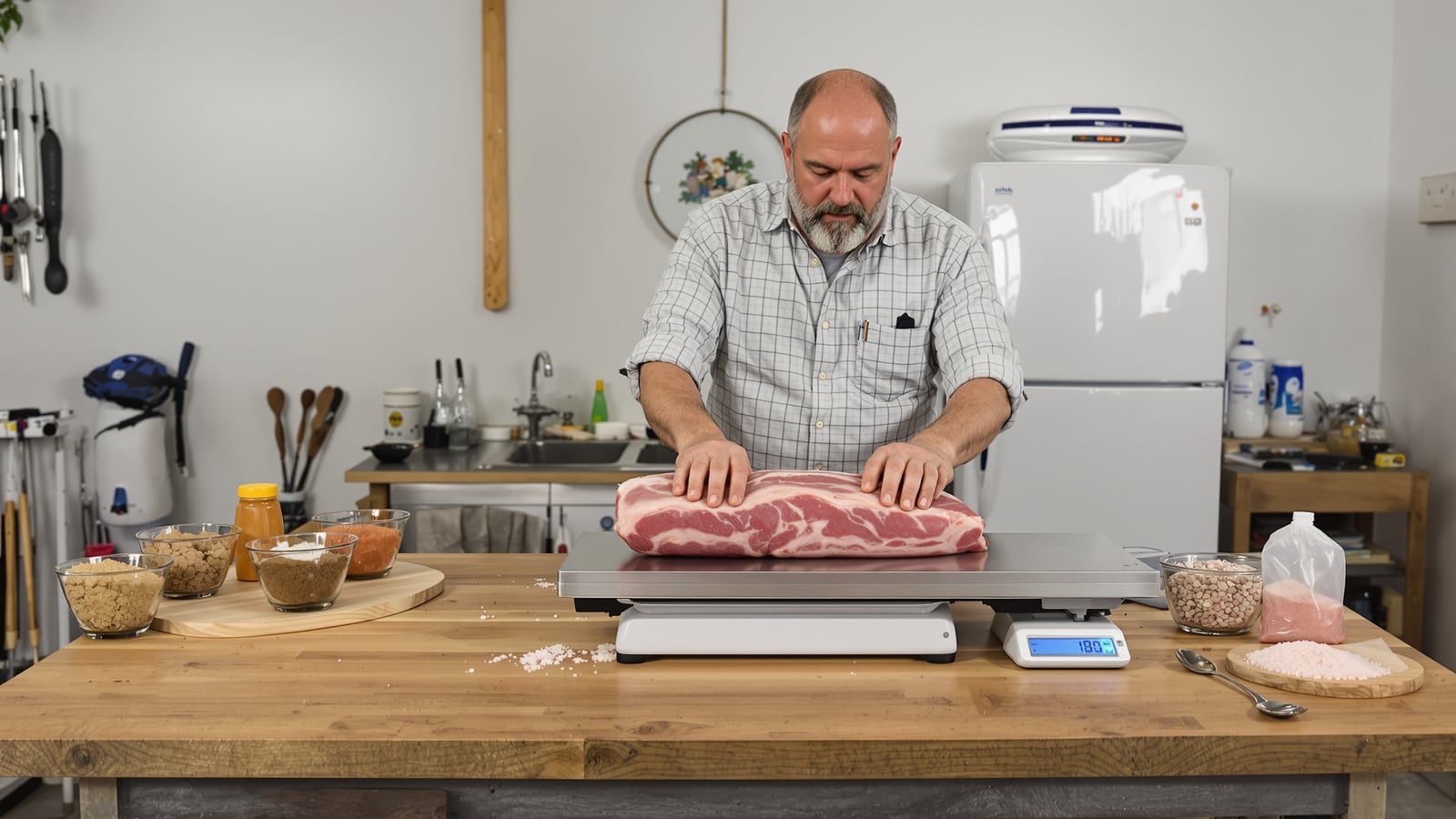
Quick answer: Weigh the belly, then weigh your salt, sugar and pink curing salt as percentages of that weight. Cure it in the fridge for about a week, flipping daily. Rinse, dry it overnight, smoke or roast it to 150°F inside, chill it hard and slice. Measuring by eye is the one way this goes wrong.
First, a correction about ham
A pork belly makes bacon. It doesn't make ham. Ham is the hind leg, and it's a different job: bigger, denser, with a bone that hides trouble. If a butcher tells you he'll sell you a belly to turn into ham, he's joking or he's confused.
The good news is that the method is the same. Salt, a measured dose of curing salt, time in the cold. Learn it on a belly, which is flat, forgiving and done in a week. Then move to ham, which I'll get to at the end.
The ingredient everyone gets wrong
Buy Cure #1. It's also sold as pink curing salt or Prague Powder #1. It's table salt mixed with sodium nitrite and dyed pink so nobody mistakes it for seasoning.
It's not Himalayan pink salt. That's a different product, and it has no nitrite. People mix these up and then wonder why the bacon went gray and why they felt nervous about it.
It's also not Cure #2, which is for long dry-aged salami and has no business in bacon.
Nitrite is what keeps the meat safe during a slow cure in the fridge. It's also why bacon tastes like bacon and not like salty pork. It's potent, so you dose it by weight, and you label the bag and keep it out of the kids' reach. A "natural" or "uncured" package at the store is cured with nitrite from celery powder anyway. You'd just be doing it with the measured stuff.
Weigh everything
You need a scale that reads to a tenth of a gram. Twenty dollars buys one. Measuring spoons won't do, because a teaspoon of fine salt and a teaspoon of flaky kosher salt are different amounts of salt.
For a 5-pound belly (about 2,268 grams), the numbers look like this:
- Kosher salt: 2.5 percent of the meat weight, about 57 g
- Sugar: 2 percent, about 45 g (brown sugar, or half brown and half maple sugar)
- Cure #1: 0.25 percent, about 5.7 g
For a different size, multiply the belly's weight in grams by those percentages. Don't round the cure up. More isn't better. It's the one number here that matters for safety, and it's the reason you own a scale.
Add black pepper if you like. Garlic powder, a little cayenne. Don't put anything wet on it.
The cure
Buy skin-off if you can. If the belly has skin, slice it off with a sharp knife, pulling the skin taut as you go. Keep it for stock or beans. Square the belly into a neat rectangle if the edges are ragged, and cure the trimmings along with it for seasoning pork later.
Mix the salt, sugar and cure in a bowl until it's one even color. Rub it over every surface, including the edges and sides. Slide the belly into a zip bag, press out the air and set it flat in the fridge on a tray. Your fridge should be somewhere from 36 to 40°F.
Over the next week the salt pulls moisture out and forms a brine in the bag. Don't drain it. Flip the bag every day and massage it a little, so the cure stays in contact with everything.
How long? A week for a belly about an inch and a half thick. Go ten days if it's thicker. Press the thickest part. When it's firm like a cooked steak and not squishy, it's done.
The part that decides the flavor: the pellicle
Pull the belly out, rinse it under cold water and pat it dry. Then put it on a rack, uncovered, in the fridge overnight.
The surface will go tacky and a little glossy. That skin is called a pellicle, and smoke sticks to it. Skip this step and the smoke runs off a wet surface, so you get a pale, cooked-pork look with half the flavor.
Smoke it, or don't
Set a smoker to 200°F with a mild wood like apple, or a little hickory if you want it louder. Cook the belly until the thickest part reads 150°F inside. That usually takes two to three hours. If you've never run your smoker, read how to run a smoker for the first time without wrecking the meat first. Better yet, start with something forgiving, as in your first smoke should not be a brisket.
No smoker? Roast it on a rack in a 200°F oven to the same 150°F. It'll taste like cured roast pork belly with a lot of character. Still very good, just less smoky. Don't try cold smoking at home as a beginner. Keeping meat in the temperature danger zone for hours is the wrong place to learn.
Slice it cold
Wrap the cooled belly and chill it overnight, or freeze it for an hour. Cold fat holds together. Warm bacon smears, tears and comes out in uneven chunks.
Use a long, sharp knife. A dull one is why homemade bacon looks like a bar fight. If yours needs help, sharpen it properly before you start. Cut slices about a quarter inch thick, which is thicker than the store's. Slice it all at once, bag it in meal-sized stacks and freeze most of it. It keeps a week or so in the fridge and months in the freezer.
What goes wrong
It's too salty. You measured by eye, or the cure ran long. Fry one slice before you bag the rest. If it's too salty, soak the slices in cold water for 30 minutes, pat them dry and fry again. A weigh-it-all approach avoids this entirely.
It's gray, not pink. Either the cure was left out, or you cooked it before it had cured long enough. Throw it out if you suspect the cure was missing, and don't gamble on it.
It burns before it crisps. Homemade bacon has more sugar on the surface than store bacon. Cook it low in a cold pan, a heavy one like cast iron, and let the fat render slowly. High heat blackens the sugar first.
It's rubbery. It was sliced warm, or it's under-rendered. Slow down and let the fat melt out.
When you're ready for ham
Once the belly goes well, try a boneless pork shoulder or a small boneless leg roast, around four to five pounds. It's a different cure, an equilibrium brine in which you weigh the meat and the water together and cure by percentage. It takes longer than bacon, and the cook has to reach a safe internal temperature all the way through.
Follow a tested recipe from a reputable curing source and use the same scale. Leave whole bone-in legs for later, because curing near the bone is where beginners get bitten.
Your first slab will cost less than a few packs of good store bacon and teach you more. And the first Saturday morning you fry a slice you made, with the kitchen smelling like a diner, you'll stop buying the kind that comes in a plastic window.
Wes Dunbar
Country & Skills
Grew up on an acreage and never quite left. Covers trucks, trades, land, and how to do the thing yourself.

Watch
Worth an hour of your evening
More from Food.
From channels we rate. Plays on YouTube.
Read next